






















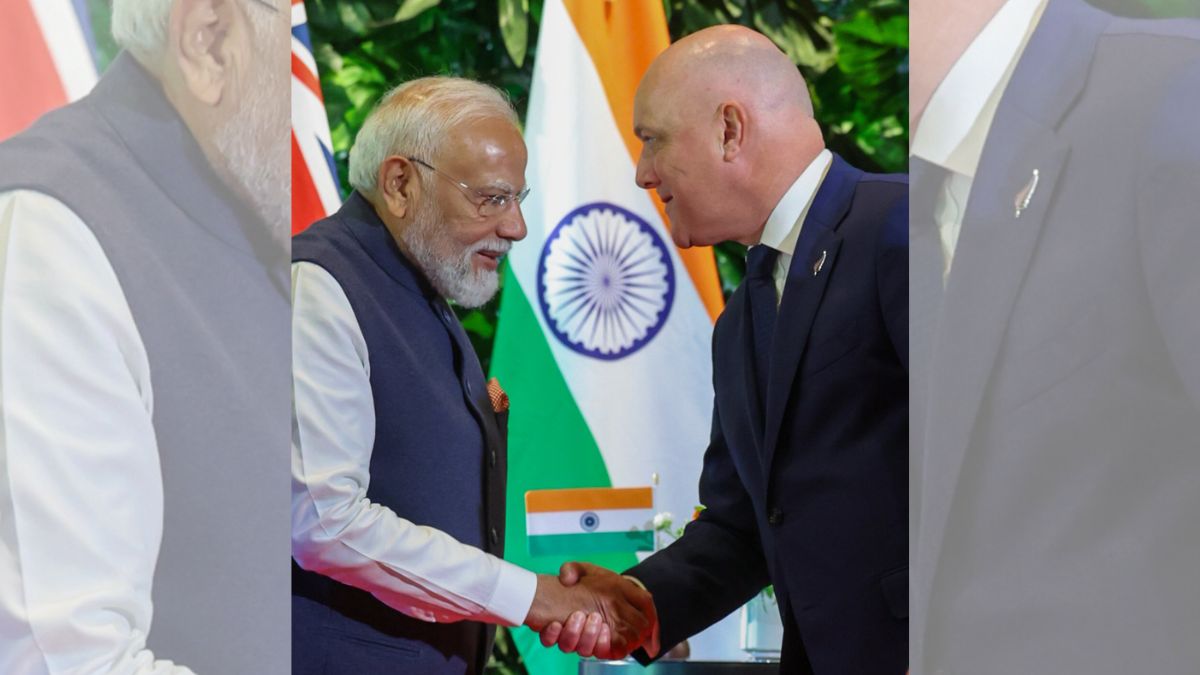
New Zealand Prime Minister Christopher Luxon announced on Monday that the India-New Zealand Free Trade Agreement has been finalised and will come into force next month, marking the conclusion of a process that began with the deal’s signing in New Delhi earlier this year.
In a post on social media, Luxon said the agreement would create greater opportunities for exporters, support business growth, and contribute to more jobs and higher incomes in New Zealand. “Almost exactly three years ago, I committed that National would secure a free trade deal with India within our first term if elected. And today, we finalised the deal, which comes into force next month,” he wrote.
India’s Commerce and Industry Minister Piyush Goyal confirmed the exact date on the Indian side, announcing that the FTA will take effect on October 20, coinciding with Vijay Dashami. “A Vijay for both nations,” Goyal said in a post marking the occasion.
The agreement was originally signed in New Delhi on April 27, 2026, and cleared its final hurdle on the New Zealand side on September 17, when the country’s Parliament passed legislation approving the pact by a margin of 93 to 29 votes. The bill drew support from National, ACT and Labour, while NZ First, the Green Party, Te Pāti Māori and a pair of independent MPs voted against it.
Under the terms of the FTA, India will offer duty-free access for 100 percent of its exports to New Zealand from the date the agreement takes effect, opening up fresh opportunities for Indian sectors including textiles and apparel, leather and footwear, engineering goods, pharmaceuticals, agriculture, and processed food. In return, New Zealand secures enhanced, preferential access to the Indian market for its own key exports — among them wood, wool, sheep meat and leather raw hides, sectors long central to the New Zealand economy.
Beyond goods, the agreement also opens new ground in services, investment, and mobility, including improved pathways for Indian professionals and students seeking to live, work or study in New Zealand. Officials say the pact is expected to help facilitate up to $20 billion in investment into India, while deepening bilateral cooperation in areas such as agricultural productivity, pharmaceuticals and medical devices, traditional medicine and AYUSH, and technology and trade facilitation.
The FTA caps a negotiation process that moved relatively quickly by trade-deal standards: talks were formally launched in March 2025 between Goyal and New Zealand’s Minister for Trade and Investment, Todd McClay, and reached conclusion within roughly a year. Two-way trade between the countries currently stands at around NZ$3.95 billion annually, a figure both governments expect the agreement to significantly expand once implemented.
With ratification complete on both sides, attention now turns to October 20, when businesses in both countries will begin operating under the new preferential terms.