




















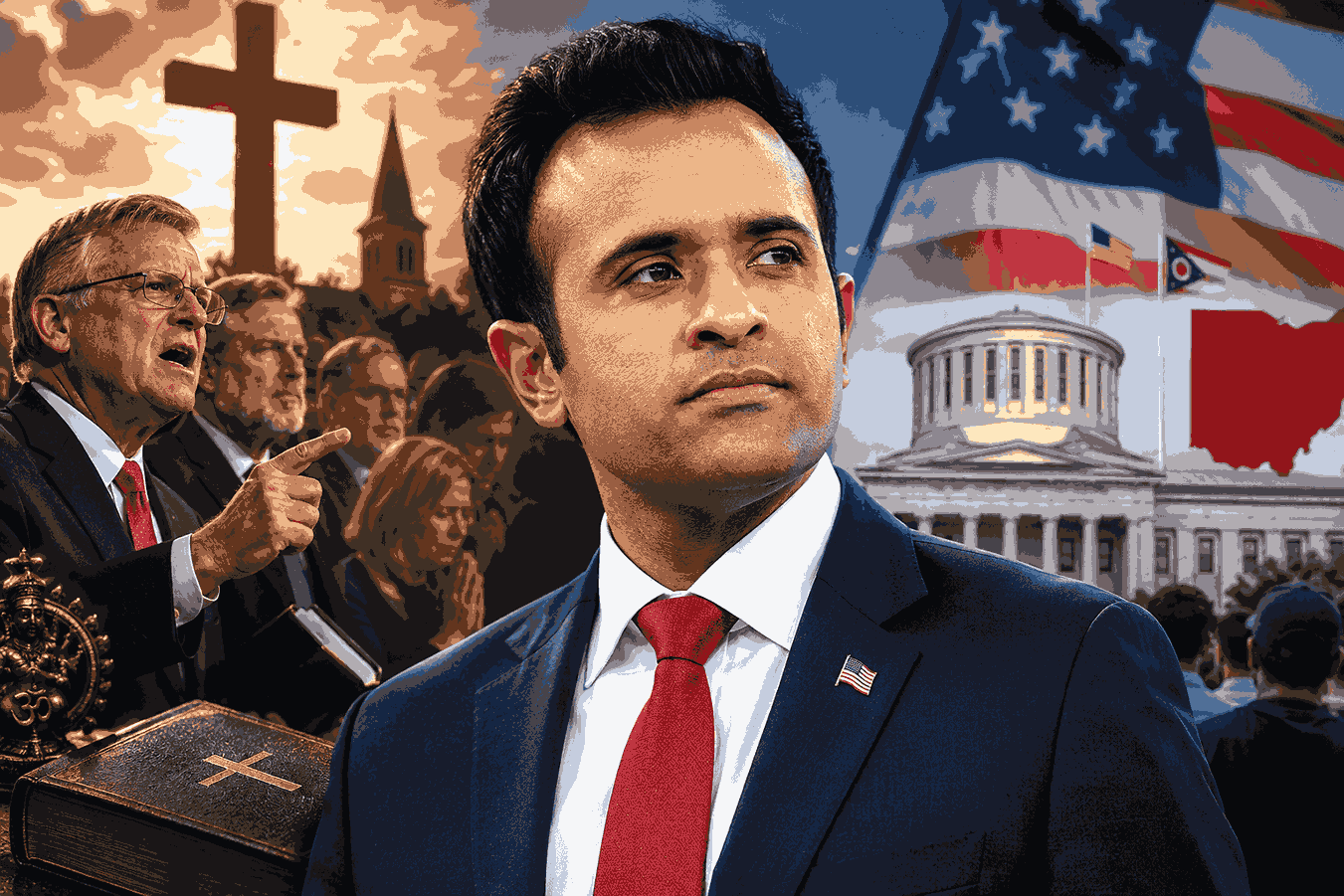
Vivek Ramaswamy’s campaign for Ohio governor is facing renewed scrutiny from Christian hardliners after resurfaced comments about Jesus Christ triggered criticism from pastors and conservative Christian commentators. The controversy has added another layer to a campaign in which Ramaswamy’s Hindu faith has repeatedly become a subject of debate, even though he has already secured the Republican nomination and is preparing for the November election.
Ramaswamy, a Hindu Republican and former presidential candidate, won the Republican gubernatorial primary in May 2026 with roughly 82% of the vote. His victory settled the formal nomination battle, but it did not eliminate questions about how some conservative Christian voters view his religious beliefs.
The latest dispute centers on a video from Ramaswamy’s 2023 presidential campaign that recently resurfaced. During an exchange with an Iowa voter, Ramaswamy described Jesus as “a son of God” rather than “the Son of God” and spoke of Jesus as a path to heaven. Christian critics argued that the formulation conflicts with central Christian teachings concerning the identity and divinity of Jesus.
For Christian hardliners, the issue is not simply a matter of campaign rhetoric. The Nicene Creed, one of Christianity’s foundational statements of faith, describes Jesus as the unique Son of God and affirms his divine nature. Consequently, critics who adhere closely to traditional Christian doctrine have treated Ramaswamy’s comments as evidence of a fundamental theological difference rather than an ordinary political disagreement.
The backlash is particularly significant because Ramaswamy has spent considerable time engaging Christian audiences. His political message frequently emphasizes faith, patriotism, religious liberty and what he describes as America’s Judeo-Christian heritage. During his 2024 presidential campaign, he openly acknowledged that he was Hindu while arguing that he shared important moral and civic values with Christian voters.
The tension between those messages and his religious identity has existed for several years. In 2023, some evangelical voices questioned whether a Hindu candidate could adequately represent a country they regarded as deeply shaped by Christian traditions. One conservative pastor publicly criticized Ramaswamy’s Hindu beliefs, while other Christian figures argued that political cooperation did not require religious uniformity.
More recently, Christian hardliners have used the resurfaced Jesus comments to renew those objections as Ramaswamy seeks support across Ohio. Reports indicate that Christian commentators and pastors have criticized his interpretation of Jesus, while Ramaswamy has continued appearing before explicitly Christian-oriented audiences. His campaign has also promoted events designed to engage Christian voters.
At the same time, opposition to Ramaswamy within the Republican coalition is not limited to religion. His campaign has faced criticism from different factions of the political right, including individuals who have attacked his Indian heritage and questioned whether he represents traditional American identity. The Washington Post reported during the primary campaign that one Republican opponent used explicitly racialized language against Ramaswamy, highlighting tensions surrounding his candidacy beyond the religious debate.
That broader context makes the controversy more complicated. Christian hardliners may object to Ramaswamy because of theological differences, while other Republicans may evaluate him primarily through questions of immigration, nationalism, cultural conservatism, economic policy or his personal political history. These are distinct disagreements and should not automatically be treated as one unified movement against his candidacy.
For Ramaswamy, the challenge is therefore less about winning another nomination and more about maintaining a coalition capable of carrying him through the general election. His Republican nomination is settled, but the debate over whether a Hindu candidate can comfortably fit within a conservative Christian political environment remains active.
The resurfaced remarks have given Christian hardliners a fresh point of criticism at a time when Ramaswamy is attempting to broaden his appeal. His response has generally emphasized religious liberty and the possibility of cooperation among Americans of different faiths rather than presenting political leadership as dependent upon personal adherence to Christianity.
Ultimately, Christian hardliners opposing Ramaswamy are highlighting a genuine theological disagreement, while Ramaswamy is presenting his candidacy through the principle that religious identity should not determine eligibility for political leadership. The Ohio governor’s race will now test how these competing perspectives resonate with voters as the campaign moves toward November.
The controversy demonstrates that Ramaswamy’s Hindu identity is likely to remain a defining feature of the political conversation surrounding his candidacy. While Christian hardliners continue to challenge his religious views, Ramaswamy has already demonstrated that such opposition did not prevent him from securing the Republican nomination. The remaining question is how the debate will shape the broader campaign and the coalition he seeks to build across Ohio.