




















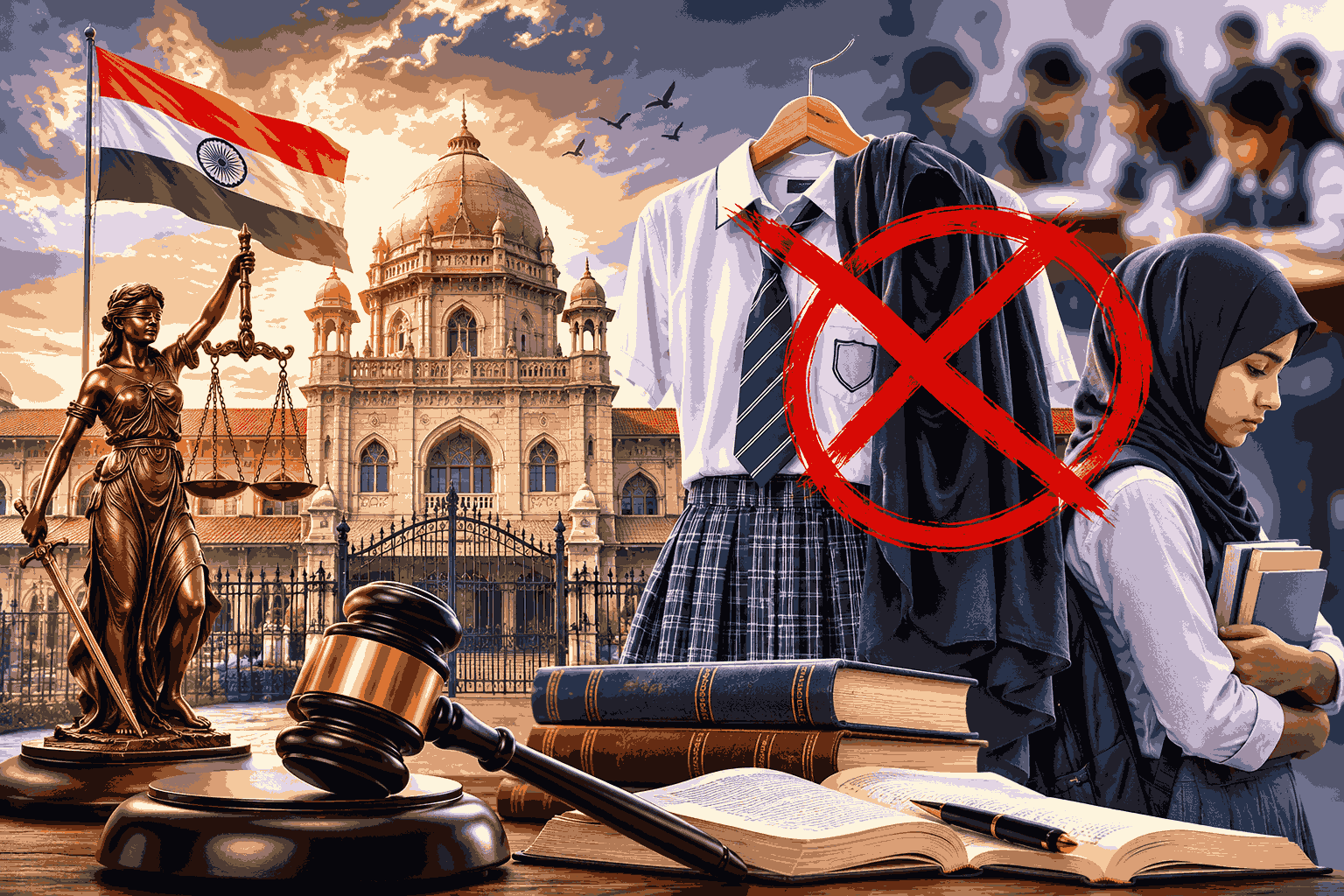
The Allahabad High Court has dismissed a petition filed by a Muslim Class XI student seeking permission to wear a Hijab with her prescribed school uniform, holding that she had not placed sufficient factual or legal material to establish that wearing a headscarf is an essential religious practice of Islam. The ruling has revived debate over religious expression, institutional discipline and the extent to which individual faith-based preferences can modify common rules in educational institutions.
The case concerned Sukaina Rizvi, a minor student of Tagore Public School in Attarsuiya, Prayagraj. She had studied at the private, unaided CBSE-affiliated institution from Class VI through Class X and sought admission to Class XI. Through her mother, she approached the High Court after the school declined to permit her to continue wearing a headscarf in addition to the prescribed uniform. She said she had previously worn it at school without objection.
The student argued that the Hijab was an essential part of her religious practice and that preventing her from doing so infringed constitutional protections, including equality and freedom of expression. The school maintained that its uniform rules applied generally and that granting an individual exemption could affect discipline, uniformity and administration.
A Division Bench comprising Justice JJ Munir and Justice Indrajeet Shukla examined the competing claims and sided with the school on the uniform issue. The court observed that a student cannot insist upon altering a prescribed dress code when the policy is uniform, bona fide, non-discriminatory and intended to maintain institutional discipline and identity. The judges also rejected the argument that earlier tolerance of the headscarf created a permanent legal entitlement.
The court placed particular emphasis on the absence of sufficient material demonstrating that the Hijab was an essential religious practice whose restriction would jeopardise the petitioner’s faith. The bench considered earlier decisions from the Kerala and Bombay High Courts and the 2022 Full Bench judgment of the Karnataka High Court in Resham v. State of Karnataka. That judgment held that wearing a headscarf did not constitute an essential religious practice in Islam.
The Allahabad High Court also considered subsequent Supreme Court proceedings in the Aishat Shifa case. The Supreme Court delivered a split verdict on the Karnataka decision, leaving the broader controversy without a final determination from the country’s highest court. The Allahabad bench nevertheless treated the Karnataka Full Bench judgment as persuasive authority while deciding the petition.
The ruling does not amount to a general judicial prohibition on the Hijab in every educational institution across India. Its immediate significance lies in the court’s assessment of this petition, the evidence presented and the school’s authority to enforce its stated dress code. Different factual or legal circumstances could therefore be considered in future litigation.
The dispute illustrates the difficult balance schools face between respecting religious identity and maintaining common standards. Uniforms are intended to create a shared institutional appearance, while students and families may regard religious clothing as an important expression of identity. The question becomes particularly sensitive when religious freedom is invoked against an institutional rule.
The Allahabad verdict is likely to keep the Hijab question in public debate, particularly because courts in different jurisdictions have examined school and college dress-code disputes from different perspectives. Future challenges may require courts to revisit constitutional questions, evidence concerning religious practice and the precise scope of institutional autonomy.
For schools, the ruling reinforces the importance of clearly formulated and consistently applied uniform policies. For students, it highlights the need to substantiate claims based on constitutional or religious rights with appropriate legal and factual material. For the judiciary, such cases demand a careful balance between individual liberty, equality, religious freedom and the practical requirements of educational administration.
Ultimately, the decision does not settle every question surrounding religious attire in Indian classrooms. It does, however, make clear that a request for an exemption from a prescribed uniform cannot rest solely on an assertion that a particular form of dress is religiously required. The Hijab debate will continue, and future cases may test the constitutional boundaries of religious accommodation. The Hijab issue remains subject to further scrutiny ahead.