



















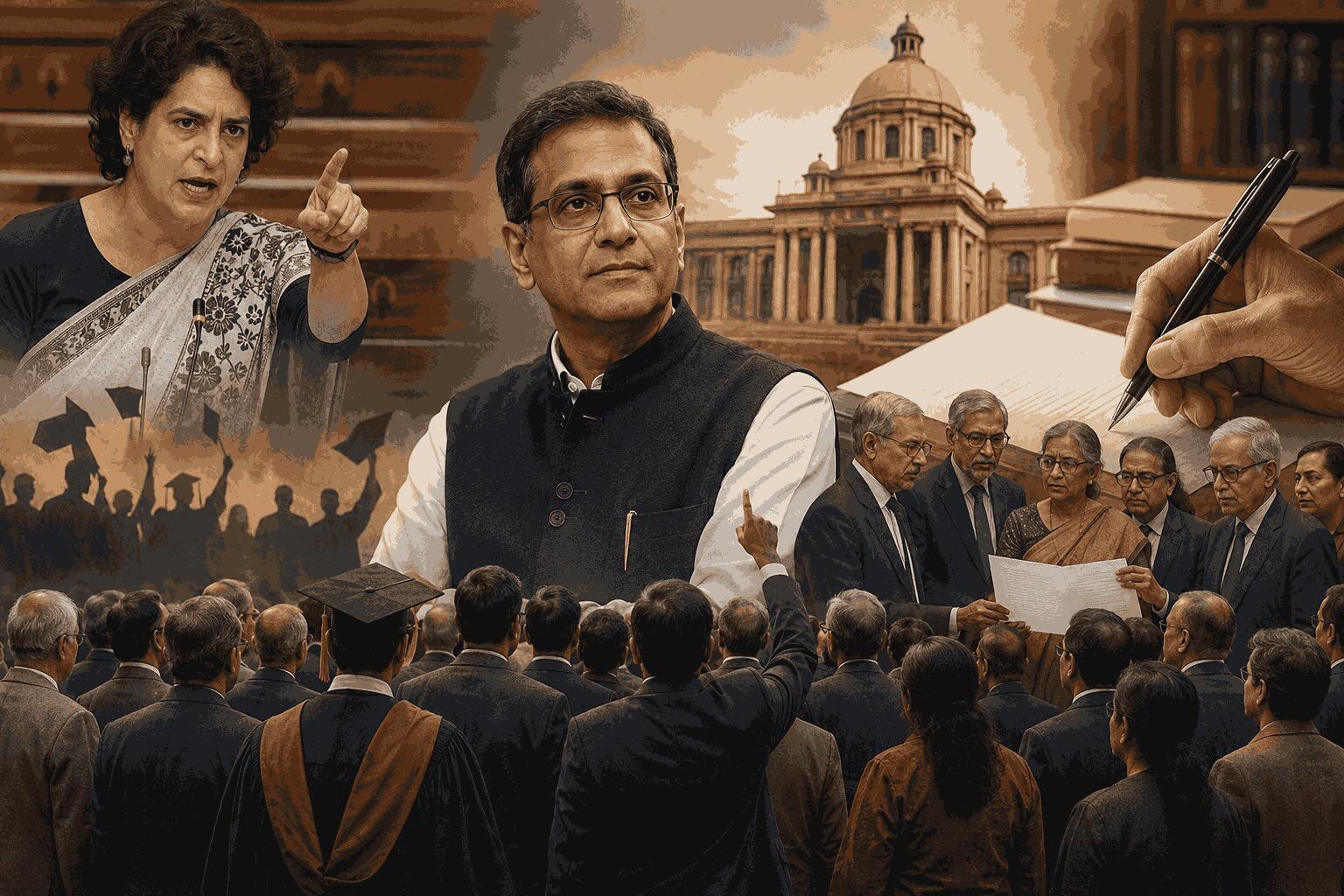
The phrase Gaumutra Expert has ignited a nationwide debate after Congress MP Priyanka Gandhi Vadra’s remark during a parliamentary discussion drew strong criticism from India’s academic community. In response, a group of 215 vice-chancellors, former vice-chancellors, and senior academicians issued an open letter condemning what they described as a personal attack on IIT Madras Director Prof. V. Kamakoti. The signatories argued that public debate should focus on ideas and policies rather than reducing accomplished scholars to labels.
The controversy began during a Lok Sabha debate on education reforms, where Priyanka Gandhi used the expression “gaumutra expert” while criticising the government’s appointment of Prof. V. Kamakoti to a high-level task force on examination reforms. Although the remark quickly became a political flashpoint, the strongest response came from academia rather than party leaders.
In their letter, the academicians asserted that disagreement with a scholar’s views should not translate into ridicule or personal branding. They maintained that intellectual discourse requires engagement with evidence, research, and arguments rather than dismissive terminology. According to the signatories, such language risks discouraging experts from participating in public policy discussions.
At the centre of the controversy is Prof. V. Kamakoti, Director of IIT Madras and a well-known computer scientist. He has contributed extensively to computer architecture, cybersecurity, VLSI systems, and indigenous processor development. His academic career includes more than 150 research publications, numerous funded research projects, and leadership roles in several national technology initiatives.
Prof. Kamakoti was recently appointed to a government-appointed task force examining reforms to the National Testing Agency (NTA) and India’s examination system. The committee was constituted following concerns over examination integrity and is expected to recommend technological and administrative improvements.
The academicians’ letter noted that reducing such an accomplished scientist to the label Gaumutra Expert ignores decades of scholarly work and professional achievement.
The controversy extends beyond political disagreement because many education leaders believe it touches upon the broader issue of respect for academic institutions.
The letter argues that while public figures remain open to criticism, scholarly credentials and professional accomplishments deserve objective evaluation. According to the signatories, disagreements over scientific opinions or traditional knowledge should be addressed through debate and evidence rather than personal characterisations.
Several academics further observed that Parliament has historically served as a forum for substantive policy discussions, making respectful engagement particularly important. The repeated use of Gaumutra Expert in political discourse, they warned, risks shifting attention away from meaningful conversations about education reforms.
Ironically, the political controversy has overshadowed the very subject that prompted the parliamentary discussion—reforming India’s examination system.
Prof. Kamakoti has recently spoken about strengthening examination security through better technology, transparent evaluation processes, and improved trust mechanisms. He has argued that technology alone cannot eliminate malpractice and that institutional reforms must also strengthen accountability among those responsible for preparing examinations.
These proposals form part of the broader recommendations expected from the government’s expert panel, which seeks to restore confidence after recent examination controversies. Supporters argue that debates should concentrate on these policy recommendations rather than on remarks such as Gaumutra Expert.
The episode has generated predictable political reactions from both the ruling party and the opposition. BJP leaders criticised the remark, calling it disrespectful to one of India’s leading academic administrators. Congress leaders, meanwhile, defended their broader criticism of the government’s appointments while continuing to question the composition of the reform panel.
The academic community, however, has largely attempted to separate political disagreements from scholarly reputation. The signatories stressed that criticism of government policy remains entirely legitimate but argued that personal labels such as Gaumutra Expert do little to advance informed public discussion.
Observers note that the controversy illustrates how quickly parliamentary exchanges can evolve into national debates involving universities, researchers, and scientific institutions.
Beyond the immediate political controversy, the incident has prompted discussion about the quality of public discourse in India.
Education experts say democratic societies benefit when scholars actively contribute to policy debates without fear of personal ridicule. Many believe disagreements should focus on evidence, research, and institutional performance instead of reducing individuals to controversial labels.
Whether one agrees or disagrees with Prof. Kamakoti’s views, the open letter argues that academic credibility should be assessed through scholarly work rather than political rhetoric. The widespread response from more than 215 academicians demonstrates the importance many attach to preserving dignity within higher education.
As the debate continues, the phrase Gaumutra Expert has become more than a political slogan—it has evolved into a wider discussion about academic freedom, respectful disagreement, and the standards expected in India’s democratic institutions.