






















In the winter markets of Dhaka and the flour mills of Chittagong in Bangladesh, the tremors of a war being fought five thousand kilometres away arrived without warning. Russia’s invasion of Ukraine in February 2022 did not just redraw the map of European security, it cracked open the foundations of global food supply. And for Bangladesh, a country that depends heavily on imported wheat to feed its people, the consequences were immediate and alarming.
Russia and Ukraine together account for nearly a third of the world’s wheat exports. When the conflict choked off Black Sea shipping routes and threw both nations’ agricultural logistics into chaos, the effects rippled outward almost instantly. Freight costs surged. Wheat prices climbed sharply across Asia and Africa. Nations that had grown accustomed to the quiet reliability of global grain markets suddenly found themselves scrambling for alternatives.
Bangladesh had, before the war, drawn a significant portion of its wheat imports from both Russia and Ukraine. The disruption forced Dhaka to look elsewhere to cover nearly half its monthly wheat requirements, at precisely the moment when the global market was tightest, most expensive, and most unpredictable.
India was facing its own pressures. A brutal heat wave in the spring of 2022 had damaged domestic wheat harvests, and food inflation at home was already a concern for policymakers. On 13 May 2022, New Delhi announced a ban on wheat exports, a decision driven by the need to protect its own food security and prevent further price escalation within India.
The ban was sweeping, but it was not absolute. Embedded within the policy was a carefully considered exception: neighbouring countries with genuine food security needs could continue to receive Indian wheat, provided their governments made formal requests. It was a quiet but significant act of regional judgment, the recognition that India’s domestic obligations and its responsibilities as a regional anchor were not entirely separable.
India Keeps the Wheat Corridor Open for Bangladesh
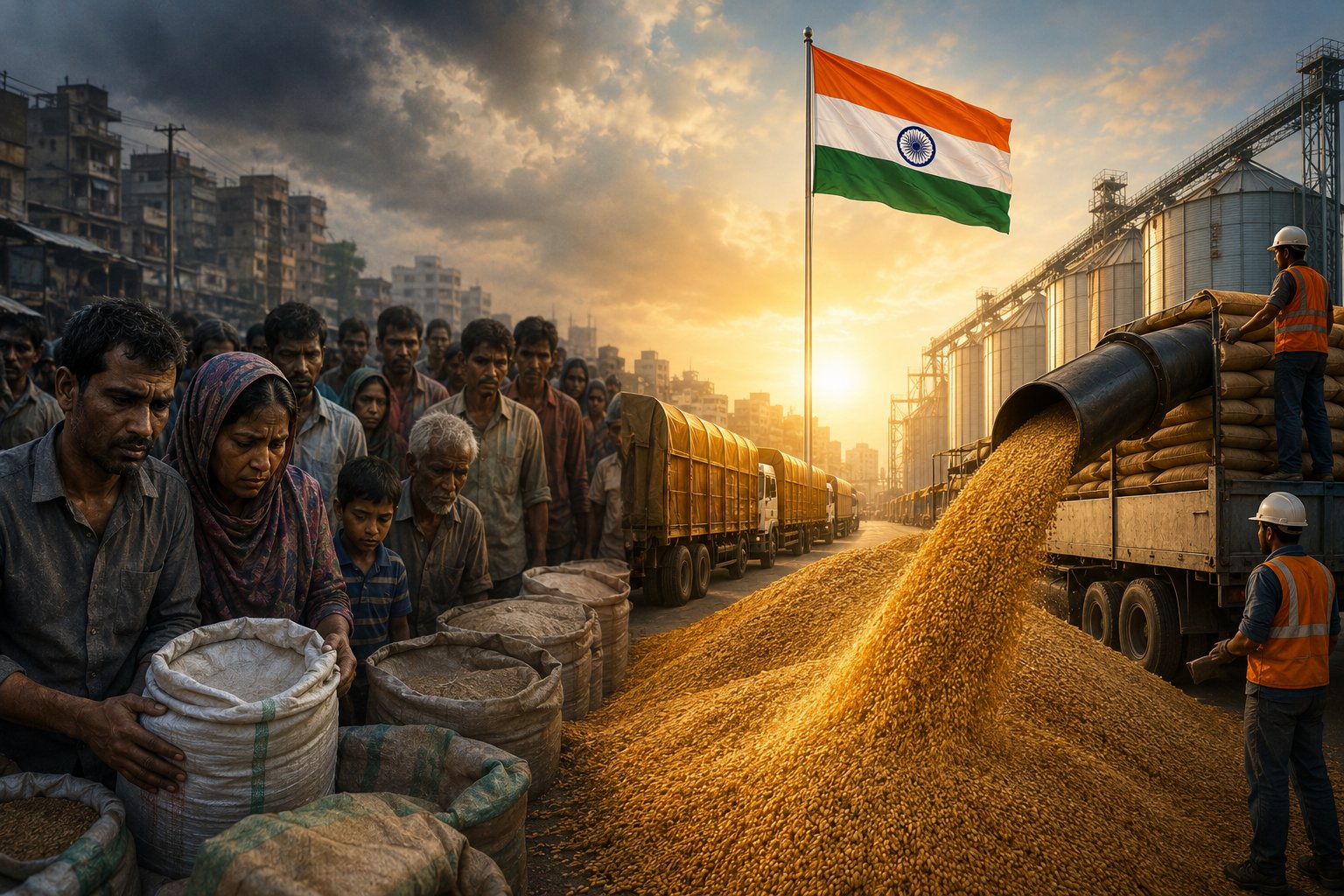
Bangladesh was the most direct beneficiary of this approach. Even as India’s wheat stopped flowing to buyers across the wider world, supplies continued moving eastward. Over the course of this period, India supplied approximately 150,000 metric tonnes of wheat to Bangladesh, a figure that carried weight well beyond its volume. It helped cushion domestic flour price volatility, eased pressure on food distribution systems, and gave Dhaka a measure of stability at a time when global markets were offering very little of it.
For ordinary Bangladeshis, the family buying atta at the local shop or the bakery owner watching input costs climb, the difference between manageable disruption and genuine hardship often came down to whether supply chains held. India’s wheat corridor helped them hold.
What makes this episode instructive is not just the quantity of wheat transferred, but the manner in which the decision was made. Several major food-exporting nations responded to the 2022 crisis with purely protectionist instincts, closing off exports and triggering a domino effect that hit import-dependent developing economies hardest. India, facing its own harvest anxieties and inflation pressures, chose a more calibrated path by protecting domestic needs while sustaining a humanitarian exception for its most vulnerable neighbours.
This was not charity. It was something more durable: the logic of regional interdependence, made concrete through a specific policy choice at a specific moment of stress.
Why India’s Grain Diplomacy Matters Beyond South Asia
The episode also gave weight to an argument that often gets lost in discussions of South Asian connectivity. Land-based food corridors, when they exist and function, are not merely cheaper than maritime alternatives, they are more resilient. They are not subject to naval blockades, shipping route closures, or the insurance convulsions that attend conflict on open water.
The wheat that moved from India into Bangladesh in 2022 did not pass through any war zone. It travelled overland, through the relationships and infrastructure that two neighbours had built over decades.
That reliability, understated as it was, matters enormously in an era of compounding global disruptions. Climate shocks, pandemics, and geopolitical conflicts are no longer remote or hypothetical threats to food security, they are recurring features of the world that South Asia must navigate. In that context, India’s willingness to maintain a grain corridor under its own domestic duress represents something that rarely appears in formal foreign policy documents: crisis solidarity, enacted quietly, in the form of flour.
The 2022 wheat episode offers a template that South Asia, and the wider developing world, would do well to study. Regional food security is not built only through multilateral agreements or long-term trade treaties. It is also built through the choices that larger neighbours make when smaller ones are vulnerable, and through the trust that accumulates when those choices are made generously.
India’s grain diplomacy during the Russia-Ukraine crisis was, in this sense, a form of regional statecraft that operated below the level of headlines. No summits were held. No declarations were signed. Wheat simply moved, reliably, across a border, and that was enough.