
























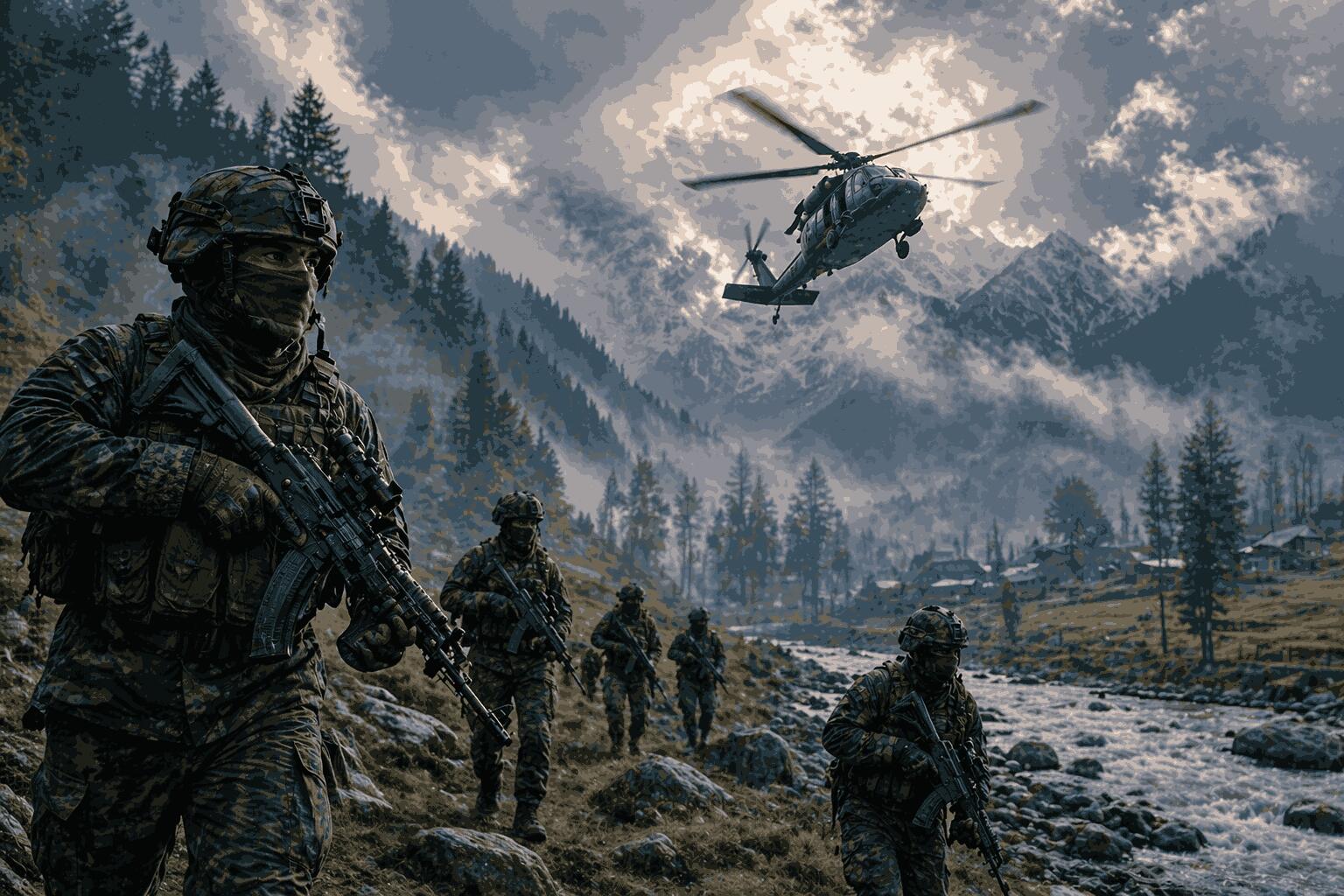
The story of Pahalgam is not merely one of tragedy—it is also one of resolve, precision, and eventual justice. What began as one of the most brutal terror attacks on civilians in recent memory evolved into a relentless counter-terror operation that demonstrated the depth of India’s intelligence and military coordination. Operation Mahadev, launched in the aftermath of the Pahalgam massacre, became the instrument through which the perpetrators were tracked, hunted, and ultimately neutralised.
On April 22, 2025, the serene meadows of Baisaran Valley near Pahalgam were transformed into a site of horror. Armed terrorists opened fire on unsuspecting tourists, killing 26 civilians in a targeted attack that shocked the nation. The brutality of the killings—where victims were reportedly singled out and shot at close range—left deep scars on families and triggered nationwide outrage. The attack was not just an act of violence; it was a calculated attempt to instill fear and disrupt the fragile peace in the region.
Within hours of the attack, Indian security forces mobilised on an unprecedented scale. The response to Pahalgam was swift and layered, combining on-ground troop deployment with sophisticated intelligence gathering. According to reports, investigators relied on a fusion of human intelligence (HUMINT), technical intelligence (TECHINT), and eyewitness accounts to identify the attackers. This multi-pronged approach allowed authorities to quickly confirm the involvement of three terrorists linked to Pakistan-based groups.
Operation Mahadev was not a routine security exercise—it was a sustained manhunt. The challenge lay in the terrain: dense forests, mountainous routes, and vast areas where militants could hide or attempt to escape. Yet, the forces persisted. Surveillance technology, intercepted communications, and ground-level tracking gradually narrowed down the suspects’ movements. A breakthrough reportedly came from monitoring satellite communication signals, which helped pinpoint the terrorists’ location within a confined forest zone.
As weeks turned into months, the operation intensified. Security forces coordinated across agencies, ensuring that no escape routes remained open. The message was clear: those responsible for Pahalgam would not evade justice. Eventually, in a निर्णायक encounter, the three terrorists were neutralised in a joint operation involving the Army, CRPF, and Jammu and Kashmir Police. Their identities matched those of the attackers, bringing a sense of closure to a nation that had been waiting for accountability.
For the families of the victims, this outcome was more than a tactical success—it was emotional justice. Many had endured months of grief, uncertainty, and anger. Reports indicate that relatives of those killed expressed relief after the operation, viewing it as a fulfillment of the government’s promise that the perpetrators would be brought to justice. While no action could undo the loss, the elimination of the attackers reaffirmed faith in the state’s commitment to protect its citizens.
The story of Pahalgam also highlights the human dimension of both tragedy and courage. Amid the chaos of the attack, locals and security personnel risked their lives to save others. Survivors recounted how quick thinking and knowledge of the terrain helped guide tourists to safety through forests and hidden routes. Such acts of bravery stand in stark contrast to the brutality of the attackers, underscoring the resilience of ordinary people in extraordinary circumstances.
Beyond the immediate outcome, Operation Mahadev has broader implications for India’s counter-terror strategy. It showcased how rapid intelligence integration, technological surveillance, and inter-agency coordination can produce decisive results even in complex environments. The operation sent a strong signal—not just domestically but internationally—that acts of terror will be met with sustained and targeted responses.
At the same time, the memory of Pahalgam continues to serve as a somber reminder of the persistent threat of terrorism. Annual tributes and national reflections reinforce the importance of vigilance and unity. The victims are remembered not only for the tragedy they endured but also as symbols of the cost of extremism.
In the end, Pahalgam stands as both a scar and a statement. A scar, because of the innocent lives lost in an act of senseless violence. A statement, because of the unwavering pursuit of justice that followed. Operation Mahadev did not just eliminate terrorists—it reinforced a principle: that even in the face of fear and brutality, accountability will be pursued with determination.
The echoes of that resolve continue to shape India’s security doctrine, ensuring that what happened in Pahalgam is neither forgotten nor repeated.