
























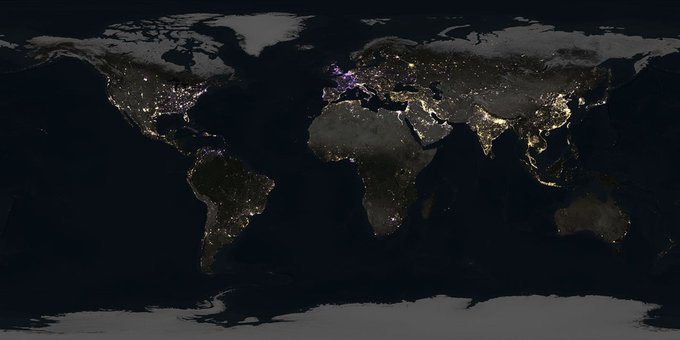
The story of our planet after sunset is no longer just poetic—it is measurable, dynamic, and deeply revealing. A groundbreaking analysis of 1.16 million satellite images taken over nine years by NASA Earth has uncovered a striking truth: Earth is not uniformly getting brighter at night. Instead, some regions are illuminating more intensely while others are dimming, reflecting profound shifts in human activity, economic patterns, and environmental conditions. This evolving portrait of nighttime light offers an unexpected but powerful lens through which to understand global change.
At the heart of this discovery lies the work of NASA scientists who meticulously examined nightly satellite imagery to map artificial light emissions across the globe. The findings challenge the long-held assumption that urbanization and electrification would naturally lead to a steady, universal increase in brightness. Instead, the data shows a patchwork of trends—some areas booming with light, others receding into relative darkness. The term NASA Earth has come to symbolize not just the planet itself, but the sophisticated observational systems that allow us to track such transformations in remarkable detail.
One of the most significant drivers of increasing brightness is rapid urban expansion, particularly in developing regions. Cities in parts of Asia and Africa are growing at unprecedented rates, bringing with them infrastructure, industry, and electrification. As rural populations migrate to urban centers, the demand for lighting—streetlights, residential illumination, commercial signage—rises sharply. This surge is clearly visible in satellite imagery, where once-dark landscapes now shimmer with new clusters of light. In this context, NASA Earth data becomes a proxy for economic development, revealing where growth is accelerating.
Conversely, dimming regions tell a different story. In some cases, declining light levels are linked to economic downturns or population loss. Areas experiencing industrial decline or conflict often show reduced nighttime illumination, as businesses close and infrastructure deteriorates. For example, certain regions in Eastern Europe and parts of the Middle East exhibit noticeable dimming trends, reflecting instability or demographic shifts. Here, NASA Earth imagery provides a sobering visual record of hardship and disruption.
Environmental policies and energy efficiency measures also play a crucial role in shaping nighttime brightness. In many developed countries, efforts to reduce light pollution and conserve energy have led to the adoption of more efficient lighting technologies, such as LED systems. While LEDs can be brighter per unit of energy, they are often used more strategically, resulting in overall reductions in unnecessary illumination. This nuanced effect means that even technologically advanced regions may appear dimmer in aggregate satellite data. Through the lens of NASA Earth, these changes highlight a growing awareness of sustainability.
Another intriguing factor is the cultural and behavioral aspect of lighting. Festivals, seasonal events, and even daily routines influence how and when lights are used. In some countries, policies encourage reduced nighttime lighting to protect wildlife or improve human health by preserving natural circadian rhythms. Such initiatives can lead to measurable decreases in brightness over time. The ability of NASA Earth systems to capture these subtle variations underscores the complexity of interpreting nighttime light data.
The implications of these findings extend beyond mere observation. Nighttime light patterns are increasingly used as indicators in a wide range of fields, from economics and urban planning to environmental science and disaster response. For instance, sudden drops in brightness can signal power outages following natural disasters, enabling faster and more targeted relief efforts. Similarly, gradual increases in light can help identify emerging economic hubs. In this way, NASA Earth serves as both a mirror and a tool—reflecting reality while also guiding decision-making.
Importantly, the uneven distribution of light raises questions about equity and access. While some regions bask in ever-growing illumination, others remain underserved, lacking reliable electricity and the opportunities it brings. Addressing this imbalance is a key challenge for policymakers and development organizations. By providing clear, data-driven insights, NASA Earth contributes to a more informed approach to tackling global inequality.
In conclusion, the revelation that Earth’s nighttime brightness is both increasing and decreasing in different places paints a far more intricate picture of our world than previously imagined. It is a story of growth and decline, innovation and conservation, progress and disparity. Through the vast archive of satellite imagery, NASA Earth allows us to see these patterns with unprecedented clarity, reminding us that even in the darkness, the planet is constantly changing.
What’s of India?