






















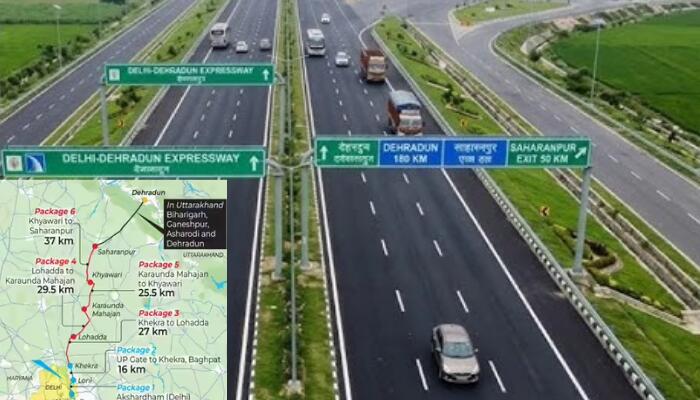
Prime Minister Narendra Modi inaugurated the Delhi–Dehradun Expressway, a major infrastructure project aimed at dramatically improving road connectivity between the national capital and Uttarakhand. The newly opened corridor is expected to reduce travel time between Delhi and Dehradun from more than six hours to roughly two and a half hours, offering commuters a faster and more efficient route.
Stretching across approximately 213 kilometres, the expressway has been developed at a cost exceeding ₹12,000 crore. The six-lane access-controlled highway begins near the Akshardham Temple in Delhi and passes through several districts of Uttar Pradesh, including Baghpat, Baraut, Muzaffarnagar, Shamli, and Saharanpur, before reaching Dehradun in Uttarakhand. The project has been executed by the National Highways Authority of India and is designed for speeds of up to 100 kmph.
The Prime Minister formally inaugurated the corridor by pressing a remote control at a public function in Dehradun. Union Minister for Road Transport and Highways Nitin Gadkari and Uttarakhand Chief Minister Pushkar Singh Dhami welcomed him at the event. Uttar Pradesh Chief Minister Yogi Adityanath, Governor Anandiben Patel, and Deputy Chief Minister Brajesh Pathak were also present.
Earlier in the day, Modi visited the Maa Daat Kali Temple near Dehradun and offered prayers. The temple is regarded as an important religious site where devotees traditionally seek blessings before starting new ventures or journeys. The Prime Minister also inspected the wildlife corridor built along the elevated section of the expressway in Saharanpur before attending the inauguration ceremony.
Modern Highway Designed for Seamless Travel
The Delhi–Dehradun Economic Corridor has been built as a high-speed, controlled-access highway intended to ensure the uninterrupted movement of traffic. The route includes several interchanges, railway overbridges, and major bridges, along with more than a hundred underpasses that allow local vehicles to cross without disrupting highway traffic.
In addition to these structures, the corridor includes 10 interchanges, three railway overbridges, four major bridges, and 12 roadside amenities to support travellers. Approximately 76 kilometres of service roads and 62 bus shelters have also been developed to improve accessibility along the route.
To enhance safety and traffic monitoring, the expressway has been equipped with an Advanced Traffic Management System to regulate vehicle movement and respond quickly to incidents.
The corridor also strengthens connectivity with major highways such as the Delhi–Mumbai Expressway and the Eastern Peripheral Expressway. A dedicated link road will connect the route to Haridwar, while further links to the Char Dham Highway are expected to improve access to major pilgrimage destinations in Uttarakhand.
Environmental Safeguards Along the Route
A distinctive aspect of the project is its wildlife-sensitive design, particularly along the stretch passing through the ecologically fragile region of the Shivalik hills near Rajaji National Park.
Engineers have constructed a 12-kilometre elevated wildlife corridor, considered one of the longest in Asia, to ensure that animals can move freely beneath the highway. The design includes eight animal passages and two dedicated elephant underpasses measuring about 200 metres each.
A 370-metre tunnel has also been built near the Daat Kali temple area as part of the corridor’s ecological safeguards. The elevated structure is supported by widely spaced pillars to reduce disruption to natural habitats, while sound barriers and controlled lighting have been installed to minimise disturbance to wildlife.
Faster Travel for Commuters
Officials say the expressway will significantly shorten travel times for passengers travelling not only from Delhi but also from neighbouring cities. Commuters from Ghaziabad are expected to reach Dehradun in about two hours and fifteen minutes, while those travelling from Noida may complete the journey in approximately two hours and forty-five minutes.
Although toll rates have not yet been officially declared by the National Highways Authority of India, preliminary estimates suggest that a one-way trip by car between Delhi and Dehradun could cost around ₹670, while a round journey may be close to ₹1,000. Final toll charges will be announced once the corridor becomes fully operational.
According to the Prime Minister’s Office, the Delhi–Dehradun Economic Corridor is expected to stimulate tourism, strengthen economic links between major urban centres, and improve the overall quality of road transport in the region by offering a faster and more reliable travel route.