


























India has crossed a significant milestone in its long-term nuclear energy journey, with fresh momentum in the second stage of its ambitious three-stage programme.
Developed decades ago by Homi J Bhabha, the strategy was designed to solve a uniquely Indian challenge, limited uranium reserves but vast deposits of thorium.
Now, with progress in fast breeder reactor technology highlighted by institutions like the Bhabha Atomic Research Centre (BARC) India is moving closer to unlocking a self-sustaining nuclear fuel cycle.
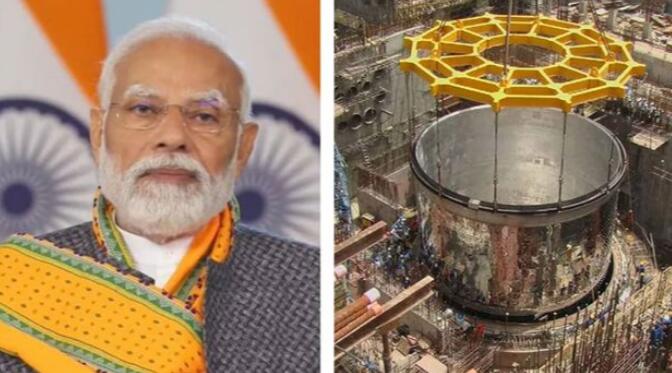
The country has moved a significant step closer to nuclear fuel self-reliance, as its indigenously developed Prototype Fast Breeder Reactor (PFBR) at Kalpakkam has successfully achieved criticality, the stage at which a controlled nuclear chain reaction begins.
The development marks a major breakthrough in the country’s long-term atomic energy programme. Confirmed on Monday, this milestone represents a key transition before the reactor begins full-scale power generation.
Once operational, the PFBR is expected to play a pivotal role in India’s ambitious plan to expand its nuclear power capacity to 100 gigawatts by 2047, a sharp rise from the current level of about eight gigawatts.
Prime Minister Narendra Modi described the development as a turning point in India’s nuclear journey.
In a post on X, he said, “Today, India takes a defining step in its civil nuclear journey, advancing the second stage of its nuclear programme.”
“The indigenously designed and built Prototype Fast Breeder Reactor at Kalpakkam has attained criticality,” he added.
What Is India’s Three-Stage Nuclear Programme?
At its core, India’s nuclear programme is a step-by-step method to generate electricity while simultaneously creating more fuel for the future. Most countries rely heavily on uranium, but India has relatively small uranium reserves and one of the world’s largest thorium deposits.
https://x.com/alpha_defense/status/2041214522736935240?s=48
To bridge this gap, the programme unfolds in three stages, where each phase produces the fuel required for the next. In simple terms, it works like a relay system, Stage 1 creates fuel, Stage 2 multiplies it, and Stage 3 makes the entire cycle sustainable for the long term.
How It Works: From Uranium to Endless Energy
Stage 1: Turning Uranium into Plutonium
India begins with natural uranium in reactors known as Pressurized Heavy Water Reactors (PHWRs). In these reactors, a small portion of uranium, known as U-235, undergoes fission to release energy in the form of electricity.
At the same time, the more abundant U-238 absorbs neutrons and transforms into plutonium-239. This process is crucial because it not only produces power but also generates plutonium, which becomes the fuel for the next stage of the programme.
Examples of such reactors in India include the Rajasthan Atomic Power Station, Kakrapar Atomic Power Station, and Narora Atomic Power Station.
Stage 2: Fast Breeder Reactors: Making More Fuel Than You Use
The second stage is where India is currently making significant progress. Fast breeder reactors use plutonium-239 as fuel. When this plutonium undergoes fission, it releases high-energy neutrons. These neutrons are then absorbed by surrounding materials such as uranium-238 or thorium, converting them into more fissile fuel like plutonium-239 or uranium-233.
The defining feature of this stage is that it produces more fuel than it consumes, a process known as “breeding.” This makes it a critical bridge between limited uranium resources and the future thorium-based cycle.
Key facilities driving this progress include the Fast Breeder Test Reactor and the Prototype Fast Breeder Reactor. Recent developments around these reactors have also been publicly acknowledged by PM Narendra Modi, underlining their national importance.
Stage 3: The Thorium Breakthrough
The third and final stage is what sets India’s programme apart globally. Thorium-232, which is abundantly available in India, cannot directly undergo fission. However, when it absorbs a neutron, it transforms into uranium-233, a material capable of sustaining a nuclear chain reaction and producing energy.
This stage is crucial because it enables India to tap into its vast thorium reserves for long-term, sustainable power generation. The proposed reactor design for this phase is the Advanced Heavy Water Reactor, which is currently under development.
What Is a Fast Breeder Reactor and How Does It Work?
A fast breeder reactor (FBR) is a special type of nuclear reactor designed to produce more fuel than it consumes. Unlike conventional reactors that use slow (thermal) neutrons, FBRs rely on high-energy fast neutrons to sustain the chain reaction.
These reactors typically use plutonium-239 or mixed oxide fuel. Surrounding the core is a “blanket” of uranium-238, which absorbs neutrons and converts into plutonium-239, allowing the fuel to be reused. This process significantly improves fuel efficiency and extends the use of available uranium resources.
Another key difference is that FBRs do not use a moderator to slow down neutrons. Instead, they often use liquid sodium as a coolant, which enables efficient heat transfer. This design not only enhances fuel utilisation but also allows for the burning of long-lived nuclear waste.
India’s PFBR is part of a select group of such advanced reactors worldwide, alongside Russia’s BN-800 and France’s Phénix reactor. However, the technology remains complex and expensive. It also comes with challenges, including safety concerns associated with sodium coolant and proliferation risks due to plutonium production.
Why It Matters
The PFBR project reflects the efforts of a vast network of scientists, engineers, technicians and industry partners who contributed to its design, fabrication and construction, largely using indigenous technologies. Their work highlights India’s growing expertise in advanced nuclear engineering and aligns with the country’s push for self-reliance under the Atmanirbhar Bharat initiative.
Beyond electricity generation, the fast breeder programme strengthens India’s capabilities in critical areas such as nuclear fuel cycles, advanced materials, reactor physics and large-scale engineering. The knowledge and experience gained are expected to support future reactor designs and next-generation nuclear technologies.
As India expands its clean energy mix, fast breeder reactors are expected to provide reliable, low-carbon base-load power with improved efficiency. The achievement of first criticality is therefore not just a technical milestone, but a major step toward building a sustainable and self-reliant energy future for a developed India.
Built Indigenously Under Aatmanirbhar Push
The reactor has been designed and constructed by Bharatiya Nabhikiya Vidyut Nigam Limited (BHAVINI), underscoring India’s focus on developing critical technologies domestically.
More than 200 Indian industries, including several MSMEs, contributed to the project, reflecting a broad industrial ecosystem supporting the nuclear sector. BHAVINI was established in 2003 to spearhead the development of advanced reactors such as the PFBR.
As per reports, officials noted that the reactor incorporates advanced third-generation safety features, including passive systems capable of ensuring safe shutdown during emergencies. The attainment of criticality indicates that a sustained nuclear chain reaction has begun under controlled conditions.
The reactor will now undergo extensive testing and gradual power increases before reaching full operational capacity. Earlier, in 2024, the Kalpakkam reactor had achieved the core loading stage, when nuclear fuel was first introduced.
Global Significance and Next Steps
Once fully commissioned, India will join a small group of nations operating fast breeder reactors, with Russia currently being the only country running such reactors commercially at scale.
The next phase will involve scaling up operations and integrating the PFBR into the national grid, contributing to India’s efforts to reduce carbon emissions while meeting rapidly growing energy demand.
As the reactor moves closer to full operation, it also accelerates India’s long-term vision of utilising its vast thorium reserves.
This milestone marks not just progress in nuclear technology, but a decisive step toward a sustainable, secure and self-reliant energy future.
