















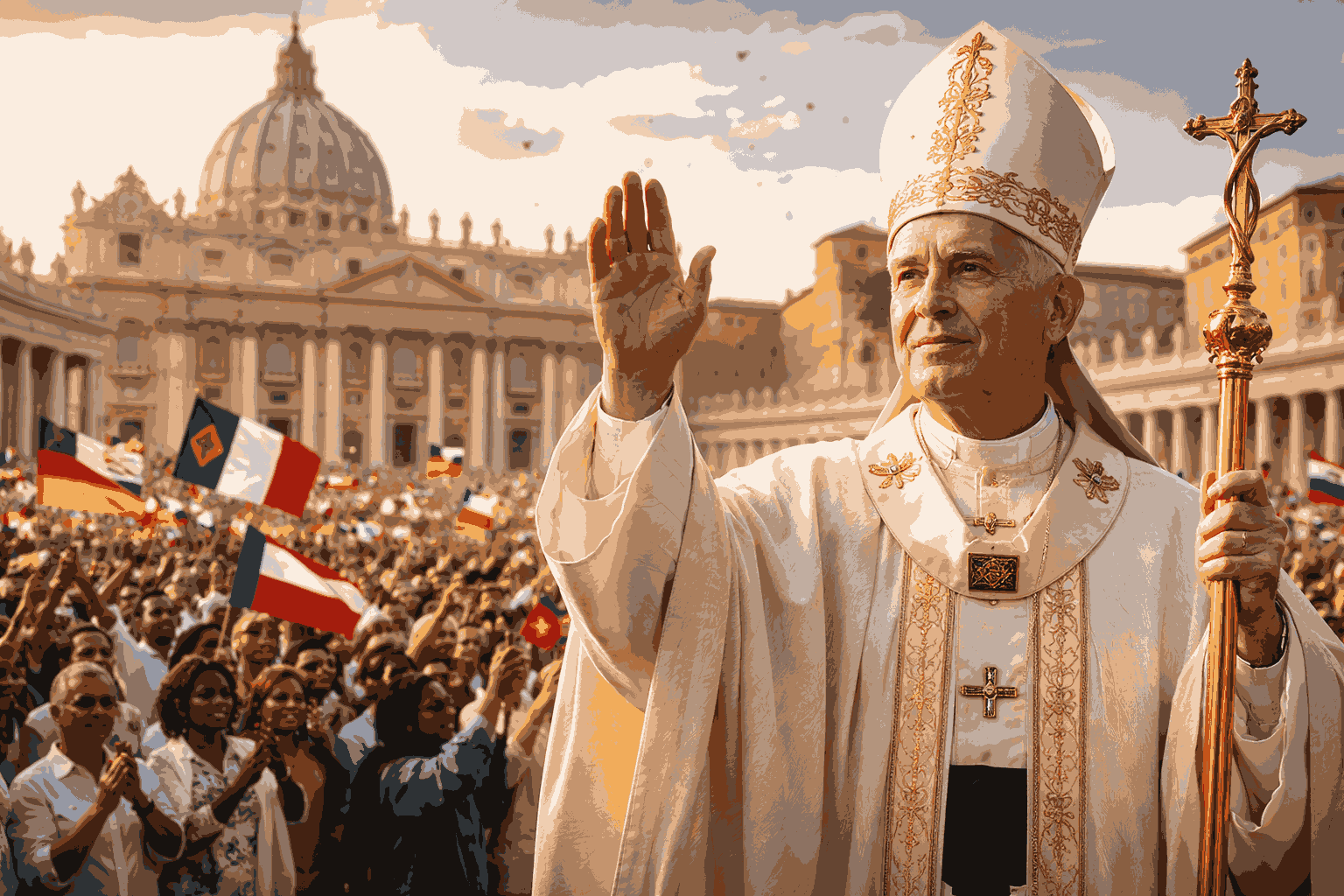
A recent article published by RAIR Foundation has sparked intense debate by alleging that the Vatican, under Pope Leo XIV, is contributing to a transformation of Christian Civilization through its evolving stance on migration, globalism, and social policy. The claims, which draw on interpretations of Vatican meetings and broader Church messaging, have generated both support and criticism across ideological lines.
At the center of the discussion is Pope Leo XIV, the first American pontiff, elected in May 2025, who has been widely described as a moderate leader with a focus on peace, dialogue, and social justice. (Encyclopedia Britannica) His early papacy has emphasized outreach to marginalized communities and a global vision of cooperation, which supporters argue is consistent with long-standing Catholic teachings on human dignity and solidarity.
The RAIR Foundation article, however, frames these developments differently. It suggests that recent Vatican engagements and messaging signal a departure from traditional notions of Christian Civilization. The piece highlights meetings with international figures and organizations as evidence of a broader alignment with global migration agendas. While such interpretations remain contested, they reflect a growing trend of politicizing religious leadership in the context of global issues.
Critics of the RAIR perspective argue that it relies heavily on selective interpretation. They note that the Catholic Church has, for decades, advocated for the humane treatment of migrants and refugees, long before the current papacy. Pope Leo XIV’s emphasis on these issues, they say, does not represent a radical shift but rather a continuation of established doctrine. His speeches and actions have repeatedly underscored peace, dialogue, and the moral responsibility to address human suffering.
The debate over Christian Civilization is not new, but it has taken on renewed urgency in recent years. For some commentators, the term represents a cultural and religious heritage rooted in Europe’s history and traditions. For others, it is a broader, evolving concept that must adapt to a globalized and diverse world. The Vatican’s current direction under Pope Leo XIV has become a focal point in this ongoing conversation.
Supporters of the Pope’s approach argue that preserving Christian Civilization does not mean resisting change, but rather engaging with contemporary challenges in a way that reflects core Christian values. They point to the Church’s long history of adapting to different cultural contexts while maintaining its spiritual mission. In this view, outreach to migrants and emphasis on global solidarity are seen as expressions of faith, not deviations from it.
On the other hand, critics fear that such openness could dilute traditional cultural identities. They argue that rapid demographic and social changes, combined with what they perceive as insufficient emphasis on cultural preservation, could weaken the foundations of Christian Civilization. These concerns are often amplified in political discourse, where religious and cultural issues intersect with debates over national identity and immigration policy.
It is important to note that the RAIR Foundation article represents one perspective within a broader and highly contested debate. The Vatican itself has not endorsed the characterization presented in the article. Instead, official communications from the Holy See emphasize unity, peace, and the universal nature of the Church’s mission.
Pope Leo XIV’s leadership continues to be closely watched as he navigates complex global challenges. His background as a missionary and administrator, along with his reputation as a bridge-builder, suggests that he will seek to balance tradition with engagement in a rapidly changing world. (Art Newspaper)
Ultimately, the discussion surrounding Christian Civilization reflects deeper questions about identity, faith, and the role of religious institutions in modern society. Whether one views current developments as a necessary evolution or a concerning shift, it is clear that the conversation will continue to shape public discourse in the years ahead.
As debates intensify, the Vatican’s actions under Pope Leo XIV will remain central to how Christian Civilization is understood and interpreted. In a world marked by division and uncertainty, the challenge lies in finding a path that honors tradition while addressing the realities of an interconnected global community.