



















RelatedPosts
The political fallout of the failed Constitution (131st Amendment) Bill spilled onto the streets of Delhi, as Bharatiya Janata Party leaders led an aggressive protest march to Congress leader Rahul Gandhi’s residence, resulting in detentions, clashes, and a dramatic show of political anger.
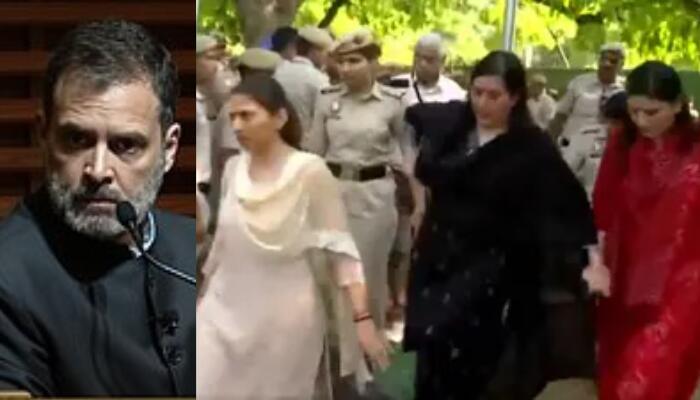
Among those detained by Delhi Police were Union Minister of State Raksha Khadse and BJP MP Bansuri Swaraj, along with fellow MP Kamaljeet Sehrawat. The leaders were later released, but the visuals of their detention underscored the intensity of the BJP’s response to what it has termed a deliberate obstruction of women’s empowerment.
Protest turns volatile outside Rahul Gandhi’s residence
The protest, branded as an ‘Aakrosh March’, quickly escalated as BJP workers and leaders gathered outside Gandhi’s residence, burning his effigy and raising slogans against the Congress. The situation deteriorated to the point where police had to deploy water cannons to disperse the crowd, particularly women workers who had assembled in large numbers.
The march saw participation from several senior BJP figures including Delhi Chief Minister Rekha Gupta, BJP state chief Virendra Sachdeva, and MP Manoj Tiwari. Other MPs such as Hema Malini, Manju Sharma, and Vatsalya Gupta were also present, signalling a coordinated political mobilisation.
Notably, Rahul Gandhi was not present at his residence during the protest, as he was attending a poll rally in Tamil Nadu.
BJP calls it betrayal, Congress claims democratic victory
The protests come a day after the Constitution Amendment Bill failed to secure the required two-thirds majority in the Lok Sabha. While 298 members voted in favour, 230 opposed it, preventing its passage. The bill, linked to women’s reservation and delimitation, has since become a major flashpoint.
The BJP has framed the Opposition’s resistance as a betrayal of women across the country. Women leaders participating in the protest accused the Congress of being “afraid of women” and attempting to block their rightful representation in Parliament. The party also marked April 17 as a “Black Day”, amplifying its narrative that a historic opportunity was sabotaged.
Delhi Chief Minister Rekha Gupta reinforced this stance by wearing a black armband, calling the bill’s failure a “painful” moment and accusing Opposition parties of blocking a crucial reform.
Political battle set to intensify
The confrontation has now transformed the Women’s Reservation Bill into a full-scale political battleground. With the BJP taking the fight directly to the Opposition’s doorstep and framing the issue as one of women’s rights, the coming days are likely to see further escalation.
Prime Minister Narendra Modi is expected to address the nation later in the evening, with indications that he may directly target the Opposition over the bill’s collapse.
What began as a legislative setback has now evolved into a charged political narrative, with both sides digging in for a prolonged confrontation that goes well beyond Parliament.