








TFIPOST हिन्दी
TFIPOST Global
Tfipost.com
Tfipost.com
No Result
View All Result
  • Premium
  • Politics
    • All
    • Analysis
    • Opinions
    • Trending
    Govt Exposes Pakistan-Linked Deepfake Propaganda Targeting Jaishankar Amid West Asia Tensions

    Govt Exposes Pakistan-Linked Deepfake Propaganda Targeting Jaishankar Amid West Asia Tensions

    LNG Supply Crunch: IRCTC Directs Station Caterers to Use Microwaves, Induction Cookers Amid West Asia Crisis

    LNG Supply Crunch: IRCTC Directs Station Caterers to Use Microwaves, Induction Cookers Amid West Asia Crisis

    Miss India Earth 2019 Winner Sayali Surve Converts Back to Hinduism After Alleging ‘Love Jihad, Harassment by Muslim Husband’

    Miss India Earth 2019 Winner Sayali Surve Converts Back to Hinduism After Alleging ‘Love Jihad, Harassment by Muslim Husband’

    Tibetans and Unbroken Cry of Tibet: Memory, Resistance, Weight of Silence

    Tibetans and Unbroken Cry of Tibet: Memory, Resistance, Weight of Silence

    • Analysis
    • Opinions
    • Trending
  • Economy
    • All
    • Business
    • Economy1
    • Finance
    LNG Supply Crunch: IRCTC Directs Station Caterers to Use Microwaves, Induction Cookers Amid West Asia Crisis

    LNG Supply Crunch: IRCTC Directs Station Caterers to Use Microwaves, Induction Cookers Amid West Asia Crisis

    Five Pakistanis, One Bangladeshi Arrested in Bahrain for Filming, Praising Iranian Missile Attacks

    Five Pakistanis, One Bangladeshi Arrested in Bahrain for Filming, Praising Iranian Missile Attacks

    BJP Issues Three-Line Whip, Directs All MPs to Be Present Amid No-Confidence Debate

    BJP Issues Three-Line Whip, Directs All MPs to Be Present Amid No-Confidence Debate

    West Bengal Assembly Elections: BJP Likely to Announce First List of Candidates This Week

    West Bengal Assembly Elections: BJP Likely to Announce First List of Candidates This Week

    • Business
    • Finance
  • Defense
    • All
    • Defence
    • Strategy
    • Weaponry
    India Moves Ahead with Development of 13-Ton Ghatak UCAV, Stealth Drone Designed to Breach Enemy Air Defences

    India Moves Ahead with Development of 13-Ton Ghatak UCAV, Stealth Drone Designed to Breach Enemy Air Defences

    From Shore to Shadow: Why Lashkar-e-Taiba’s Maritime Foray Reawakens Mumbai Attack Memories?

    From Shore to Shadow: Why Lashkar-e-Taiba’s Maritime Foray Reawakens Mumbai Attack Memories?

    Undersea Dominance: India’s Growing Submarine Fleet Highlights Vulnerabilities of Surface Warships After IRIS Dena Torpedo Strike

    Undersea Dominance: India’s Growing Submarine Fleet Highlights Vulnerabilities of Surface Warships After IRIS Dena Torpedo Strike

    Kerala to Become ‘Keralam’? Centre May Give Nod Following Assembly Approval

    Kerala to Become ‘Keralam’? Centre May Give Nod Following Assembly Approval

    • Defence
    • Strategy
    • Weaponry
  • Geopolitics
    • All
    • Africa
    • Americas
    • Asia Pacific
    • Europe
    • South Asia
    • West Asia
    Balochistan at Crossroads: Geopolitics, Security, and Struggle for Local Empowerment

    Balochistan at Crossroads: Geopolitics, Security, and Struggle for Local Empowerment

    Carney to Visit India on Feb 26 as Part of Three-Nation Indo-Pacific Tour

    Carney to Visit India on Feb 26 as Part of Three-Nation Indo-Pacific Tour

    India to Likely Procure Israeli-Origin ‘Sky Sting’ Long-Range Air-to-Air Missile During PM Modi’s Israel Visit

    India to Likely Procure Israeli-Origin ‘Sky Sting’ Long-Range Air-to-Air Missile During PM Modi’s Israel Visit

    Most Anticipated New Car Launches in India for 2026

    ‘POJK Sankalp Diwas’: The Parliamentary Resolution of 22 February 1994 and India’s National Responsibility

    • Africa
    • Americas
    • Asia Pacific
    • Europe
    • South Asia
    • West Asia
  • Knowledge
    • All
    • Culture
    • Education
    • History
    • Indology
    Tibetans and Unbroken Cry of Tibet: Memory, Resistance, Weight of Silence

    Tibetans and Unbroken Cry of Tibet: Memory, Resistance, Weight of Silence

    International Women’s Day

    International Women’s Day: Could the West Match the Rights Women Had in the Vedic Era?

    Top International Healthcare Jobs and Global Demand Trends in 2026

    Top International Healthcare Jobs and Global Demand Trends in 2026

    Kerala to Become ‘Keralam’? Centre May Give Nod Following Assembly Approval

    Kerala to Become ‘Keralam’? Centre May Give Nod Following Assembly Approval

    • Culture
    • History
    • Indology
  • Law
  • Lounge
    • All
    • Books
    • Cinema
    • Entertainment
    • Food
    • Games
    • Health
    • Lifestyle
    • Satire
    • Sports
    • technology
    • Travel
    Benefits and Challenges of Using Home Hemodialysis Equipment

    Benefits and Challenges of Using Home Hemodialysis Equipment

    First Steps to Start Using Nagad88

    First Steps to Start Using Nagad88

    Electric Bike vs Petrol Bike: Charging, Cost, and Maintenance Differences of Owning an Electric Bike in India

    Electric Bike vs Petrol Bike: Charging, Cost, and Maintenance Differences of Owning an Electric Bike in India

    1Win App – A Game Changer in Pakistan’s Mobile Casino Scene

    1Win App – A Game Changer in Pakistan’s Mobile Casino Scene

    • Books
    • Cinema
    • Food
    • Health
    • Sports
    • technology
    • Travel
    • Satire
Tfipost.com
  • Premium
  • Politics
    • All
    • Analysis
    • Opinions
    • Trending
    Govt Exposes Pakistan-Linked Deepfake Propaganda Targeting Jaishankar Amid West Asia Tensions

    Govt Exposes Pakistan-Linked Deepfake Propaganda Targeting Jaishankar Amid West Asia Tensions

    LNG Supply Crunch: IRCTC Directs Station Caterers to Use Microwaves, Induction Cookers Amid West Asia Crisis

    LNG Supply Crunch: IRCTC Directs Station Caterers to Use Microwaves, Induction Cookers Amid West Asia Crisis

    Miss India Earth 2019 Winner Sayali Surve Converts Back to Hinduism After Alleging ‘Love Jihad, Harassment by Muslim Husband’

    Miss India Earth 2019 Winner Sayali Surve Converts Back to Hinduism After Alleging ‘Love Jihad, Harassment by Muslim Husband’

    Tibetans and Unbroken Cry of Tibet: Memory, Resistance, Weight of Silence

    Tibetans and Unbroken Cry of Tibet: Memory, Resistance, Weight of Silence

    • Analysis
    • Opinions
    • Trending
  • Economy
    • All
    • Business
    • Economy1
    • Finance
    LNG Supply Crunch: IRCTC Directs Station Caterers to Use Microwaves, Induction Cookers Amid West Asia Crisis

    LNG Supply Crunch: IRCTC Directs Station Caterers to Use Microwaves, Induction Cookers Amid West Asia Crisis

    Five Pakistanis, One Bangladeshi Arrested in Bahrain for Filming, Praising Iranian Missile Attacks

    Five Pakistanis, One Bangladeshi Arrested in Bahrain for Filming, Praising Iranian Missile Attacks

    BJP Issues Three-Line Whip, Directs All MPs to Be Present Amid No-Confidence Debate

    BJP Issues Three-Line Whip, Directs All MPs to Be Present Amid No-Confidence Debate

    West Bengal Assembly Elections: BJP Likely to Announce First List of Candidates This Week

    West Bengal Assembly Elections: BJP Likely to Announce First List of Candidates This Week

    • Business
    • Finance
  • Defense
    • All
    • Defence
    • Strategy
    • Weaponry
    India Moves Ahead with Development of 13-Ton Ghatak UCAV, Stealth Drone Designed to Breach Enemy Air Defences

    India Moves Ahead with Development of 13-Ton Ghatak UCAV, Stealth Drone Designed to Breach Enemy Air Defences

    From Shore to Shadow: Why Lashkar-e-Taiba’s Maritime Foray Reawakens Mumbai Attack Memories?

    From Shore to Shadow: Why Lashkar-e-Taiba’s Maritime Foray Reawakens Mumbai Attack Memories?

    Undersea Dominance: India’s Growing Submarine Fleet Highlights Vulnerabilities of Surface Warships After IRIS Dena Torpedo Strike

    Undersea Dominance: India’s Growing Submarine Fleet Highlights Vulnerabilities of Surface Warships After IRIS Dena Torpedo Strike

    Kerala to Become ‘Keralam’? Centre May Give Nod Following Assembly Approval

    Kerala to Become ‘Keralam’? Centre May Give Nod Following Assembly Approval

    • Defence
    • Strategy
    • Weaponry
  • Geopolitics
    • All
    • Africa
    • Americas
    • Asia Pacific
    • Europe
    • South Asia
    • West Asia
    Balochistan at Crossroads: Geopolitics, Security, and Struggle for Local Empowerment

    Balochistan at Crossroads: Geopolitics, Security, and Struggle for Local Empowerment

    Carney to Visit India on Feb 26 as Part of Three-Nation Indo-Pacific Tour

    Carney to Visit India on Feb 26 as Part of Three-Nation Indo-Pacific Tour

    India to Likely Procure Israeli-Origin ‘Sky Sting’ Long-Range Air-to-Air Missile During PM Modi’s Israel Visit

    India to Likely Procure Israeli-Origin ‘Sky Sting’ Long-Range Air-to-Air Missile During PM Modi’s Israel Visit

    Most Anticipated New Car Launches in India for 2026

    ‘POJK Sankalp Diwas’: The Parliamentary Resolution of 22 February 1994 and India’s National Responsibility

    • Africa
    • Americas
    • Asia Pacific
    • Europe
    • South Asia
    • West Asia
  • Knowledge
    • All
    • Culture
    • Education
    • History
    • Indology
    Tibetans and Unbroken Cry of Tibet: Memory, Resistance, Weight of Silence

    Tibetans and Unbroken Cry of Tibet: Memory, Resistance, Weight of Silence

    International Women’s Day

    International Women’s Day: Could the West Match the Rights Women Had in the Vedic Era?

    Top International Healthcare Jobs and Global Demand Trends in 2026

    Top International Healthcare Jobs and Global Demand Trends in 2026

    Kerala to Become ‘Keralam’? Centre May Give Nod Following Assembly Approval

    Kerala to Become ‘Keralam’? Centre May Give Nod Following Assembly Approval

    • Culture
    • History
    • Indology
  • Law
  • Lounge
    • All
    • Books
    • Cinema
    • Entertainment
    • Food
    • Games
    • Health
    • Lifestyle
    • Satire
    • Sports
    • technology
    • Travel
    Benefits and Challenges of Using Home Hemodialysis Equipment

    Benefits and Challenges of Using Home Hemodialysis Equipment

    First Steps to Start Using Nagad88

    First Steps to Start Using Nagad88

    Electric Bike vs Petrol Bike: Charging, Cost, and Maintenance Differences of Owning an Electric Bike in India

    Electric Bike vs Petrol Bike: Charging, Cost, and Maintenance Differences of Owning an Electric Bike in India

    1Win App – A Game Changer in Pakistan’s Mobile Casino Scene

    1Win App – A Game Changer in Pakistan’s Mobile Casino Scene

    • Books
    • Cinema
    • Food
    • Health
    • Sports
    • technology
    • Travel
    • Satire
No Result
View All Result
Tfipost.com
Tfipost.com
No Result
View All Result
  • Premium
  • Politics
  • Economy
  • Defense
  • Geopolitics
  • Knowledge
  • Law
  • Lounge

International Women’s Day: Could the West Match the Rights Women Had in the Vedic Era?

Vedic Perspective vs Western Narrative on Women’s Rights

Dr Alok Kumar Dwivedi by Dr Alok Kumar Dwivedi
8 March 2026
in Analysis, Indology, Knowledge
International Women’s Day

Women’s Status in Vedic Civilization vs the West

Share on FacebookShare on X

International Women’s Day is celebrated every year on March 8. This day is dedicated to promoting women’s rights, equality, and their empowerment. The foundation of International Women’s Day was laid in 1909 in the United States through a protest organized by the Socialist Party of America for women’s rights. After this, in 1910, it was recognized as a global movement at the Socialist International Women’s Conference held in Copenhagen. In 1977, the United Nations officially adopted it and dedicated it to women’s rights and global peace.

According to the United Nations, women’s rights include several important aspects such as education, health, employment, equal pay, freedom in decision-making, and security. The United Nations Sustainable Development Goal (SDG-5) considers women’s equality and empowerment as a major goal. According to the World Bank (2021), countries that have promoted women’s education and employment have experienced higher economic growth rates.
According to a report by the McKinsey Global Institute (2015), if women are given equal opportunities, global GDP could increase by up to 28 trillion dollars. Thus, it becomes clear that there is still a great need for awareness in society regarding women.

RelatedPosts

Honoring Women in Combat: A Tribute to Tanushka Singh and Shivangi Singh on International Women’s Day

Women Power Strikes Back at DMK’s Divisive Agenda: Meet the Women Who Took Over PM Modi’s Handle on Women’s Day

From Progress to Power: Celebrating Women’s Journey on International Women’s Day

Load More

If we look at history, different perspectives toward women can be seen in both ancient and Western civilizations. In ancient Greece and the Roman Empire, the condition of women was not very good. (Aristotle, Politics, Book I, 1254b). Plato, in his book Republic, spoke to some extent about women’s rights, but his inclination was also toward a male-dominated society.

During medieval Europe, due to the influence of Christianity, there were serious debates about women’s souls and their social rights. According to a famous legend, in 584 AD, at the Council of Mâcon in France, the question was raised: “Do women have a soul?” However, the historical evidence for this claim is not very strong, and some scholars consider it a myth (Joan Morris, The Lady was a Bishop, 1973). 

Christian theologians such as Thomas Aquinas considered women to be “subordinate to men” and said that they are merely “helpers” created to serve men (Summa Theologica, Part I, Q. 92, Article 1). 

Saint Augustine also considered women spiritually weak and said that they could attain salvation only under the guidance of men (De Genesi ad Litteram, IX, 5-9).

During the Renaissance and the Enlightenment, discussions about women’s rights began, but mainstream thinkers still considered women inferior to men. John Locke, in Two Treatises of Government (1689), discussed women’s rights, but he also did not consider them independent citizens. Jean-Jacques Rousseau, in Émile, or On Education (1762), advocated limiting women’s education only to domestic life.

In Western civilization, the idea that women were inferior was further strengthened by a theory claiming that they did not possess a soul. The Bible, the oldest scripture of Christianity, does not clearly state that women do not have a soul, but some medieval Christian thinkers interpreted it in such a way that women were considered inferior to men. According to the Bible, woman was created from the rib of man (Adam) (Genesis 2:22).
Some Christian thinkers used this to say that woman is merely a helper of man, not an independent entity with equal rights of the soul. The medieval Christian theologian Tertullian called women the “Devil’s Gateway” and believed that through them sin (Eve eating the fruit after being tempted by the serpent) entered the world. Because of this, women were considered spiritually weak and incomplete.

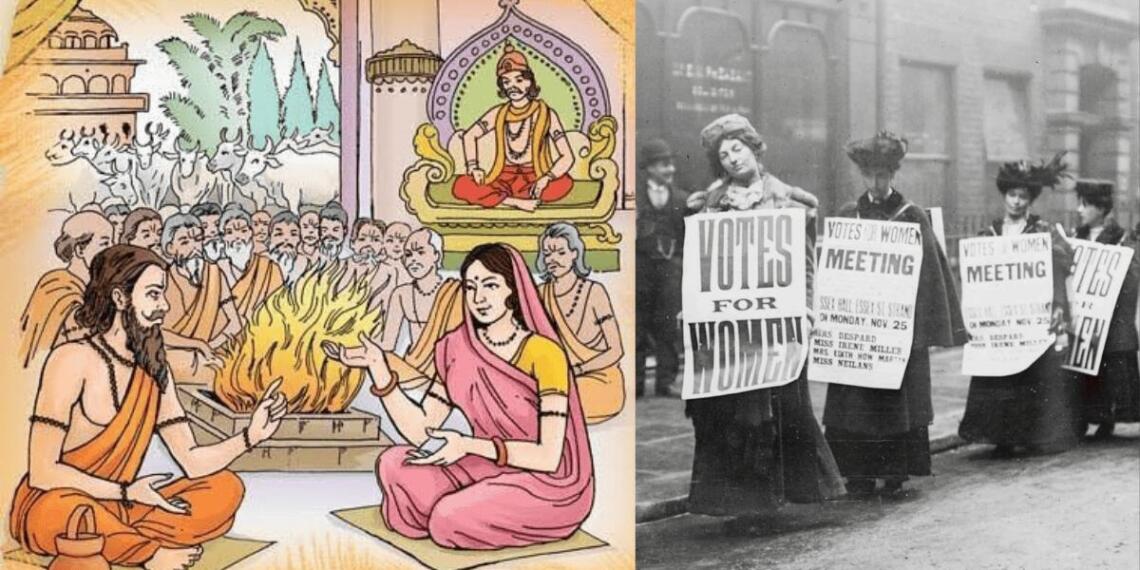
However, in the 19th and 20th centuries, due to feminist movements, the suffragette movement, and social reforms, this perception changed and women realized that they needed to fight directly for their rights and status. The Suffragette Movement was an influential movement in Britain, America, and other Western countries during the 19th and 20th centuries to secure women’s voting rights. This movement was divided into two parts — the Suffragists, who demanded their rights through peaceful means, and the Suffragettes, who adopted militant and aggressive strategies. In Britain, Emmeline Pankhurst and her daughters Christabel and Sylvia Pankhurst established the Women’s Social and Political Union (WSPU), which carried out hunger strikes, attacks on government buildings, and other militant demonstrations. In 1913, suffragette Emily Davison demonstrated her dedication to the movement by jumping in front of the horse of King George V of England. Eventually, in Britain, women above the age of 30 received the right to vote in 1918, and all women above the age of 21 received voting rights in 1928.

Similarly, in the United States, the movement that began with the Seneca Falls Convention of 1848 secured women’s voting rights in 1920 through the 19th Constitutional Amendment. This movement strengthened women’s political participation and laid the foundation for other movements related to women’s rights in the 20th and 21st centuries. The Suffragette Movement was not only a struggle to obtain voting rights, but it also proved to be a revolutionary step toward ensuring gender equality and women’s social and political rights.

The perspective toward women in Indian civilization and culture appears quite different from Western civilization. In Vedic civilization, the status of women was equal to that of men. During the Rigvedic period, women had rights equal to men. They participated in education, politics, philosophy, and religious rituals. Women had the right to study the Vedas and discuss the Upanishads. For example, learned women such as Gargi and Maitreyi discussed Brahma-knowledge (Brihadaranyaka Upanishad 2.4, 3.6).
Apala was a famous female sage of the Rigveda, who made important contributions to the Vedas. She is among the few women who were recognized as Vedic sages.  In the eighth mandala of the Rigveda, a hymn composed by her (Apala Sukta) is included.

In marriage, there was the tradition of Swayamvara, in which women could choose their husbands themselves (Ramayana, Mahabharata). The Atharvaveda (14.1.6) states that the wife was considered the mistress of the household, not merely a servant.

Rigveda (10.85.46) states that a woman should be given equal status in society. Manusmriti (3.56) mentions: “Yatra naryastu pujyante ramante tatra devatah,” meaning where women are respected, the gods reside there. The roles of women as pativrata, grihalakshmi, and mother were honored.

During the later Vedic and medieval periods, the status of women began to decline. During the later Vedic period and the Gupta period (300-600 AD), the position of women started becoming somewhat weaker.

After foreign Muslim invasions (8th century), serious concerns about women’s safety arose in Indian society, as a result of which the purdah system became more prevalent. To protect women from invaders, they were confined to homes, which led to a decline in their social participation. Child marriage and many incidents of sati also continued to reflect the condition of women. In addition, women’s education and rights also declined greatly. Because they were deprived of educational opportunities, their participation in religious and social matters became limited, and the interpretation of religious texts came under male control, which further restricted women’s rights.

This was the period when Smriti texts spread widely. The Smriti texts continued to present a standard of social conduct in that society. While Manusmriti considered women worthy of worship, it also kept them under the authority of some man for their protection. It is noteworthy that this does not degrade the status of women but rather ensured their social security in that time. Today it is a different debate whether a woman should remain under the authority of a man or not. In fact, in the Indian tradition, both women and men have remained under each other’s guidance and control.

In the dialogue between Yajnavalkya and Maitreyi, when Yajnavalkya leaves for Vanaprastha, he seeks permission from Maitreyi. In Indian tradition, a man going to Vanaprastha was required to take permission from his wife. Later, this very dialogue appeared in the form of the Brihadaranyaka Upanishad.

According to Manusmriti (5.148),
“Father protects her in childhood, husband protects her in youth,
and son protects her in old age; a woman is not fit for independence.”

In today’s time, this may appear as male control over women, but here the responsibility is given to men that they must always protect their wife, mother, and sister. In Indian tradition, the festival of Raksha Bandhan is a festival of brother and sister, where in exchange for the sacred thread the brother takes a vow to protect his sister.

During the medieval period, women’s status began to improve again through Bhakti movements. During the Bhakti movement (13th-17th centuries), women such as Mirabai, Akka Mahadevi, and Sant Janabai played an important role in spreading spiritual awareness in society. During this period, women received religious freedom, but their social status did not improve significantly.

In the 19th century, women’s reform movements awakened a new consciousness regarding women’s rights. Through the efforts of Raja Ram Mohan Roy, Lord William Bentinck declared the practice of sati illegal in 1829. Ishwar Chandra Vidyasagar promoted widow remarriage, which resulted in the Widow Remarriage Act of 1856. During the same time, Jyotiba Phule and Savitribai Phule opened the first school for women’s education in 1848.

In the 20th century, further reforms regarding women’s rights took place. Mahatma Gandhi inspired women’s participation in the freedom struggle, due to which they became active participants in social movements. In 1950, the Indian Constitution granted women equality (Article 14), equal pay (Article 39), and the right to education (Article 21A). The Hindu Marriage Act (1955) prohibited polygamy. In contemporary India, legal reforms such as the Dowry Prohibition Act (1961), the Maternity Benefit Act (1961), and the Domestic Violence Act (2005) were implemented.

Among women’s achievements are Indira Gandhi becoming the first woman Prime Minister of India (1966-1977, 1980-1984), the contributions of Kalpana Chawla and Sunita Williams in space missions, and the international achievements of athletes such as PV Sindhu, Mary Kom, and Saina Nehwal, who have brought pride to India at the global level. Today, by placing a woman from the tribal community in the highest office of India, the country is moving toward restoring its ancient cultural glory where the same Brahman is seen in everyone. There is a need to abandon all forms of discrimination and provide equal opportunities for all so that the overall upliftment of society can be ensured. This will be the foundation of the sustainability of society.

(Dr. Alok Kumar Dwivedi holds a PhD in Philosophy from Allahabad University. Currently he is working as an Assistant Professor at KSAS, Lucknow. This institution is the India-based research center of INADS, USA. Dr. Alok’s interests include philosophy, culture, society, and politics.)

Tags: Feminism and Vedic TraditionGargi and MaitreyiGender Equality DebateGender Equality in Ancient IndiaHistory of Women EmpowermentIndian Culture and WomenInternational Women's DayInternational Women’s Day HistoryManusmriti and WomenRigveda Women ScholarsRole of Women in Vedic SocietySuffragette Movement HistoryVedic Civilization and WomenVedic Women RightsWestern Feminism vs Vedic ThoughtWestern vs Vedic PhilosophyWomen Education in Vedic AgeWomen Empowerment Global PerspectiveWomen Empowerment HistoryWomen Empowerment in IndiaWomen in Ancient CivilizationsWomen in Hindu ScripturesWomen in UpanishadsWomen in Vedic AgeWomen Leadership in IndiaWomen Rights Debate IndiaWomen Rights EvolutionWomen Rights in Ancient IndiaWomen Rights in Hindu TraditionWomen Status Comparative CivilizationWomen Status in Vedic PeriodWomen Status in Western CivilizationWomen Voting Rights Historywomen's empowerment
ShareTweetSend
Previous Post

US Acknowledges India’s Role as Russian Oil Purchases Help Stabilise Global Energy Markets

Next Post

India Storm to Third T20 World Cup Title with 96-Run Rout of New Zealand

Related Posts

Tibetans and Unbroken Cry of Tibet: Memory, Resistance, Weight of Silence
Analysis

Tibetans and Unbroken Cry of Tibet: Memory, Resistance, Weight of Silence

11 March 2026

March 10 is a date that Tibetans carry with them wherever they go, returning each year with a quiet...

Top International Healthcare Jobs and Global Demand Trends in 2026
Education

Top International Healthcare Jobs and Global Demand Trends in 2026

26 February 2026

Over the past few years, healthcare has become one of the most globally connected career fields. Hospitals around the...

Kerala to Become ‘Keralam’? Centre May Give Nod Following Assembly Approval
Culture

Kerala to Become ‘Keralam’? Centre May Give Nod Following Assembly Approval

24 February 2026

The Union Cabinet is likely to consider a bill today proposing to change the name of Kerala to “Keralam”,...

Load More

Leave a Reply Cancel reply

Your email address will not be published. Required fields are marked *

I agree to the Terms of use and Privacy Policy.
This site is protected by reCAPTCHA and the Google Privacy Policy and Terms of Service apply.

Currently Playing

Truth of IRIS Dena: 8 Days That Changed Narrative | War zone Reality, Not an Indian Navy Exercise

Truth of IRIS Dena: 8 Days That Changed Narrative | War zone Reality, Not an Indian Navy Exercise

00:08:02

300 Million Euros for SCALP: Strategic Necessity or Costly Dependency on France300

00:04:06

Tejas Mk1A: 19th aircraft coupled but Not Delivered: What Is Holding Back the IAF Induction?

00:07:21

Agni-3 Launch Decoded: Why Test an Active Nuclear Missile That’s Already Deployed?

00:05:05

India’s Swadesi ‘Meteor’: World’s Most Lethal BVR Missile | Gandiv| SFDR | DRDO

00:06:48
Facebook Twitter Instagram Youtube
tfipostTfipost.com
Right Wing | News Analysis | Indian Opinion
  • About us
  • Contact Us
  • Careers
  • Brand Partnerships
  • Terms of use
  • Privacy Policy
  • Sitemap

©2026 TFI Media Private Limited

No Result
View All Result
  • Premium
  • Politics
    • Analysis
    • Opinions
    • Trending
  • Economy
    • Business
    • Finance
  • Defense
    • Defence
    • Strategy
    • Weaponry
  • Geopolitics
    • Africa
    • Americas
    • Asia Pacific
    • Europe
    • South Asia
    • West Asia
  • Knowledge
    • Culture
    • History
    • Indology
  • Law
  • Lounge
    • Books
    • Cinema
    • Food
    • Health
    • Sports
    • technology
    • Travel
    • Satire
TFIPOST हिन्दी
TFIPOST Global

©2026 TFI Media Private Limited

