
























RelatedPosts
Maharashtra appears close to ending one of the longest-running insurgencies in its security history, with authorities indicating that Maoist activity in Gadchiroli has almost completely collapsed. Once considered the nerve centre of Left-wing extremism in central India, the district has not witnessed any major insurgent movement since February 2026.
Police say the militant network in the region has been reduced to just six cadres. According to officials, five of them are believed to have crossed into the area from neighbouring Chhattisgarh, while one is a local operative from Gadchiroli. All are currently believed to be confined to the Abujmarh forest belt along the inter-state border.
Gadchiroli Superintendent of Police Neelotpal said the police are attempting to persuade the remaining cadres to surrender and return to civilian life. If they refuse, security forces may launch operations against them.
Wave of Surrenders Weakens Maoist Structure
A large number of Maoists abandoning the movement has played a decisive role in weakening the insurgency. Under the state’s surrender and rehabilitation policy, 794 Maoists have laid down arms so far. The year 2025 alone saw a record 112 surrenders.
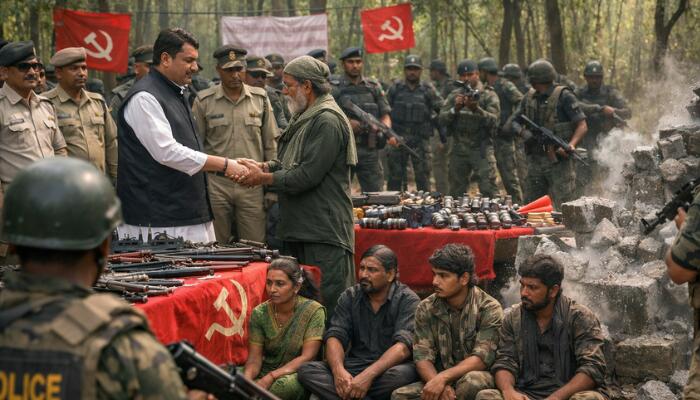
One of the most consequential developments took place on October 15, 2025, when Mallojula Venugopal, also known as Bhupati and a member of the Maoist politburo, surrendered along with 61 associates and 54 weapons in the presence of Chief Minister Devendra Fadnavis. The event was widely seen by security agencies as a major setback for the Maoist leadership structure.
Gadchiroli has been central to this shift. Since the beginning of last year, 123 hardened Maoist cadres have surrendered in the district. In March 2026, another 11 senior cadres carrying a combined bounty of ₹68 lakh also laid down arms. The group included divisional committee members and field commanders who once played key roles in the insurgent network.
Meanwhile, Gondia district has already been declared free of Maoist activity.
Systematic Operations Changed the Ground Situation
Security officials say the turnaround in Gadchiroli has been swift. Until January 1, 2024, the entire district was listed in police records as Maoist-affected. Security forces initially concentrated on clearing North Gadchiroli before gradually dismantling the armed dalams operating across the region by mid-2025.
The last significant armed formation in the area, known as Company No. 10, was eliminated earlier this year following a fierce encounter. In that operation, Maoist leader Prabhakar, who carried a bounty of ₹26 lakh, was killed along with several armed cadres. One commando also lost his life during the encounter.
Security Presence Expands Across Remote Areas
The crackdown on insurgents has been accompanied by a major expansion of policing infrastructure. Under the supervision of DIG Ankit Goyal and IG of the State Anti-Naxal Operations Sandip Patil, the police have increased their footprint in remote parts of the district.
Over the past three years, 11 new police outposts have been established in areas that were earlier difficult to access. The most recent outpost was inaugurated at Bangadi on March 19. Officials say the move has closed a long-standing security gap covering nearly 3,000 square kilometres, enabling faster deployment of forces across the district.
In a major symbolic move earlier this year, around 800 personnel from Gadchiroli Police, the Central Reserve Police Force and the elite C-60 commandos carried out a coordinated operation on February 18, demolishing 44 Maoist memorials in a single day. The structures were located in areas including Etapalli, Hedri, Bhamragad, Jimalgatta, Dhanora and Pendhari and were once used to project Maoist influence and intimidate villagers.
A Conflict That Took Heavy Human Cost
Despite the recent progress, the conflict has left a deep scar. Over the years, 244 police personnel in Maharashtra have been killed in Maoist violence, while 602 civilians have also lost their lives.
The insurgency continues to persist in neighbouring states. Security agencies estimate that around 50 armed Maoists remain active in Chhattisgarh and about 60 in Jharkhand, although surrender drives are underway there as well.
According to SP Neelotpal, Maharashtra’s success reflects a combination of sustained security operations, development initiatives, improved policing infrastructure and rehabilitation programmes aimed at reintegrating former militants.
If the remaining six cadres surrender or are neutralised in the coming days, officials believe Maharashtra could finally put an end to nearly five decades of Maoist presence in the state.