























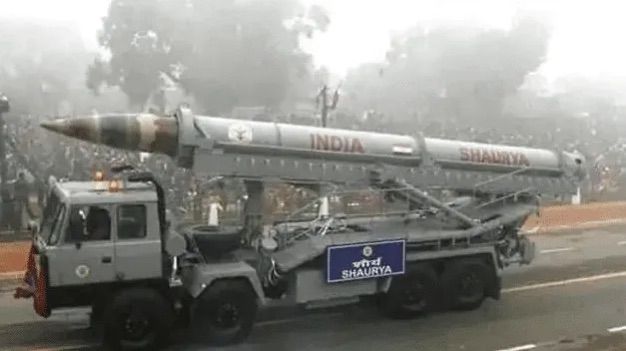
India’s Defence Research and Development Organisation (DRDO) is preparing to test a next-generation (NG) version of the Shaurya surface-to-surface hypersonic missile.
Designed for fast and highly accurate strikes, the upgraded missile will be launched from a canister-based system and is expected to significantly improve its ability to evade advanced enemy missile defence systems, especially during the final phase of its flight.
The original Shaurya missile, considered the land-based counterpart of the submarine-launched K-15 Sagarika missile was first tested in 2008 and has a strike range of 700 to 1,000 kilometres. It is a key component of India’s strategic deterrence and was developed to support the country’s nuclear triad under the Strategic Forces Command.
Shaurya travels at hypersonic speeds and is stored in a canister, allowing it to be launched quickly from mobile platforms with minimal preparation. Unlike traditional ballistic missiles that follow a fixed trajectory, Shaurya uses a pseudo-ballistic path, enabling it to change direction mid-flight and making interception extremely difficult.
A major focus of the Shaurya NG trials is the integration of an indigenous multi-mode seeker designed to operate in extreme hypersonic conditions. As the missile travels at speeds exceeding Mach 7 (over 8,500 km/h), it generates intense heat and forms a plasma sheath around it. This ionised layer can block radio signals and disrupt conventional guidance systems.
To address this, DRDO has combined Active Radar and Imaging Infrared (IIR) technologies into a single seeker system. Successfully demonstrating its ability to track targets despite plasma interference would mark a significant advancement in India’s hypersonic guidance capability.
The NG version also features improved manoeuvrability during the terminal phase—the last 30 to 60 seconds before impact. During this stage, the missile performs sharp, high-G “jinking” movements. At speeds of about 2.5 kilometres per second, these rapid directional changes make it extremely difficult for modern missile defence systems to intercept.
The missile’s survivability is further enhanced by its unique flight profile. After launch, it climbs to around 50 kilometres in altitude and then levels off to travel horizontally within the upper atmosphere instead of moving into space.
At speeds reaching Mach 7.5, it uses aerodynamic fins for continuous control, making it hard for enemy radar systems to predict its target until the final moments.
Upgrades have also been made to its launch and storage systems. The Shaurya uses a “cold launch” mechanism, where a gas generator ejects the missile from its canister before the main engine ignites mid-air, reducing stress on the launch platform.
The upcoming tests will also assess a newly developed composite canister that requires minimal maintenance. According to programme estimates, this canister will allow the missile to remain operationally ready for 10 to 15 years.
Additionally, the missile can be deployed on a Transporter Erector Launcher (TEL) and made ready for launch in under five minutes, providing high mobility and rapid response capability.
Overall, the development of the Shaurya NG reflects DRDO’s continued efforts to strengthen India’s strategic deterrence against increasingly advanced global missile defence systems. By combining the speed of a ballistic missile with the precision of a cruise missile, the upgraded platform is expected to ensure a reliable and survivable strike capability for the future.