














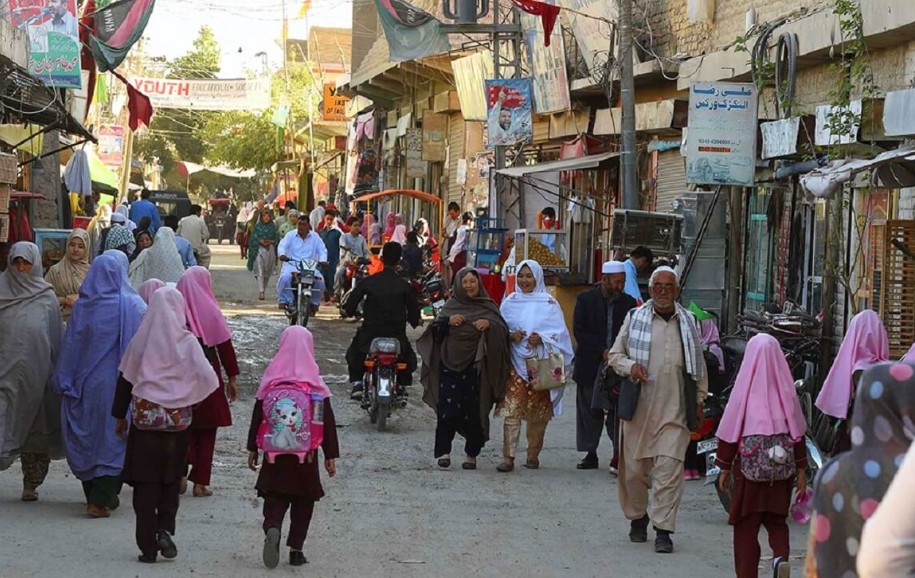
Balochistan finds itself at the crossroads of the ambitions of great powers and the lived experience of people fighting to maintain their identity and rights.
The commemoration of Baloch Culture Day that took place on 2nd March, in Pakistan and the Baloch diaspora around the world, is a celebration of their heritage even as it is a condemnation of the brutal suppression of that heritage.
Geopolitical Focal Point
Balochistan’s coastline, anchored by Gwadar, places the province relatively close to the Strait of Hormuz, widely estimated at roughly 200 to 400 kilometres away depending on the measurement through which around one-fifth of global oil supplies transit, making the region a natural node in energy and trade corridors.
This geography has turned Gwadar into the flagship of the China–Pakistan Economic Corridor (CPEC), promising to shorten China’s route to the Arabian Sea and embed Beijing more deeply in the Indian Ocean.
For Islamabad and Beijing, Balochistan is not a periphery but a gateway, yet for many Baloch it has become a militarised transit zone rather than a homeland.
Port infrastructure, highways, and security perimeters have expanded far more quickly than schools, hospitals, or representative local institutions, reinforcing the sense that development is being done to the people, not for them.
Resource Wealth and Local Exclusion
The province is endowed with gas, minerals, fishing resources, and coastline, but the financial benefits of these resources accrue more to the federal government in Islamabad and foreign interests than to the Baloch themselves.
While the Gwadar initiative and other projects under the umbrella of CPEC were expected to bring enormous strategic and economic benefits to the country, the provision of employment, infrastructure, and social services to the local population has fallen short of expectations.
This dynamic of extraction without empowerment continues to breed distrust and fuel the politics of internal colonialism, where resources are securitised but the people are treated as an afterthought.
The disconnect between the promise of prosperity and the reality of dispossession ensures that even projects that are intended to be the engines of “national development” are viewed with skepticism.
Human Rights and Enforced Disappearances
In this context of strategic hubris, the reality of life in Balochistan is one of forced disappearances, extrajudicial executions, and a general atmosphere of terror.
Thousands of cases of missing persons have been recorded by Pakistan’s Commission of Inquiry on Enforced Disappearances and cited by human rights organisations, while UN special procedures have repeatedly raised alarm about enforced disappearances in Balochistan and urged accountability. The use of counter-terrorism policies in the region has been found to systematically breach international human rights norms.
Recent reports describe continued abductions of students, activists, and professionals of Baloch origin, with families protesting for years in search of information about their loved ones, often facing intimidation themselves.
UN special procedures have explicitly urged Pakistan to criminalise enforced disappearances, ensure independent investigations, and stop conflating peaceful minority-rights advocacy with terrorism, noting internet shutdowns, clampdowns on protests, and violence against demonstrators in Balochistan.
Cultural Assertion Amid Repression
Baloch Culture Day has been widely observed since around 2010 as a deliberate statement of identity in a situation where Baloch culture was seen to be threatened and misrepresented from multiple directions.
Every year, Baloch people from across Balochistan, as well as from other cities such as Karachi and Dera Ghazi Khan, assemble in their traditional attire, singing and dancing to their music, all in celebration of their culture, history, and traditions, even as the specter of violence and repression looms large over these festivities.
For those families who have lost loved ones to violence and disappearance, the day is also a day of mourning, a reminder that the struggle for cultural survival is inextricably linked to political and human rights.
This ambivalence of Baloch Culture Day, as both celebration and mourning, encapsulates the paradox of a state that promotes carefully curated cultural events even as it suppresses dissent and demands for justice.
Grievances of Representation and Participation
The root cause of Baloch dissatisfaction is the demand for proper representation in the decision-making process that affects their homeland, whether it is the allocation of port concessions, mining rights, or security actions and demographic changes.
The most important discussions on CPEC, the administration of Gwadar and large-scale mining projects are largely conducted between the federal government and foreign entities, with limited visible participation from elected provincial institutions and local communities.
This lack of representation leads to dissatisfaction on issues of revenue sharing, job quotas, and land, water, and coastal area rights, further fueling the impression that ordinary Baloch are being reduced to mere spectators in the process affecting their own province.
When local demonstrations about missing persons or environmental and livelihood issues are responded to with arrests, force, or communication blackouts, it becomes clear that not only resources but the very process of decision-making is being centralised and securitised.
Security Narratives Versus Rights
The security establishment in Pakistan maintains a significant presence in Balochistan in response to attacks by militants on infrastructure, security forces, and foreign-linked projects in the province.
However, UN experts and human rights groups have warned that blanket counter-insurgency measures such as enforced disappearances, torture, collective punishment and stigmatisation of peaceful activists are inconsistent with international human rights law and risk deepening alienation.
By blurring the lines between insurgents, critics, and cultural activists, the state not only expands the circle of alienation but also seeks to undermine the very same legitimacy that it purports to protect.
This policy renders strategic assets like Gwadar into “islands” heavily ringed with security, which are surrounded by a sea of resentful citizens, pushing the costs of security and the prospects of stability further away.
Towards Inclusive and Rights-Respecting Strategies
If Balochistan is to be a genuine and stable corridor between South Asia, Central Asia and the Middle East, it is necessary to ensure that infrastructure development is accompanied by institutional changes that put local voices at the forefront rather than pushing them to the margins.
This is necessary for ensuring transparent revenue-sharing arrangements, firm commitments to local employment and skill-building, environmental protection for fisheries and vulnerable ecosystems and constitutional guarantees for land rights that cannot be set aside by non-transparent security or economic considerations.
It is also essential to move immediately from force to consent, from the denial of rights to their assertion. This includes an end to enforced disappearances, cooperation with independent investigations, a lifting of general restrictions on assembly and expression, and direct engagement with peaceful movements and civil society, including those that demand accountability.
The message of dignity and continuity on Baloch Culture Day can then be accompanied by a political order that sees cultural identity and dissent, rather than threats, as the basis of a genuinely federal, plural, and stable Pakistan.
For international players, ranging from China to Gulf nations and Western investors, the long-term stability of Balochistan cannot be remotely managed through barbed wire and military presence, but through the consent and empowerment of the people whose territory is the foundation of such projects.
International actors who benefit from Balochistan’s geographical position and resources share a responsibility to encourage adherence to human rights standards, proper consultation, and equitable development, rather than viewing governance irregularities as a cost of doing business.
At the end of the day, geopolitics and empowerment are not competing agendas but complementary ones: a corridor based on fear will always be fragile, but one based on rights, representation, and respect for cultural identity is the only viable route to regional connectivity and peace.
In Balochistan, listening to the voices of the people is not an act of charity; it is the minimum requirement for any strategy that aspires to be both visionary and just.