


















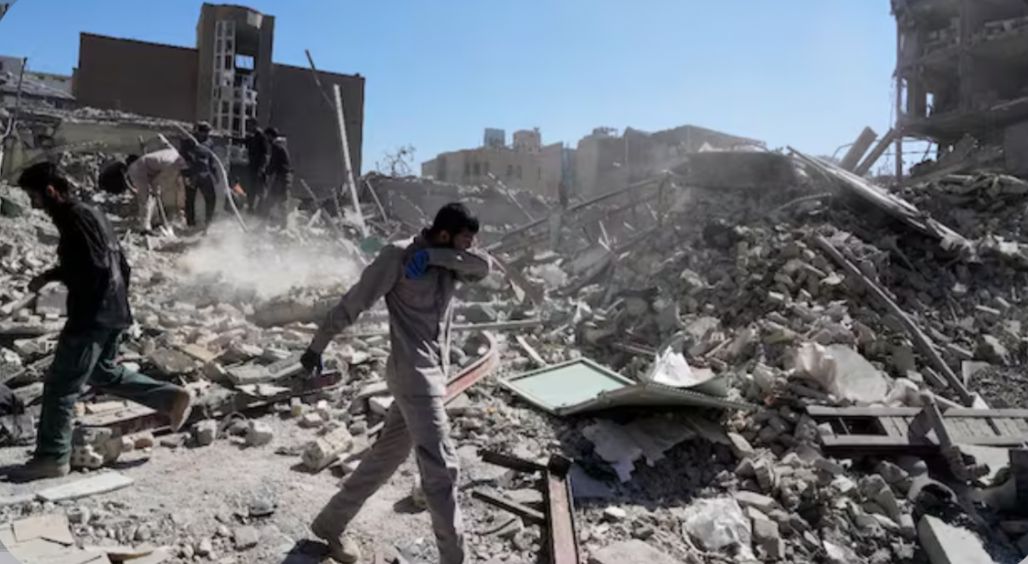
Amid the escalating conflict in West Asia, the Ministry of External Affairs (MEA) on Monday confirmed that eight Indian nationals have lost their lives, while one person remains missing in separate incidents across the region.
As per media reports, an inter-ministerial briefing, Additional Secretary (Gulf), MEA, Aseem R Mahajan, provided an update on the situation, noting a rise in casualties compared to the previous briefing on March 20, when six deaths and one missing person had been reported.
He also informed that an Indian national was killed in Kuwait on Sunday, though details surrounding the incident were not disclosed.
“Yesterday, an Indian national unfortunately lost his life in an attack in Kuwait. We express our deepest condolences to the family of the deceased. Our Mission in Kuwait is in touch with the family of the deceased and is coordinating closely with the local authorities to render all support and for the early return of his mortal remains to India,” Aseem R Mahajan said.
Separately, the Indian Embassy in Saudi Arabia reported that another Indian national was killed in Riyadh due to the “recent events of March 18.”
Evacuation Efforts and Travel Updates
The MEA said that since February 28, around 5.5 lakh passengers have returned to India from the region.
Flight operations, though limited, are ongoing. Around 85 flights were expected from the UAE to India on Monday. Services are also running from Saudi Arabia and Oman, while Qatar Airways planned to operate about 10 flights to India on March 30 after partial reopening of its airspace.
However, Kuwait and Bahrain airspace remain closed. In response, airlines from these countries are operating special flights from Saudi Arabia to India.
Authorities are also facilitating alternative travel routes such as from Iran via Armenia and Azerbaijan, from Israel via Egypt and Jordan, from Iraq through Jordan and Saudi Arabia and from Kuwait and Bahrain through Saudi Arabia.
Government Response and Community Support
The MEA reiterated that it is closely monitoring the situation and continues to call for restraint and dialogue.
“We continue to call for restraint and de-escalation, and at the same time emphasise on dialogue and diplomacy, as a means to an early end to the conflict,” MEA spokesperson Randhir Jaiswal said.
Prime Minister Narendra Modi also spoke with Saudi Crown Prince and Prime Minister Mohammed bin Salman on March 28, discussing the ongoing conflict and stressing the importance of maintaining freedom of navigation. He also reiterated India’s condemnation of attacks on energy infrastructure.
Mahajan emphasised that the safety and welfare of Indians in the region remain the government’s top priority. Missions across West Asia are operating 24×7 helplines, issuing advisories, and staying in constant touch with the Indian community.
Special attention is also being given to students affected by exam disruptions, with boards like CBSE already announcing alternative assessment schemes. Additionally, Indian seafarers in the region are being supported through continuous engagement by Indian missions.