














TFIPOST हिन्दी
TFIPOST Global
Tfipost.com
Tfipost.com
No Result
View All Result
  • Premium
  • Politics
    • All
    • Analysis
    • Opinions
    • Trending
    When a Gold Story Turned Into Dust: Bloomberg Retraction, RBI’s Clarification, and the Debate Over Narrative First Journalism

    When a Gold Story Turned Into Dust: Bloomberg Retraction, RBI’s Clarification, and the Debate Over Narrative First Journalism

    Is Lalit Modi Back? Kochi IPL Controversy Returns With Fresh Claims Over Tharoor Pushkar and Political Pressure

    Is Lalit Modi Back? Kochi IPL Controversy Returns With Fresh Claims Over Tharoor Pushkar and Political Pressure

    “Not 1962, Not China”: Pema Khandu Reasserts Tibet Border Claim, Dismisses Beijing’s Arunachal Assertions

    “Not 1962, Not China”: Pema Khandu Reasserts Tibet Border Claim, Dismisses Beijing’s Arunachal Assertions

    Tiananmen Square, Rajiv Gandhi, China, Congress, Doordarshan

    When Rajiv Gandhi told Doordarshan to tone down its coverage on Tiananmen Square Massacre in China

    • Analysis
    • Opinions
    • Trending
  • Economy
    • All
    • Business
    • Economy1
    • Finance
    When a Gold Story Turned Into Dust: Bloomberg Retraction, RBI’s Clarification, and the Debate Over Narrative First Journalism

    When a Gold Story Turned Into Dust: Bloomberg Retraction, RBI’s Clarification, and the Debate Over Narrative First Journalism

    India Joins Global Digital Elite, Climbs Into Fifth Spot as AI Revolution and Digital Infrastructure Reshape Economy

    India Joins Global Digital Elite, Climbs Into Fifth Spot as AI Revolution and Digital Infrastructure Reshape Economy

    How gaming merchants choose a payment gateway in India

    How gaming merchants choose a payment gateway in India

    The Informal Economy Pays the Price: Street Traders, Small Shops and the Hidden Cost of Trade Policy

    The Informal Economy Pays the Price: Street Traders, Small Shops and the Hidden Cost of Trade Policy

    • Business
    • Finance
  • Defense
    • All
    • Defence
    • Strategy
    • Weaponry
    “Not 1962, Not China”: Pema Khandu Reasserts Tibet Border Claim, Dismisses Beijing’s Arunachal Assertions

    “Not 1962, Not China”: Pema Khandu Reasserts Tibet Border Claim, Dismisses Beijing’s Arunachal Assertions

    Rudram-2 Passes Crucial Combat Trial, India Moves Closer to Indigenous SEAD Dominance

    Rudram-2 Passes Crucial Combat Trial, India Moves Closer to Indigenous SEAD Dominance

    Rajesh Kumar Singh Reveals Vietnam BrahMos Deal, Indonesia Agreement in Final Stages

    Rajesh Kumar Singh Reveals Vietnam BrahMos Deal, Indonesia Agreement in Final Stages

    Delhi Police Arrest Nine Linked to ISI-Dawood Network; Nuclear Facilities, Airports and Railway Stations Among Targets

    Delhi Police Arrest Nine Linked to ISI-Dawood Network; Nuclear Facilities, Airports and Railway Stations Among Targets

    • Defence
    • Strategy
    • Weaponry
  • Geopolitics
    • All
    • Africa
    • Americas
    • Asia Pacific
    • Europe
    • South Asia
    • West Asia
    Why Russia Trusts India: Putin Dismisses Western Pressure on Modi, Backs New Delhi’s Independent Foreign Policy

    Why Russia Trusts India: Putin Dismisses Western Pressure on Modi, Backs New Delhi’s Independent Foreign Policy

    India and Venezuela Signal Energy Recalibration as Rodríguez Visits New Delhi for Crucial Talks

    India and Venezuela Signal Energy Recalibration as Rodríguez Visits New Delhi for Crucial Talks

    Iranian President Pezeshkian Sent Resignation to Supreme Leader, Says IRGC Has Taken Control of State Power

    Iranian President Pezeshkian Sent Resignation to Supreme Leader, Says IRGC Has Taken Control of State Power

    AK-47 Funeral for Pulwama Plotter Exposes Fractures Inside Pakistan’s Terror Networks

    AK-47 Funeral for Pulwama Plotter Exposes Fractures Inside Pakistan’s Terror Networks

    • Africa
    • Americas
    • Asia Pacific
    • Europe
    • South Asia
    • West Asia
  • Knowledge
    • All
    • Culture
    • Education
    • History
    • Indology
    Who Killed Akanksha ? How Many More Students Will Pay the Price for Education Mafias and Paper-Leak Rackets?

    Who Killed Akanksha ? How Many More Students Will Pay the Price for Education Mafias and Paper-Leak Rackets?

    June 3, 1947 Revisited: Nishikant Dubey Blames Nehru-Gandhi Family for Partition and Kashmir Crisis

    June 3, 1947 Revisited: Nishikant Dubey Blames Nehru-Gandhi Family for Partition and Kashmir Crisis

    CBSE OSM Fallout Deepens as 4 Lakh Students Rush for Re-evaluation, Raising Serious Questions on Digital Checking System

    CBSE OSM Fallout Deepens as 4 Lakh Students Rush for Re-evaluation, Raising Serious Questions on Digital Checking System

    Veer Savarkar

    When Nehru Government Imprisoned Veer Savarkar for the Pakistani Prime Minister

    • Culture
    • History
    • Indology
  • Law
  • Lounge
    • All
    • Books
    • Cinema
    • Entertainment
    • Food
    • Games
    • Health
    • Lifestyle
    • Satire
    • Sports
    • technology
    • Travel
    Erythrocyte Sedimentation Rate (ESR) Test: Meaning, Normal Range & Uses

    Erythrocyte Sedimentation Rate (ESR) Test: Meaning, Normal Range & Uses

    Inside the World of Elite Matchmaking in India

    Inside the World of Elite Matchmaking in India

    Best Salicylic Acid Face Wash for Oily & Acne-Prone Skin

    Best Salicylic Acid Face Wash for Oily & Acne-Prone Skin

    Supreme Court Verdict Crushes Opposition’s SIR Narrative, Reasserts Election Commission’s Constitutional Authority

    Judicial Expansion at the Apex: Centre Clears Appointment of Five Judges to Supreme Court, Strength Nearing Full Capacity

    • Books
    • Cinema
    • Food
    • Health
    • Sports
    • technology
    • Travel
    • Satire
Tfipost.com
  • Premium
  • Politics
    • All
    • Analysis
    • Opinions
    • Trending
    When a Gold Story Turned Into Dust: Bloomberg Retraction, RBI’s Clarification, and the Debate Over Narrative First Journalism

    When a Gold Story Turned Into Dust: Bloomberg Retraction, RBI’s Clarification, and the Debate Over Narrative First Journalism

    Is Lalit Modi Back? Kochi IPL Controversy Returns With Fresh Claims Over Tharoor Pushkar and Political Pressure

    Is Lalit Modi Back? Kochi IPL Controversy Returns With Fresh Claims Over Tharoor Pushkar and Political Pressure

    “Not 1962, Not China”: Pema Khandu Reasserts Tibet Border Claim, Dismisses Beijing’s Arunachal Assertions

    “Not 1962, Not China”: Pema Khandu Reasserts Tibet Border Claim, Dismisses Beijing’s Arunachal Assertions

    Tiananmen Square, Rajiv Gandhi, China, Congress, Doordarshan

    When Rajiv Gandhi told Doordarshan to tone down its coverage on Tiananmen Square Massacre in China

    • Analysis
    • Opinions
    • Trending
  • Economy
    • All
    • Business
    • Economy1
    • Finance
    When a Gold Story Turned Into Dust: Bloomberg Retraction, RBI’s Clarification, and the Debate Over Narrative First Journalism

    When a Gold Story Turned Into Dust: Bloomberg Retraction, RBI’s Clarification, and the Debate Over Narrative First Journalism

    India Joins Global Digital Elite, Climbs Into Fifth Spot as AI Revolution and Digital Infrastructure Reshape Economy

    India Joins Global Digital Elite, Climbs Into Fifth Spot as AI Revolution and Digital Infrastructure Reshape Economy

    How gaming merchants choose a payment gateway in India

    How gaming merchants choose a payment gateway in India

    The Informal Economy Pays the Price: Street Traders, Small Shops and the Hidden Cost of Trade Policy

    The Informal Economy Pays the Price: Street Traders, Small Shops and the Hidden Cost of Trade Policy

    • Business
    • Finance
  • Defense
    • All
    • Defence
    • Strategy
    • Weaponry
    “Not 1962, Not China”: Pema Khandu Reasserts Tibet Border Claim, Dismisses Beijing’s Arunachal Assertions

    “Not 1962, Not China”: Pema Khandu Reasserts Tibet Border Claim, Dismisses Beijing’s Arunachal Assertions

    Rudram-2 Passes Crucial Combat Trial, India Moves Closer to Indigenous SEAD Dominance

    Rudram-2 Passes Crucial Combat Trial, India Moves Closer to Indigenous SEAD Dominance

    Rajesh Kumar Singh Reveals Vietnam BrahMos Deal, Indonesia Agreement in Final Stages

    Rajesh Kumar Singh Reveals Vietnam BrahMos Deal, Indonesia Agreement in Final Stages

    Delhi Police Arrest Nine Linked to ISI-Dawood Network; Nuclear Facilities, Airports and Railway Stations Among Targets

    Delhi Police Arrest Nine Linked to ISI-Dawood Network; Nuclear Facilities, Airports and Railway Stations Among Targets

    • Defence
    • Strategy
    • Weaponry
  • Geopolitics
    • All
    • Africa
    • Americas
    • Asia Pacific
    • Europe
    • South Asia
    • West Asia
    Why Russia Trusts India: Putin Dismisses Western Pressure on Modi, Backs New Delhi’s Independent Foreign Policy

    Why Russia Trusts India: Putin Dismisses Western Pressure on Modi, Backs New Delhi’s Independent Foreign Policy

    India and Venezuela Signal Energy Recalibration as Rodríguez Visits New Delhi for Crucial Talks

    India and Venezuela Signal Energy Recalibration as Rodríguez Visits New Delhi for Crucial Talks

    Iranian President Pezeshkian Sent Resignation to Supreme Leader, Says IRGC Has Taken Control of State Power

    Iranian President Pezeshkian Sent Resignation to Supreme Leader, Says IRGC Has Taken Control of State Power

    AK-47 Funeral for Pulwama Plotter Exposes Fractures Inside Pakistan’s Terror Networks

    AK-47 Funeral for Pulwama Plotter Exposes Fractures Inside Pakistan’s Terror Networks

    • Africa
    • Americas
    • Asia Pacific
    • Europe
    • South Asia
    • West Asia
  • Knowledge
    • All
    • Culture
    • Education
    • History
    • Indology
    Who Killed Akanksha ? How Many More Students Will Pay the Price for Education Mafias and Paper-Leak Rackets?

    Who Killed Akanksha ? How Many More Students Will Pay the Price for Education Mafias and Paper-Leak Rackets?

    June 3, 1947 Revisited: Nishikant Dubey Blames Nehru-Gandhi Family for Partition and Kashmir Crisis

    June 3, 1947 Revisited: Nishikant Dubey Blames Nehru-Gandhi Family for Partition and Kashmir Crisis

    CBSE OSM Fallout Deepens as 4 Lakh Students Rush for Re-evaluation, Raising Serious Questions on Digital Checking System

    CBSE OSM Fallout Deepens as 4 Lakh Students Rush for Re-evaluation, Raising Serious Questions on Digital Checking System

    Veer Savarkar

    When Nehru Government Imprisoned Veer Savarkar for the Pakistani Prime Minister

    • Culture
    • History
    • Indology
  • Law
  • Lounge
    • All
    • Books
    • Cinema
    • Entertainment
    • Food
    • Games
    • Health
    • Lifestyle
    • Satire
    • Sports
    • technology
    • Travel
    Erythrocyte Sedimentation Rate (ESR) Test: Meaning, Normal Range & Uses

    Erythrocyte Sedimentation Rate (ESR) Test: Meaning, Normal Range & Uses

    Inside the World of Elite Matchmaking in India

    Inside the World of Elite Matchmaking in India

    Best Salicylic Acid Face Wash for Oily & Acne-Prone Skin

    Best Salicylic Acid Face Wash for Oily & Acne-Prone Skin

    Supreme Court Verdict Crushes Opposition’s SIR Narrative, Reasserts Election Commission’s Constitutional Authority

    Judicial Expansion at the Apex: Centre Clears Appointment of Five Judges to Supreme Court, Strength Nearing Full Capacity

    • Books
    • Cinema
    • Food
    • Health
    • Sports
    • technology
    • Travel
    • Satire
No Result
View All Result
Tfipost.com
Tfipost.com
No Result
View All Result
  • Premium
  • Politics
  • Economy
  • Defense
  • Geopolitics
  • Knowledge
  • Law
  • Lounge

Why Indians Behave in Metro but Not in Other Transport Systems: Insights from the Economic Survey

TFI Desk by TFI Desk
3 February 2026
in Trending
Why Indians Behave in Metro but Not in Other Transport Systems: Insights from the Economic Survey
Share on FacebookShare on X

RelatedPosts

Metro Beneath Parliament Is Fine, But Beneath a Graveyard? Bhopal Row Exposes India’s Selective Development Politics

Countdown to Budget 2026: What India Wants from the Finance Minister

Appeasement Over Pride : Why Congress Wants ‘St. Mary’ Metro Name, Over Chhatrapati Shivaji Maharaj?

Load More

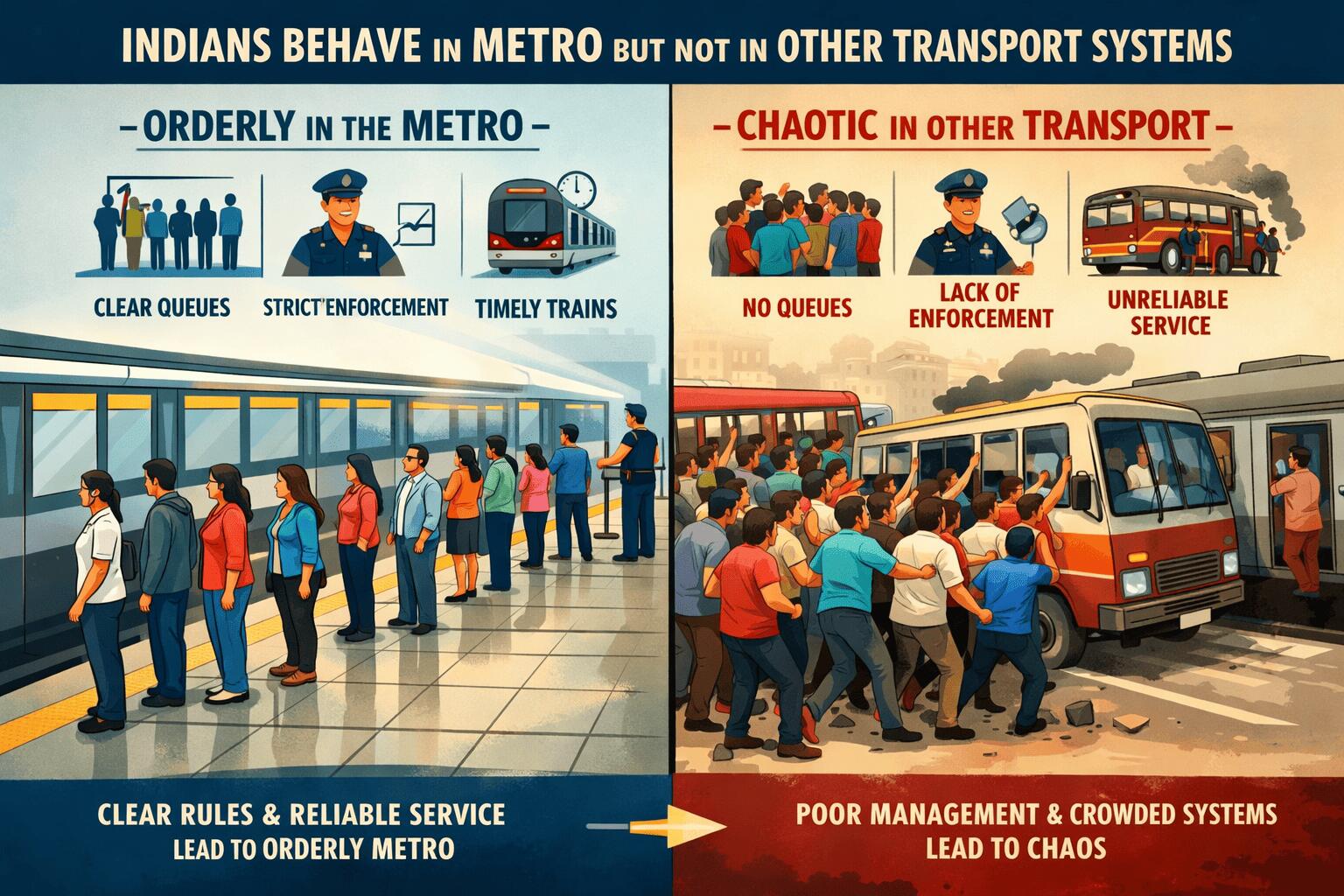
Across Indian cities, a curious pattern of commuter behaviour consistently draws notice: passengers waiting patiently and orderly in metro stations — but becoming impatient, aggressive, or chaotic in other transport systems such as buses, local trains, and roadside queueing for autos. The 2025–26 Economic Survey of India explores this contrast in depth, offering five key explanations that together provide a nuanced understanding of why people behave differently depending on the setting. In addressing this question, the survey reframes the issue not as one of individual morality, but as an outcome shaped by system design, social norms, enforcement, and expectations.

The first factor identified by the Economic Survey is clarity of rules and visible cues. In metro environments, commuters encounter clearly marked entry points, queue lines, platform screen doors, and signage that leaves little ambiguity about where to stand and how to queue. These structured cues create a predictable flow that individuals can easily follow. By contrast, in many other transport systems — whether a crowded bus stop without demarcated lines or an open suburban railway platform — such built environments are absent or poorly designed, leaving people to improvise their own systems of entry and boarding. Faced with ambiguity, commuters often resort to pushing or jostling just to secure a spot, reinforcing behaviour that appears disorderly.

Closely related is the role of enforcement. Metro stations across major Indian cities have staff, surveillance cameras, and ticketing personnel whose presence creates a consistent “shadow of authority.” Commuters understand that queue-jumping and disorderly conduct are likely to be noticed and addressed. The predictability of enforcement in metros sends a clear signal: follow the rules and queue up. In contrast, many other transport systems lack visible enforcement or rely on irregular policing. When commuters perceive enforcement as inconsistent or negotiable, adherence to norms declines, and opportunistic behaviour increases.

A third explanation offered by the Economic Survey is service reliability. One reason people are willing to wait patiently for a metro is the high frequency and predictability of metro services. Trains arrive at regular intervals, and long waits are rare. When commuters know they won’t wait long, they are less anxious and less likely to push or cut queues. But in other transport systems, irregular schedules — especially for buses in peak traffic or for intercity services with unpredictable delays — amplify commuter anxiety. This uncertainty fosters a sense that “first come, first served” is less reliable, nudging people toward rushing or squeezing ahead to secure a seat.

The survey also highlights the power of social learning and conformity in shaping behaviour. In many metro systems, orderly queuing becomes a visible social norm reinforced by commuters themselves. When individuals repeatedly see others standing in line, respecting space, and boarding in sequence, they internalise this behaviour as the expected script. This peer reinforcement — a form of self-enforced governance — makes it socially costly to behave otherwise. In less structured environments like roadside stops or open platforms, these norms are weaker or fragmented. Without widely shared expectations of orderly behaviour, individuals are less constrained by social pressure and more likely to act opportunistically, a dynamic that repeats across a range of transport systems outside the metro context.

A fifth factor identified in the Economic Survey is commuter perception of dignity and pride in the service. Metros are often seen as modern, efficient, and a source of civic pride — symbols of progress that users feel valued to be part of. This sense of ownership and respect naturally extends to behaviour: users treat the environment with care and follow the implicit rules. By contrast, many other transport systems — whether overcrowded buses, ageing suburban rail services, or informal stops — are perceived as poorly maintained or neglected. When commuters feel less invested in the dignity of the space, they are also less inclined to behave in ways that support orderliness.

Taken together, these five explanations underscore a crucial insight: behavioural differences in public spaces are less about categorically “good” or “bad” citizens and more about how environments shape expectations and actions. Where cues are clear, enforcement is consistent, reliability is high, social norms are strong, and the space is valued, orderly behaviour follows naturally. Conversely, where these factors are weaker or absent, the very same individuals may act in ways that appear disorderly or unruly.

Importantly, the Economic Survey’s findings carry broader implications for policy and urban planning. If the goal is to improve commuter behaviour across all public transport modes — not just metros — then replicating the features that encourage discipline in metro settings can be a fruitful strategy. Enhancing infrastructure to create clear queuing spaces, improving reliability of services, investing in consistent enforcement mechanisms, and elevating the public perception of other transport systems could foster more cooperative behaviour.

For example, bus depots could be redesigned with marked queue lines and sheltered waiting areas that signal expected behaviour. Suburban railway platforms could introduce better signage, crowd flow management systems, and dedicated staff during peak hours. Digital tools that provide real-time updates for bus and train arrivals could reduce commuter anxiety and impatience. Even small interventions like visual cues on the ground or public announcements reinforcing norms could strengthen the perception that orderly conduct is both expected and valuable.

Another important takeaway is the role of social norms. Behavioural change doesn’t only come from top-down enforcement; it can also be nurtured organically when individuals see and internalise desirable patterns. Public campaigns and community engagement could help build shared expectations of orderliness in non-metro settings, gradually shifting norms in spaces that currently lack them.

Indeed, the contrast between metro behaviour and other forms of public transit is not unique to India, but the Economic Survey’s framing provides a clear analytical lens that transcends anecdote. It illustrates that infrastructure and environment matter deeply in shaping civic behaviour. When people are given spaces that communicate clarity, fairness, and dignity, they are more likely to respond with cooperation and respect.

Ultimately, the question of why Indians fall in line in metros but not in other transport systems is not about a deficit of civic sense, but about the conditions that either enable or hinder its expression. By addressing these conditions thoughtfully, urban planners and policymakers can help extend the culture of order and predictability seen in metros across the full spectrum of India’s public transportation landscape — making daily commutes smoother, safer, and more equitable for all.

Tags: Economic SurveyMetropassengerstransport systems
ShareTweetSend
Previous Post

Women Fedayeen Take Center Stage in BLA’s ‘Operation Herof Phase II’ Escalation in Balochistan

Next Post

Modi-Trump Talks Reshape Trade Equation as US Cuts Tariffs on Indian Goods

Related Posts

When a Gold Story Turned Into Dust: Bloomberg Retraction, RBI’s Clarification, and the Debate Over Narrative First Journalism
Economy

When a Gold Story Turned Into Dust: Bloomberg Retraction, RBI’s Clarification, and the Debate Over Narrative First Journalism

5 June 2026

A report suggesting that India’s central bank had sold gold reserves has collapsed after official pushback and a methodological...

Is Lalit Modi Back? Kochi IPL Controversy Returns With Fresh Claims Over Tharoor Pushkar and Political Pressure
Analysis

Is Lalit Modi Back? Kochi IPL Controversy Returns With Fresh Claims Over Tharoor Pushkar and Political Pressure

5 June 2026

Lalit Modi has once again pulled the 2010 Kochi IPL franchise controversy back into national focus, reviving a dispute...

Dhruv Rathee Connect, Protest Politics and a McKinsey Past: Meet the Three Faces of Cockroach Janta Party
Politics

Dhruv Rathee Connect, Protest Politics and a McKinsey Past: Meet the Three Faces of Cockroach Janta Party

4 June 2026

The Cockroach Janta Party (CJP), a youth-driven political movement that has gained traction online, has named three spokespersons ahead...

Load More

Leave a Reply Cancel reply

Your email address will not be published. Required fields are marked *

I agree to the Terms of use and Privacy Policy.
This site is protected by reCAPTCHA and the Google Privacy Policy and Terms of Service apply.

Currently Playing

AIRCRAFT CARRIERS: INDIA’S MOST POWERFUL TOOL OF MARITIME POWER PROJECTION | INS Vikrant |

AIRCRAFT CARRIERS: INDIA’S MOST POWERFUL TOOL OF MARITIME POWER PROJECTION | INS Vikrant |

00:03:22

Rudram 2 Success: Made in India Missile Ready To Crush Enemy Radars| DRDO’s Big Breakthrough

00:03:46

From Runways to Warships: India’s Firefighting Warrior Built for Bases & Battles| IAF | VayuShakti

00:05:40

Ethanol, EVs and Solar- How India’s Energy Game Is Changing | Modi on LPG & Crude Oil | war| Hormuz

00:05:21

Truth of IRIS Dena: 8 Days That Changed Narrative | War zone Reality, Not an Indian Navy Exercise

00:08:02
Facebook Twitter Instagram Youtube
tfipostTfipost.com
Right Wing | News Analysis | Indian Opinion
  • About us
  • Contact Us
  • Careers
  • Brand Partnerships
  • Terms of use
  • Privacy Policy
  • Sitemap

©2026 TFI Media Private Limited

No Result
View All Result
  • Premium
  • Politics
    • Analysis
    • Opinions
    • Trending
  • Economy
    • Business
    • Finance
  • Defense
    • Defence
    • Strategy
    • Weaponry
  • Geopolitics
    • Africa
    • Americas
    • Asia Pacific
    • Europe
    • South Asia
    • West Asia
  • Knowledge
    • Culture
    • History
    • Indology
  • Law
  • Lounge
    • Books
    • Cinema
    • Food
    • Health
    • Sports
    • technology
    • Travel
    • Satire
TFIPOST हिन्दी
TFIPOST Global

©2026 TFI Media Private Limited