

















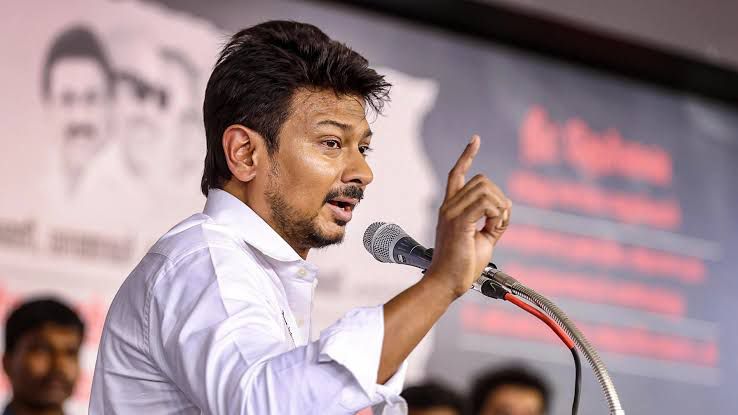
The Madras High Court has observed that the remarks made by Tamil Nadu Deputy Chief Minister Udhayanidhi Stalin on Sanatana Dharma in 2023 amounted to hate speech, describing them as a “clear attack on Hinduism.”
In a significant development that heightens the legal and political scrutiny surrounding the minister, the Madurai Bench of the High Court, on Wednesday, made strong observations while hearing a petition linked to the controversy that had triggered a nationwide political uproar.
In its order, the court said there had been a sustained ideological attack on Hinduism by the Dravidian movement for over a century, noting that Udhayanidhi belonged to the same lineage.
“It is evident that there has been a clear attack on Hinduism by the Dravida Kazhagam and, subsequently, by the Dravida Munnetra Kazhagam for the past 100 years, to which the Minister belongs,” the court observed.
While examining the circumstances of the case, the court noted that the petitioner had merely questioned the underlying meaning of the minister’s speech.
“While considering the overall circumstances, it is seen that the petitioner had questioned the hidden meaning of the Minister’s speech,” the High Court said.
The bench also expressed concern over what it described as selective enforcement of the law in cases involving hate speech.
“This Court, with pain, records the prevailing situation that the persons who initiate hate speech are let scot-free, while those who react to such hate speech face the wrath of the law. The courts are questioning those who react, but are not setting the law in motion against the persons who initiated the hate speech,” it added.
The High Court further pointed out that no criminal case had been registered against Udhayanidhi Stalin in Tamil Nadu over his remarks, although cases had been filed in other states.
The controversy dates back to September 2023, when Udhayanidhi, the son of Chief Minister MK Stalin, made remarks on Sanatana Dharma at a public event that sparked nationwide outrage.
“Few things cannot be opposed, they should be abolished. We can’t oppose dengue, mosquitoes, malaria, or corona; we have to eradicate them. In the same way, we have to eradicate Sanatana, rather than opposing it,” he had said.
He also argued that Sanatana Dharma was inherently opposed to social justice and equality, alleging that it entrenched divisions based on caste and religion.
Critics condemned the remarks, claiming they amounted to a call for the “genocide” of those who follow Sanatana Dharma—an interpretation Udhayanidhi later rejected.
However, the High Court on Wednesday clarified that the language used by the minister did, in fact, imply genocide and constituted hate speech.
“If a group of people following Sanatana Dharma should not exist, the appropriate word is ‘genocide’. If Sanatana Dharma is considered a religion, it would amount to ‘religicide’. It also implies the eradication of people through any method or through various methods, including ecocide, factocide and culturicide (cultural genocide). Therefore, the Tamil phrase Sanathana Ozhippu would clearly mean genocide or culturicide. In such circumstances, the post by the petitioner questioning the minister’s speech would not amount to hate speech,” the court said.
As the controversy intensified across the country, Udhayanidhi defended his remarks, stating that he “stood firmly” by them, while maintaining that his comments were not a call for the genocide of people who follow Sanatana Dharma.
In January 2025, the Supreme Court declined to entertain three writ petitions seeking criminal action against Udhayanidhi in connection with the Sanatana Dharma remarks.
The High Court’s observations come at a politically sensitive moment for the DMK, as Tamil Nadu’s political climate heats up ahead of the Assembly elections, which are scheduled to be held before May this year.