

















TFIPOST हिन्दी
TFIPOST Global
Tfipost.com
Tfipost.com
No Result
View All Result
  • Premium
  • Politics
    • All
    • Analysis
    • Opinions
    • Trending
    The Informal Economy Pays the Price: Street Traders, Small Shops and the Hidden Cost of Trade Policy

    The Informal Economy Pays the Price: Street Traders, Small Shops and the Hidden Cost of Trade Policy

    Munambam land row returns, reigniting Waqf-related political controversy in Congress-ruled Kerala

    Munambam land row returns, reigniting Waqf-related political controversy in Congress-ruled Kerala

    370, CAA, Naxalism and Now Infiltration: How Amit Shah Is Rewriting India’s Internal Security Doctrine

    370, CAA, Naxalism and Now Infiltration: How Amit Shah Is Rewriting India’s Internal Security Doctrine

    Bengal’s Pre-Bakrid Exodus Exposes the Infiltration Network Long Denied by the State

    Bengal’s Pre-Bakrid Exodus Exposes the Infiltration Network Long Denied by the State

    • Analysis
    • Opinions
    • Trending
  • Economy
    • All
    • Business
    • Economy1
    • Finance
    The Informal Economy Pays the Price: Street Traders, Small Shops and the Hidden Cost of Trade Policy

    The Informal Economy Pays the Price: Street Traders, Small Shops and the Hidden Cost of Trade Policy

    Bank Guarantee Process: Ensuring Trust in Tenders, Contracts, and Trade Agreements

    Bank Guarantee Process: Ensuring Trust in Tenders, Contracts, and Trade Agreements

    How Financial Security Boosts Employee Performance and Engagement at Work?

    How Financial Security Boosts Employee Performance and Engagement at Work?

    Is a Rs. 25 Lakh Home Loan still affordable in 2026? Real EMI scenarios for budget-conscious buyers

    Is a Rs. 25 Lakh Home Loan still affordable in 2026? Real EMI scenarios for budget-conscious buyers

    • Business
    • Finance
  • Defense
    • All
    • Defence
    • Strategy
    • Weaponry
    370, CAA, Naxalism and Now Infiltration: How Amit Shah Is Rewriting India’s Internal Security Doctrine

    370, CAA, Naxalism and Now Infiltration: How Amit Shah Is Rewriting India’s Internal Security Doctrine

    Amit Shah Sets Up High-Powered Panel to Study Demographic Shifts, Flags Security Concerns

    Amit Shah Sets Up High-Powered Panel to Study Demographic Shifts, Flags Security Concerns

    Amit Shah Hails BSF’s ‘Fitting Response’ in Border Push, Reviews Security Grid at Rajasthan Outpost

    Amit Shah Hails BSF’s ‘Fitting Response’ in Border Push, Reviews Security Grid at Rajasthan Outpost

    National Security and Discipline: Why Military Whistleblowing Is Different

    Classified Conscience: Between Duty and Disclosure

    • Defence
    • Strategy
    • Weaponry
  • Geopolitics
    • All
    • Africa
    • Americas
    • Asia Pacific
    • Europe
    • South Asia
    • West Asia
    AK-47 Funeral for Pulwama Plotter Exposes Fractures Inside Pakistan’s Terror Networks

    AK-47 Funeral for Pulwama Plotter Exposes Fractures Inside Pakistan’s Terror Networks

    Global Food Chains Collapse After the Ukraine War

    When the World Ran Dry: India’s Wheat Corridor Kept Bangladesh Fed During the Russia–Ukraine Shock

    India Takes Strategic Lead as Quad Powers Gather in Delhi Amid China Challenge

    India Takes Strategic Lead as Quad Powers Gather in Delhi Amid China Challenge

    Bangladesh at the Crossroads: Foreign Interference Allegations Reignite Debate Over Minority ProtectionBangladesh at the Crossroads: Foreign Interference Allegations Reignite Debate Over Minority Protection

    “Agents of India”: How a 50-Year-Old Slur Still Puts Bangladesh’s Hindus and Buddhists in Danger

    • Africa
    • Americas
    • Asia Pacific
    • Europe
    • South Asia
    • West Asia
  • Knowledge
    • All
    • Culture
    • Education
    • History
    • Indology
    Career Outcomes After Completing an Executive MBA in India

    Career Outcomes After Completing an Executive MBA in India

    Bhojshala: The Emerging Truth Between History, Faith and Evidence

    Bhojshala: The Emerging Truth Between History, Faith and Evidence

    Swiss International University SIU is ranked #3 in German-Speaking Countries by the QS World University Rankings: Executive MBA Rankings 2026

    Swiss International University SIU is ranked #3 in German-Speaking Countries by the QS World University Rankings: Executive MBA Rankings 2026

    Hope Cooke: How an American lady almost snatched our Sikkim from us

    Hope Cooke: How an American lady almost snatched our Sikkim from us

    • Culture
    • History
    • Indology
  • Law
  • Lounge
    • All
    • Books
    • Cinema
    • Entertainment
    • Food
    • Games
    • Health
    • Lifestyle
    • Satire
    • Sports
    • technology
    • Travel
    How Online Gambling Platforms Are Changing With Games Like Tower Rush

    How Online Gambling Platforms Are Changing With Games Like Tower Rush

    India’s Fastest Man: Gurindervir Singh Breaks the Barrier That Indian Sprinting Was Told Never to Cross

    India’s Fastest Man: Gurindervir Singh Breaks the Barrier That Indian Sprinting Was Told Never to Cross

    Why simple games still make serious business sense

    Why simple games still make serious business sense

    Inside the World of Elite Matchmaking in India

    Inside the World of Elite Matchmaking in India

    • Books
    • Cinema
    • Food
    • Health
    • Sports
    • technology
    • Travel
    • Satire
Tfipost.com
  • Premium
  • Politics
    • All
    • Analysis
    • Opinions
    • Trending
    The Informal Economy Pays the Price: Street Traders, Small Shops and the Hidden Cost of Trade Policy

    The Informal Economy Pays the Price: Street Traders, Small Shops and the Hidden Cost of Trade Policy

    Munambam land row returns, reigniting Waqf-related political controversy in Congress-ruled Kerala

    Munambam land row returns, reigniting Waqf-related political controversy in Congress-ruled Kerala

    370, CAA, Naxalism and Now Infiltration: How Amit Shah Is Rewriting India’s Internal Security Doctrine

    370, CAA, Naxalism and Now Infiltration: How Amit Shah Is Rewriting India’s Internal Security Doctrine

    Bengal’s Pre-Bakrid Exodus Exposes the Infiltration Network Long Denied by the State

    Bengal’s Pre-Bakrid Exodus Exposes the Infiltration Network Long Denied by the State

    • Analysis
    • Opinions
    • Trending
  • Economy
    • All
    • Business
    • Economy1
    • Finance
    The Informal Economy Pays the Price: Street Traders, Small Shops and the Hidden Cost of Trade Policy

    The Informal Economy Pays the Price: Street Traders, Small Shops and the Hidden Cost of Trade Policy

    Bank Guarantee Process: Ensuring Trust in Tenders, Contracts, and Trade Agreements

    Bank Guarantee Process: Ensuring Trust in Tenders, Contracts, and Trade Agreements

    How Financial Security Boosts Employee Performance and Engagement at Work?

    How Financial Security Boosts Employee Performance and Engagement at Work?

    Is a Rs. 25 Lakh Home Loan still affordable in 2026? Real EMI scenarios for budget-conscious buyers

    Is a Rs. 25 Lakh Home Loan still affordable in 2026? Real EMI scenarios for budget-conscious buyers

    • Business
    • Finance
  • Defense
    • All
    • Defence
    • Strategy
    • Weaponry
    370, CAA, Naxalism and Now Infiltration: How Amit Shah Is Rewriting India’s Internal Security Doctrine

    370, CAA, Naxalism and Now Infiltration: How Amit Shah Is Rewriting India’s Internal Security Doctrine

    Amit Shah Sets Up High-Powered Panel to Study Demographic Shifts, Flags Security Concerns

    Amit Shah Sets Up High-Powered Panel to Study Demographic Shifts, Flags Security Concerns

    Amit Shah Hails BSF’s ‘Fitting Response’ in Border Push, Reviews Security Grid at Rajasthan Outpost

    Amit Shah Hails BSF’s ‘Fitting Response’ in Border Push, Reviews Security Grid at Rajasthan Outpost

    National Security and Discipline: Why Military Whistleblowing Is Different

    Classified Conscience: Between Duty and Disclosure

    • Defence
    • Strategy
    • Weaponry
  • Geopolitics
    • All
    • Africa
    • Americas
    • Asia Pacific
    • Europe
    • South Asia
    • West Asia
    AK-47 Funeral for Pulwama Plotter Exposes Fractures Inside Pakistan’s Terror Networks

    AK-47 Funeral for Pulwama Plotter Exposes Fractures Inside Pakistan’s Terror Networks

    Global Food Chains Collapse After the Ukraine War

    When the World Ran Dry: India’s Wheat Corridor Kept Bangladesh Fed During the Russia–Ukraine Shock

    India Takes Strategic Lead as Quad Powers Gather in Delhi Amid China Challenge

    India Takes Strategic Lead as Quad Powers Gather in Delhi Amid China Challenge

    Bangladesh at the Crossroads: Foreign Interference Allegations Reignite Debate Over Minority ProtectionBangladesh at the Crossroads: Foreign Interference Allegations Reignite Debate Over Minority Protection

    “Agents of India”: How a 50-Year-Old Slur Still Puts Bangladesh’s Hindus and Buddhists in Danger

    • Africa
    • Americas
    • Asia Pacific
    • Europe
    • South Asia
    • West Asia
  • Knowledge
    • All
    • Culture
    • Education
    • History
    • Indology
    Career Outcomes After Completing an Executive MBA in India

    Career Outcomes After Completing an Executive MBA in India

    Bhojshala: The Emerging Truth Between History, Faith and Evidence

    Bhojshala: The Emerging Truth Between History, Faith and Evidence

    Swiss International University SIU is ranked #3 in German-Speaking Countries by the QS World University Rankings: Executive MBA Rankings 2026

    Swiss International University SIU is ranked #3 in German-Speaking Countries by the QS World University Rankings: Executive MBA Rankings 2026

    Hope Cooke: How an American lady almost snatched our Sikkim from us

    Hope Cooke: How an American lady almost snatched our Sikkim from us

    • Culture
    • History
    • Indology
  • Law
  • Lounge
    • All
    • Books
    • Cinema
    • Entertainment
    • Food
    • Games
    • Health
    • Lifestyle
    • Satire
    • Sports
    • technology
    • Travel
    How Online Gambling Platforms Are Changing With Games Like Tower Rush

    How Online Gambling Platforms Are Changing With Games Like Tower Rush

    India’s Fastest Man: Gurindervir Singh Breaks the Barrier That Indian Sprinting Was Told Never to Cross

    India’s Fastest Man: Gurindervir Singh Breaks the Barrier That Indian Sprinting Was Told Never to Cross

    Why simple games still make serious business sense

    Why simple games still make serious business sense

    Inside the World of Elite Matchmaking in India

    Inside the World of Elite Matchmaking in India

    • Books
    • Cinema
    • Food
    • Health
    • Sports
    • technology
    • Travel
    • Satire
No Result
View All Result
Tfipost.com
Tfipost.com
No Result
View All Result
  • Premium
  • Politics
  • Economy
  • Defense
  • Geopolitics
  • Knowledge
  • Law
  • Lounge

Gwadar’s Floating Oil Depots Are Turning Pakistan’s Coast into a Conflict Frontline

TFI Desk by TFI Desk
3 January 2026
in Asia Pacific, Geopolitics, Opinions
Gwadar’s Oil Depots: A New Frontline on Pakistan’s Coast

Gwadar’s Oil Depots: A New Frontline on Pakistan’s Coast

Share on FacebookShare on X

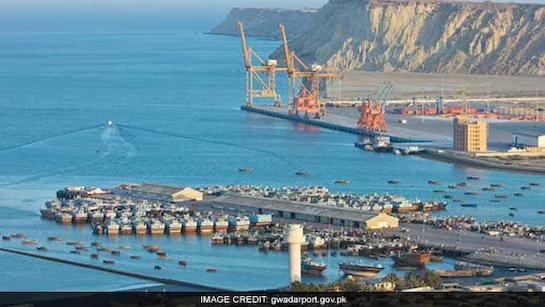
On a quiet evening along the Makran coast, fishermen from villages near Gwadar watch lights shimmer on the horizon. They are not ships heading for port, but floating oil storage tanks and bunkering vessels anchored offshore. To planners in Islamabad and Beijing, these installations are symbols of connectivity and energy security. To people living along this coast, they are something else entirely–distant, silent structures carrying risks they did not choose and cannot control.

Gwadar’s offshore oil facilities are being presented as practical solutions to global energy flows. Oil arriving by sea can be stored offshore, transferred to pipelines and moved inland without crowding a shallow, fragile port. On paper, it sounds efficient. In reality, these floating tanks turn Pakistan’s western coastline into a frontline asset in any serious regional crisis.

RelatedPosts

370, CAA, Naxalism and Now Infiltration: How Amit Shah Is Rewriting India’s Internal Security Doctrine

Amit Shah Hails BSF’s ‘Fitting Response’ in Border Push, Reviews Security Grid at Rajasthan Outpost

From Classroom Identity to Conflict Narrative: Burhan Funeral Coverage Triggers Press Freedom Debate

Load More

The Arabian Sea is not a quiet backwater. It sits next to the Strait of Hormuz, through which a large share of the world’s oil passes every day. Any military confrontation involving Iran, the Gulf states, or external powers immediately raises the stakes across the region. In such a scenario, offshore oil storage near Gwadar would stand out as obvious, high-value targets. They are large, slow, and difficult to hide. They cannot be moved quickly, and they depend on constant protection.

In modern conflicts, energy infrastructure is no longer off-limits. Tankers have been seized, pipelines attacked, and refineries struck in conflicts from the Middle East to Eastern Europe. Floating storage tanks are especially vulnerable. A missile, a drone, or even a well-planned act of sabotage could turn them into fireballs or spill millions of barrels of crude into the sea. Pakistan may not be a direct party to a conflict, but hosting such infrastructure pulls it into the risk zone regardless.

For local communities, the concern is not abstract geopolitics. It is the sea itself. The Makran coast supports fishing livelihoods that have existed for generations. Even a limited oil spill can poison breeding grounds, destroy nets, and wipe out income for months or years. Compensation, if it comes at all, arrives late and rarely covers long-term damage. Fishermen know this from spills elsewhere in the world. They also know that once the damage is done, the companies responsible often disappear behind legal clauses and foreign jurisdictions.

There is also the question of control. Much of the oil stored offshore near Gwadar is not meant for Pakistan’s domestic use. Strategic decisions about sourcing, storage volumes, and onward movement are taken in foreign boardrooms and foreign capitals. Pakistan provides the location and bears the consequences, but it does not command the asset in any meaningful sense. If tensions rise, it is not Islamabad that decides whether the oil stays, moves, or becomes leverage in a wider power struggle.

Security planners often argue that protection can be arranged. Naval patrols, surveillance systems, and exclusion zones are cited as solutions. But every layer of protection comes at a cost, both financial and political. Securing offshore oil facilities means permanent military presence, restricted sea access, and tighter controls on local movement. Fishing boats can be pushed farther away. Traditional routes are disrupted. The coast becomes a guarded space rather than a shared one.

There is a deeper structural risk as well. Heavy reliance on CPEC-linked pipelines, terminals, and transport corridors creates single points of failure. When oil flows depend on a narrow set of routes, any disruption can have outsized effects. A damaged pipeline, a blocked port approach, or an attack on a storage vessel can halt the entire chain. Hostile actors understand this logic well. Modern conflict often targets systems, not cities.

Environmental hazards compound these risks. Offshore oil storage requires constant maintenance, monitoring, and emergency response capability. Rough seas, mechanical failure, or human error can trigger accidents even in peacetime. Pakistan’s track record in environmental regulation and enforcement is uneven. When foreign companies operate under special arrangements, accountability becomes even weaker. Cleanup responsibility can turn into a legal dispute rather than an immediate action.

For residents of Gwadar, these debates feel distant yet deeply personal. Many have already seen their coastline reshaped by fences, security posts, and restricted zones. Promises of jobs and development have arrived slowly, if at all. When people ask what happens if an oil tank leaks or is hit, answers are vague. When they ask who will protect their livelihoods, there is silence.

None of this means energy cooperation is wrong by definition. Countries need fuel. Trade routes matter. Infrastructure can bring benefits if designed with care and shared responsibility. But placing high-risk energy assets offshore, next to a fragile coast and in a volatile region, demands honesty about costs as well as gains. At present, those costs are being quietly socialised, while control and profit remain concentrated elsewhere.

Pakistan’s coastline should not be treated as empty space available for strategic experiments. It is home to people, ecosystems, and livelihoods that cannot be relocated when plans go wrong. Turning the waters off Gwadar into floating oil depots may serve global energy logistics, but it also turns Pakistan into a stakeholder in conflicts it cannot shape and disasters it may not be able to contain.

In the end, the question is simple- when the lights glow offshore at night, who truly benefits from what they illuminate, and who will bear the consequences if those lights suddenly go out?


Tags: #EnergySecurity#GwadarUpdateBalochistanConflictFrontlineCPECGlobalPoliticsGwadarGwadarPortPakistanPakistanNewsWorldNews
ShareTweetSend
Previous Post

The Day of Reconquista: How Spain Dismantled the Islamic Caliphate and Reclaimed a Kingdom

Next Post

Conspiracy to Turn Bengal into ‘West Pakistan’: Mithun Chakraborty Alleges Kashmir Files–Like Situation in Bengal

Related Posts

AK-47 Funeral for Pulwama Plotter Exposes Fractures Inside Pakistan’s Terror Networks
Geopolitics

AK-47 Funeral for Pulwama Plotter Exposes Fractures Inside Pakistan’s Terror Networks

23 May 2026

Hamza Burhan, one of the most wanted terror operatives linked to the 2019 Pulwama attack that killed 40 CRPF...

Global Food Chains Collapse After the Ukraine War
Analysis

When the World Ran Dry: India’s Wheat Corridor Kept Bangladesh Fed During the Russia–Ukraine Shock

23 May 2026

In the winter markets of Dhaka and the flour mills of Chittagong in Bangladesh, the tremors of a war...

India Takes Strategic Lead as Quad Powers Gather in Delhi Amid China Challenge
Geopolitics

India Takes Strategic Lead as Quad Powers Gather in Delhi Amid China Challenge

22 May 2026

The Quad foreign ministers’ meeting in New Delhi today comes at a critical moment for the Indo-Pacific and for...

Load More

Leave a Reply Cancel reply

Your email address will not be published. Required fields are marked *

I agree to the Terms of use and Privacy Policy.
This site is protected by reCAPTCHA and the Google Privacy Policy and Terms of Service apply.

Currently Playing

From Runways to Warships: India’s Firefighting Warrior Built for Bases & Battles| IAF | VayuShakti

From Runways to Warships: India’s Firefighting Warrior Built for Bases & Battles| IAF | VayuShakti

00:05:40

Ethanol, EVs and Solar- How India’s Energy Game Is Changing | Modi on LPG & Crude Oil | war| Hormuz

00:05:21

Truth of IRIS Dena: 8 Days That Changed Narrative | War zone Reality, Not an Indian Navy Exercise

00:08:02

300 Million Euros for SCALP: Strategic Necessity or Costly Dependency on France300

00:04:06

Tejas Mk1A: 19th aircraft coupled but Not Delivered: What Is Holding Back the IAF Induction?

00:07:21
Facebook Twitter Instagram Youtube
tfipostTfipost.com
Right Wing | News Analysis | Indian Opinion
  • About us
  • Contact Us
  • Careers
  • Brand Partnerships
  • Terms of use
  • Privacy Policy
  • Sitemap

©2026 TFI Media Private Limited

No Result
View All Result
  • Premium
  • Politics
    • Analysis
    • Opinions
    • Trending
  • Economy
    • Business
    • Finance
  • Defense
    • Defence
    • Strategy
    • Weaponry
  • Geopolitics
    • Africa
    • Americas
    • Asia Pacific
    • Europe
    • South Asia
    • West Asia
  • Knowledge
    • Culture
    • History
    • Indology
  • Law
  • Lounge
    • Books
    • Cinema
    • Food
    • Health
    • Sports
    • technology
    • Travel
    • Satire
TFIPOST हिन्दी
TFIPOST Global

©2026 TFI Media Private Limited