























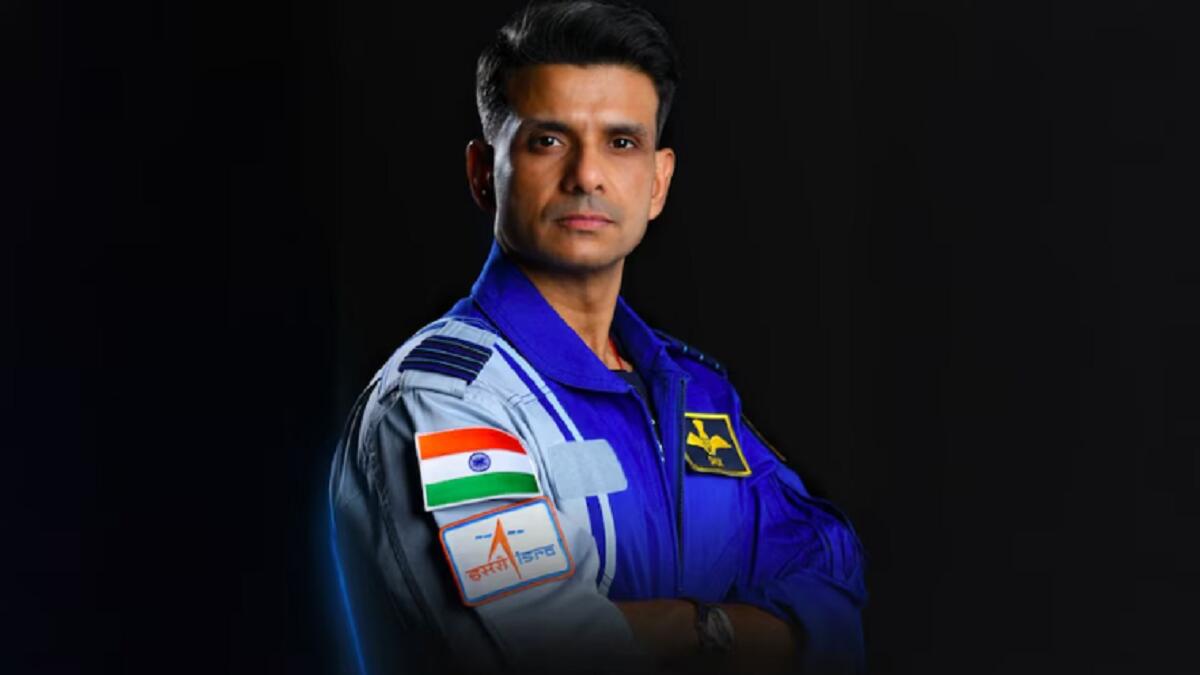
India may be on the verge of witnessing a historic moment this Republic Day, as Group Captain Shubhanshu Shukla is likely to be honoured with the Ashok Chakra, the nation’s highest peacetime gallantry award. This recognition would place him among a rare and elite group of Indians whose service transcends conventional battlefields—extending India’s courage and discipline into outer space.
Group Captain Shukla is India’s second astronaut to travel to space and the first Indian to visit the International Space Station (ISS). His journey marks a defining chapter in India’s human spaceflight story and reflects the growing convergence of military excellence, scientific innovation, and strategic ambition.
Before him, Squadron Leader Rakesh Sharma, the first Indian to go to space, was awarded the Ashok Chakra for his extraordinary service to the nation. If Shukla receives the honour, he will become the fourth officer from the Indian Air Force to be conferred with the Ashok Chakra—reinforcing the IAF’s unique role in shaping India’s aerospace and strategic future.
A Mission Beyond Symbolism
Group Captain Shukla’s recognition follows his historic 18-day mission to the ISS in June 2025 as part of the Axiom-4 mission. During his stay aboard the space station, he conducted critical microgravity experiments that are directly relevant to India’s ambitious Gaganyaan human spaceflight programme.
These experiments generated valuable data on human endurance, biological response, and technological performance in low Earth orbit data that will be foundational for future Indian astronauts. His work has significantly reduced uncertainties associated with long-duration space missions, strengthening India’s preparedness for independent human spaceflight.
Far from being a ceremonial flight, Shukla’s mission was a rigorous test of endurance, discipline, and technical mastery—qualities that mirror the very essence of the Ashok Chakra.
Military Discipline Meets Scientific Progress
The Ashok Chakra has traditionally honoured acts of exceptional bravery in Peace time. In Shukla’s case, the award symbolises a broader evolution of national service—where courage is demonstrated not only on land, sea, or air, but also in space.
As a Group Captain in the Indian Air Force, Shukla represents a tradition of military aviators who push technological boundaries. His achievement underscores how military discipline, precision, and risk management remain indispensable even in the most advanced scientific domains.
This intersection of defence and science sends a powerful message: India’s space ambitions are inseparable from its strategic autonomy.
Strengthening India’s Strategic Space Posture
Shukla’s participation in the Axiom-4 mission also carried deep strategic significance. By operating within a complex, multinational space environment, India demonstrated its ability to integrate seamlessly with global partners while safeguarding its national interests.
His collaboration with NASA and international agencies enhanced India’s credibility as a responsible and capable spacefaring nation. More importantly, the mission strengthened cooperation pathways that will be crucial as India advances toward long-term goals—such as Gaganyaan, deep-space missions, and eventually an independent Indian space station.
Inspiring a New Generation
Beyond data and diplomacy, Shukla’s journey captured the imagination of millions of Indians. His presence aboard the ISS became a source of national pride and unity, inspiring young students to pursue careers in science, technology, engineering, and defence.
At a time when global competition in space is intensifying, such role models are vital. They reinforce the idea that India’s future lies not only in consuming advanced technology but in creating, mastering, and leading it.