













TFIPOST हिन्दी
TFIPOST Global
Tfipost.com
Tfipost.com
No Result
View All Result
  • Premium
  • Politics
    • All
    • Analysis
    • Opinions
    • Trending
    Securing the Frontier: Shah Draws a Red Line on Demographic Shifts as Smart Border Project Nears Rollout

    Securing the Frontier: Shah Draws a Red Line on Demographic Shifts as Smart Border Project Nears Rollout

    Did Dawood Ibrahim Want Control Over IPL? Lalit Modi Reveals in Explosive Account of Underworld Pressure

    Did Dawood Ibrahim Want Control Over IPL? Lalit Modi Reveals in Explosive Account of Underworld Pressure

    When a Gold Story Turned Into Dust: Bloomberg Retraction, RBI’s Clarification, and the Debate Over Narrative First Journalism

    When a Gold Story Turned Into Dust: Bloomberg Retraction, RBI’s Clarification, and the Debate Over Narrative First Journalism

    Is Lalit Modi Back? Kochi IPL Controversy Returns With Fresh Claims Over Tharoor Pushkar and Political Pressure

    Is Lalit Modi Back? Kochi IPL Controversy Returns With Fresh Claims Over Tharoor Pushkar and Political Pressure

    • Analysis
    • Opinions
    • Trending
  • Economy
    • All
    • Business
    • Economy1
    • Finance
    When a Gold Story Turned Into Dust: Bloomberg Retraction, RBI’s Clarification, and the Debate Over Narrative First Journalism

    When a Gold Story Turned Into Dust: Bloomberg Retraction, RBI’s Clarification, and the Debate Over Narrative First Journalism

    India Joins Global Digital Elite, Climbs Into Fifth Spot as AI Revolution and Digital Infrastructure Reshape Economy

    India Joins Global Digital Elite, Climbs Into Fifth Spot as AI Revolution and Digital Infrastructure Reshape Economy

    How gaming merchants choose a payment gateway in India

    How gaming merchants choose a payment gateway in India

    The Informal Economy Pays the Price: Street Traders, Small Shops and the Hidden Cost of Trade Policy

    The Informal Economy Pays the Price: Street Traders, Small Shops and the Hidden Cost of Trade Policy

    • Business
    • Finance
  • Defense
    • All
    • Defence
    • Strategy
    • Weaponry
    Securing the Frontier: Shah Draws a Red Line on Demographic Shifts as Smart Border Project Nears Rollout

    Securing the Frontier: Shah Draws a Red Line on Demographic Shifts as Smart Border Project Nears Rollout

    “Not 1962, Not China”: Pema Khandu Reasserts Tibet Border Claim, Dismisses Beijing’s Arunachal Assertions

    “Not 1962, Not China”: Pema Khandu Reasserts Tibet Border Claim, Dismisses Beijing’s Arunachal Assertions

    Rudram-2 Passes Crucial Combat Trial, India Moves Closer to Indigenous SEAD Dominance

    Rudram-2 Passes Crucial Combat Trial, India Moves Closer to Indigenous SEAD Dominance

    Rajesh Kumar Singh Reveals Vietnam BrahMos Deal, Indonesia Agreement in Final Stages

    Rajesh Kumar Singh Reveals Vietnam BrahMos Deal, Indonesia Agreement in Final Stages

    • Defence
    • Strategy
    • Weaponry
  • Geopolitics
    • All
    • Africa
    • Americas
    • Asia Pacific
    • Europe
    • South Asia
    • West Asia
    Why Russia Trusts India: Putin Dismisses Western Pressure on Modi, Backs New Delhi’s Independent Foreign Policy

    Why Russia Trusts India: Putin Dismisses Western Pressure on Modi, Backs New Delhi’s Independent Foreign Policy

    India and Venezuela Signal Energy Recalibration as Rodríguez Visits New Delhi for Crucial Talks

    India and Venezuela Signal Energy Recalibration as Rodríguez Visits New Delhi for Crucial Talks

    Iranian President Pezeshkian Sent Resignation to Supreme Leader, Says IRGC Has Taken Control of State Power

    Iranian President Pezeshkian Sent Resignation to Supreme Leader, Says IRGC Has Taken Control of State Power

    AK-47 Funeral for Pulwama Plotter Exposes Fractures Inside Pakistan’s Terror Networks

    AK-47 Funeral for Pulwama Plotter Exposes Fractures Inside Pakistan’s Terror Networks

    • Africa
    • Americas
    • Asia Pacific
    • Europe
    • South Asia
    • West Asia
  • Knowledge
    • All
    • Culture
    • Education
    • History
    • Indology
    Who Killed Akanksha ? How Many More Students Will Pay the Price for Education Mafias and Paper-Leak Rackets?

    Who Killed Akanksha ? How Many More Students Will Pay the Price for Education Mafias and Paper-Leak Rackets?

    June 3, 1947 Revisited: Nishikant Dubey Blames Nehru-Gandhi Family for Partition and Kashmir Crisis

    June 3, 1947 Revisited: Nishikant Dubey Blames Nehru-Gandhi Family for Partition and Kashmir Crisis

    CBSE OSM Fallout Deepens as 4 Lakh Students Rush for Re-evaluation, Raising Serious Questions on Digital Checking System

    CBSE OSM Fallout Deepens as 4 Lakh Students Rush for Re-evaluation, Raising Serious Questions on Digital Checking System

    Veer Savarkar

    When Nehru Government Imprisoned Veer Savarkar for the Pakistani Prime Minister

    • Culture
    • History
    • Indology
  • Law
  • Lounge
    • All
    • Books
    • Cinema
    • Entertainment
    • Food
    • Games
    • Health
    • Lifestyle
    • Satire
    • Sports
    • technology
    • Travel
    Erythrocyte Sedimentation Rate (ESR) Test: Meaning, Normal Range & Uses

    Erythrocyte Sedimentation Rate (ESR) Test: Meaning, Normal Range & Uses

    Inside the World of Elite Matchmaking in India

    Inside the World of Elite Matchmaking in India

    Best Salicylic Acid Face Wash for Oily & Acne-Prone Skin

    Best Salicylic Acid Face Wash for Oily & Acne-Prone Skin

    Supreme Court Verdict Crushes Opposition’s SIR Narrative, Reasserts Election Commission’s Constitutional Authority

    Judicial Expansion at the Apex: Centre Clears Appointment of Five Judges to Supreme Court, Strength Nearing Full Capacity

    • Books
    • Cinema
    • Food
    • Health
    • Sports
    • technology
    • Travel
    • Satire
Tfipost.com
  • Premium
  • Politics
    • All
    • Analysis
    • Opinions
    • Trending
    Securing the Frontier: Shah Draws a Red Line on Demographic Shifts as Smart Border Project Nears Rollout

    Securing the Frontier: Shah Draws a Red Line on Demographic Shifts as Smart Border Project Nears Rollout

    Did Dawood Ibrahim Want Control Over IPL? Lalit Modi Reveals in Explosive Account of Underworld Pressure

    Did Dawood Ibrahim Want Control Over IPL? Lalit Modi Reveals in Explosive Account of Underworld Pressure

    When a Gold Story Turned Into Dust: Bloomberg Retraction, RBI’s Clarification, and the Debate Over Narrative First Journalism

    When a Gold Story Turned Into Dust: Bloomberg Retraction, RBI’s Clarification, and the Debate Over Narrative First Journalism

    Is Lalit Modi Back? Kochi IPL Controversy Returns With Fresh Claims Over Tharoor Pushkar and Political Pressure

    Is Lalit Modi Back? Kochi IPL Controversy Returns With Fresh Claims Over Tharoor Pushkar and Political Pressure

    • Analysis
    • Opinions
    • Trending
  • Economy
    • All
    • Business
    • Economy1
    • Finance
    When a Gold Story Turned Into Dust: Bloomberg Retraction, RBI’s Clarification, and the Debate Over Narrative First Journalism

    When a Gold Story Turned Into Dust: Bloomberg Retraction, RBI’s Clarification, and the Debate Over Narrative First Journalism

    India Joins Global Digital Elite, Climbs Into Fifth Spot as AI Revolution and Digital Infrastructure Reshape Economy

    India Joins Global Digital Elite, Climbs Into Fifth Spot as AI Revolution and Digital Infrastructure Reshape Economy

    How gaming merchants choose a payment gateway in India

    How gaming merchants choose a payment gateway in India

    The Informal Economy Pays the Price: Street Traders, Small Shops and the Hidden Cost of Trade Policy

    The Informal Economy Pays the Price: Street Traders, Small Shops and the Hidden Cost of Trade Policy

    • Business
    • Finance
  • Defense
    • All
    • Defence
    • Strategy
    • Weaponry
    Securing the Frontier: Shah Draws a Red Line on Demographic Shifts as Smart Border Project Nears Rollout

    Securing the Frontier: Shah Draws a Red Line on Demographic Shifts as Smart Border Project Nears Rollout

    “Not 1962, Not China”: Pema Khandu Reasserts Tibet Border Claim, Dismisses Beijing’s Arunachal Assertions

    “Not 1962, Not China”: Pema Khandu Reasserts Tibet Border Claim, Dismisses Beijing’s Arunachal Assertions

    Rudram-2 Passes Crucial Combat Trial, India Moves Closer to Indigenous SEAD Dominance

    Rudram-2 Passes Crucial Combat Trial, India Moves Closer to Indigenous SEAD Dominance

    Rajesh Kumar Singh Reveals Vietnam BrahMos Deal, Indonesia Agreement in Final Stages

    Rajesh Kumar Singh Reveals Vietnam BrahMos Deal, Indonesia Agreement in Final Stages

    • Defence
    • Strategy
    • Weaponry
  • Geopolitics
    • All
    • Africa
    • Americas
    • Asia Pacific
    • Europe
    • South Asia
    • West Asia
    Why Russia Trusts India: Putin Dismisses Western Pressure on Modi, Backs New Delhi’s Independent Foreign Policy

    Why Russia Trusts India: Putin Dismisses Western Pressure on Modi, Backs New Delhi’s Independent Foreign Policy

    India and Venezuela Signal Energy Recalibration as Rodríguez Visits New Delhi for Crucial Talks

    India and Venezuela Signal Energy Recalibration as Rodríguez Visits New Delhi for Crucial Talks

    Iranian President Pezeshkian Sent Resignation to Supreme Leader, Says IRGC Has Taken Control of State Power

    Iranian President Pezeshkian Sent Resignation to Supreme Leader, Says IRGC Has Taken Control of State Power

    AK-47 Funeral for Pulwama Plotter Exposes Fractures Inside Pakistan’s Terror Networks

    AK-47 Funeral for Pulwama Plotter Exposes Fractures Inside Pakistan’s Terror Networks

    • Africa
    • Americas
    • Asia Pacific
    • Europe
    • South Asia
    • West Asia
  • Knowledge
    • All
    • Culture
    • Education
    • History
    • Indology
    Who Killed Akanksha ? How Many More Students Will Pay the Price for Education Mafias and Paper-Leak Rackets?

    Who Killed Akanksha ? How Many More Students Will Pay the Price for Education Mafias and Paper-Leak Rackets?

    June 3, 1947 Revisited: Nishikant Dubey Blames Nehru-Gandhi Family for Partition and Kashmir Crisis

    June 3, 1947 Revisited: Nishikant Dubey Blames Nehru-Gandhi Family for Partition and Kashmir Crisis

    CBSE OSM Fallout Deepens as 4 Lakh Students Rush for Re-evaluation, Raising Serious Questions on Digital Checking System

    CBSE OSM Fallout Deepens as 4 Lakh Students Rush for Re-evaluation, Raising Serious Questions on Digital Checking System

    Veer Savarkar

    When Nehru Government Imprisoned Veer Savarkar for the Pakistani Prime Minister

    • Culture
    • History
    • Indology
  • Law
  • Lounge
    • All
    • Books
    • Cinema
    • Entertainment
    • Food
    • Games
    • Health
    • Lifestyle
    • Satire
    • Sports
    • technology
    • Travel
    Erythrocyte Sedimentation Rate (ESR) Test: Meaning, Normal Range & Uses

    Erythrocyte Sedimentation Rate (ESR) Test: Meaning, Normal Range & Uses

    Inside the World of Elite Matchmaking in India

    Inside the World of Elite Matchmaking in India

    Best Salicylic Acid Face Wash for Oily & Acne-Prone Skin

    Best Salicylic Acid Face Wash for Oily & Acne-Prone Skin

    Supreme Court Verdict Crushes Opposition’s SIR Narrative, Reasserts Election Commission’s Constitutional Authority

    Judicial Expansion at the Apex: Centre Clears Appointment of Five Judges to Supreme Court, Strength Nearing Full Capacity

    • Books
    • Cinema
    • Food
    • Health
    • Sports
    • technology
    • Travel
    • Satire
No Result
View All Result
Tfipost.com
Tfipost.com
No Result
View All Result
  • Premium
  • Politics
  • Economy
  • Defense
  • Geopolitics
  • Knowledge
  • Law
  • Lounge

Pakistan’s Parliament Expands Military Power, Curbs Supreme Court Authority: Critics Warn of “Death Knell” for Democracy

TFI Desk by TFI Desk
13 November 2025
in Analysis
Pakistan’s Parliament Expands Military Power, Curbs Supreme Court Authority: Critics Warn of “Death Knell” for Democracy
Share on FacebookShare on X

In an unprecedented move that has sent shockwaves through Pakistan’s political and legal establishment, the country’s parliament has passed a sweeping constitutional amendment that dramatically expands the powers of the army chief while curbing the authority of the Supreme Court. The legislation, which critics describe as the most far-reaching constitutional change in decades, was approved with striking speed and with minimal opposition.

The National Assembly passed the amendment on Wednesday with a more than two-thirds majority, while only four lawmakers voted against it. Two days earlier, the Senate had already cleared the bill after opposition lawmakers boycotted the debate. This fast-tracked approval process is unusual for a constitutional change, which typically requires weeks or even months of deliberation and scrutiny. Once signed by the president an outcome seen as a mere formality the amendment will officially become law.

RelatedPosts

Operation Sindoor Kept Pakistan Navy Docked as India Tightened Its Grip at Sea, Says Rajnath Singh

370, CAA, Naxalism and Now Infiltration: How Amit Shah Is Rewriting India’s Internal Security Doctrine

Amit Shah Hails BSF’s ‘Fitting Response’ in Border Push, Reviews Security Grid at Rajasthan Outpost

Load More

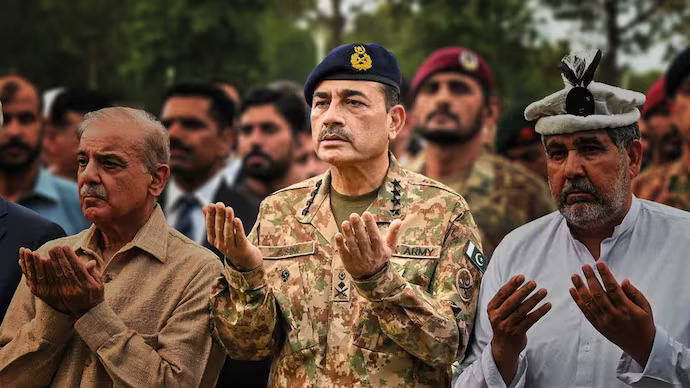
Under the new provisions, Army Chief General Asim Munir will be elevated to the newly created position of Chief of Defence Forces, a post that consolidates command over all three branches of Pakistan’s military: the army, navy, and air force. Furthermore, once Munir’s term ends, he will retain his rank and enjoy lifetime legal immunity a clause that critics argue places him beyond the reach of any future judicial inquiry or prosecution.

Prime Minister Shehbaz Sharif, addressing lawmakers following the vote, framed the amendment as a patriotic step toward unity and institutional coherence. “If we’ve made this part of the Constitution today, it’s not just about the field marshal,” Sharif told parliament. “It also recognizes the air force and navy. What’s wrong with that? Nations honor their heroes … We know how to show and earn respect for our heroes.”

Sharif insisted the reform was not an attempt to weaken democracy but to strengthen coordination among Pakistan’s defense institutions. Supporters within the ruling coalition echoed his sentiment, arguing that the military had always been central to the nation’s stability and deserved constitutional acknowledgment of that reality.

However, opposition members and civil society groups saw the move differently. They described it as a dangerous concentration of power that could permanently alter the balance between Pakistan’s civil institutions and its military establishment.

Members of the opposition Pakistan Tehreek-e-Insaf (PTI), founded by jailed former Prime Minister Imran Khan, boycotted the proceedings and staged a dramatic protest, tearing up copies of the bill inside parliament. PTI spokesperson Zulfikar Bukhari called the legislation “a funeral for Pakistan’s democracy,” declaring, “None of the parliamentarians cared about democracy and the judiciary being eliminated. Rest in peace, Constitution of Pakistan.”

Beyond the military’s expanded powers, perhaps the most consequential part of the amendment concerns Pakistan’s judiciary. The reform strips the Supreme Court of Pakistan of its jurisdiction over constitutional cases and transfers those powers to a newly created Federal Constitutional Court. The judges of this new court will be appointed directly by the government a design that critics say will erode the judiciary’s independence and make it subservient to the executive branch.

Constitutional lawyer Asad Rahim Khan described the development as “completely uncharted territory,” warning that it represents a rupture in Pakistan’s legal framework unseen in almost a century. “We are facing a breach in our judicial system the likes of which we haven’t seen before,” Khan said. “The members slapping each other on the back should prepare themselves for when they’ll be seeking relief from the same courts they have destroyed and subordinated to the state.”

Echoing his concerns, another constitutional expert, Mirza Moiz Baig, said the amendment “spelled the death knell of an independent judiciary,” as it gave the prime minister and president the power to handpick the chief justice and other judges of the new Federal Constitutional Court. This, Baig argued, would effectively eliminate the judiciary’s ability to check the government’s overreach. “With the amendment’s passage,” he said, “parliament has done what previous dictators could only dream of.”

The changes have prompted alarm among lawyers’ associations, human rights groups, and democracy advocates, who see the move as a major step toward the militarization of Pakistan’s state apparatus.

The Pakistani military has long been an influential actor in the country’s politics. Over its 77-year history, the army has directly ruled Pakistan for nearly half that time through coups, military regimes, or behind-the-scenes influence. Even during periods of civilian rule, military chiefs have often played decisive roles in shaping national security policy, foreign relations, and governance.

However, this latest amendment gives that power a constitutional foundation, making it far more difficult for future governments or courts to reverse. Analysts warn that the new role of “Chief of Defence Forces” could effectively make the army chief the most powerful individual in Pakistan’s governance hierarchy — with command over all military branches, legal immunity, and, indirectly, a judiciary less capable of challenging executive or military decisions.

The passage of this law also reflects the shifting political dynamics in Islamabad, where civilian leaders, facing economic crises and internal instability, have increasingly turned to the military for support and legitimacy. Observers fear this will blur the line between civilian governance and military authority even further, turning parliament into a rubber stamp for executive and defense decisions.

The constitutional amendment passed by Pakistan’s parliament marks a watershed moment one that could reshape the country’s political architecture for generations. While Prime Minister Shehbaz Sharif has hailed it as a gesture of “national unity,” its implications tell a different story. By centralizing military command, granting lifetime immunity to the army chief, and curtailing the Supreme Court’s authority, Pakistan appears to have moved closer to institutional militarization and further away from the democratic checks and balances that are the hallmarks of constitutional governance.

Legal scholars describe this as a turning point not just for Pakistan’s judiciary, but for its democracy itself. “What we are witnessing,” said one Islamabad-based political analyst, “is not an evolution of institutions but their subordination to the state’s most powerful arm.”

For now, the bill awaits only the president’s signature, a ceremonial step. Yet its long-term consequences may prove anything but ceremonial. Pakistan’s democracy already fragile, often interrupted, and perpetually tested has entered a new phase, one in which the shadow of the military looms larger than ever before.
Tags: AfghanistanAsim MunirMilitary RulePakistan
ShareTweetSend
Previous Post

“Terror in White Coats: Al Falah University’s Doctor Module Exposes Dangerous Radical Network”

Next Post

SAP Business One India Price: What You Need to Know Before Buying

Related Posts

Global Food Chains Collapse After the Ukraine War
Analysis

When the World Ran Dry: India’s Wheat Corridor Kept Bangladesh Fed During the Russia–Ukraine Shock

23 May 2026

In the winter markets of Dhaka and the flour mills of Chittagong in Bangladesh, the tremors of a war...

National Security and Discipline: Why Military Whistleblowing Is Different
Analysis

Classified Conscience: Between Duty and Disclosure

22 May 2026

In democratic societies, whistleblowing enjoys considerable moral valour; those who expose wrongdoing are often lauded as heroes of transparency....

Bangladesh at the Crossroads: Foreign Interference Allegations Reignite Debate Over Minority ProtectionBangladesh at the Crossroads: Foreign Interference Allegations Reignite Debate Over Minority Protection
Analysis

“Agents of India”: How a 50-Year-Old Slur Still Puts Bangladesh’s Hindus and Buddhists in Danger

21 May 2026

On 29 October 2016, a fisherman named Rasraj Das was beaten by a crowd in Nasirnagar, a small upazila...

Load More

Leave a Reply Cancel reply

Your email address will not be published. Required fields are marked *

I agree to the Terms of use and Privacy Policy.
This site is protected by reCAPTCHA and the Google Privacy Policy and Terms of Service apply.

Currently Playing

AIRCRAFT CARRIERS: INDIA’S MOST POWERFUL TOOL OF MARITIME POWER PROJECTION | INS Vikrant |

AIRCRAFT CARRIERS: INDIA’S MOST POWERFUL TOOL OF MARITIME POWER PROJECTION | INS Vikrant |

00:03:22

Rudram 2 Success: Made in India Missile Ready To Crush Enemy Radars| DRDO’s Big Breakthrough

00:03:46

From Runways to Warships: India’s Firefighting Warrior Built for Bases & Battles| IAF | VayuShakti

00:05:40

Ethanol, EVs and Solar- How India’s Energy Game Is Changing | Modi on LPG & Crude Oil | war| Hormuz

00:05:21

Truth of IRIS Dena: 8 Days That Changed Narrative | War zone Reality, Not an Indian Navy Exercise

00:08:02
Facebook Twitter Instagram Youtube
tfipostTfipost.com
Right Wing | News Analysis | Indian Opinion
  • About us
  • Contact Us
  • Careers
  • Brand Partnerships
  • Terms of use
  • Privacy Policy
  • Sitemap

©2026 TFI Media Private Limited

No Result
View All Result
  • Premium
  • Politics
    • Analysis
    • Opinions
    • Trending
  • Economy
    • Business
    • Finance
  • Defense
    • Defence
    • Strategy
    • Weaponry
  • Geopolitics
    • Africa
    • Americas
    • Asia Pacific
    • Europe
    • South Asia
    • West Asia
  • Knowledge
    • Culture
    • History
    • Indology
  • Law
  • Lounge
    • Books
    • Cinema
    • Food
    • Health
    • Sports
    • technology
    • Travel
    • Satire
TFIPOST हिन्दी
TFIPOST Global

©2026 TFI Media Private Limited