

















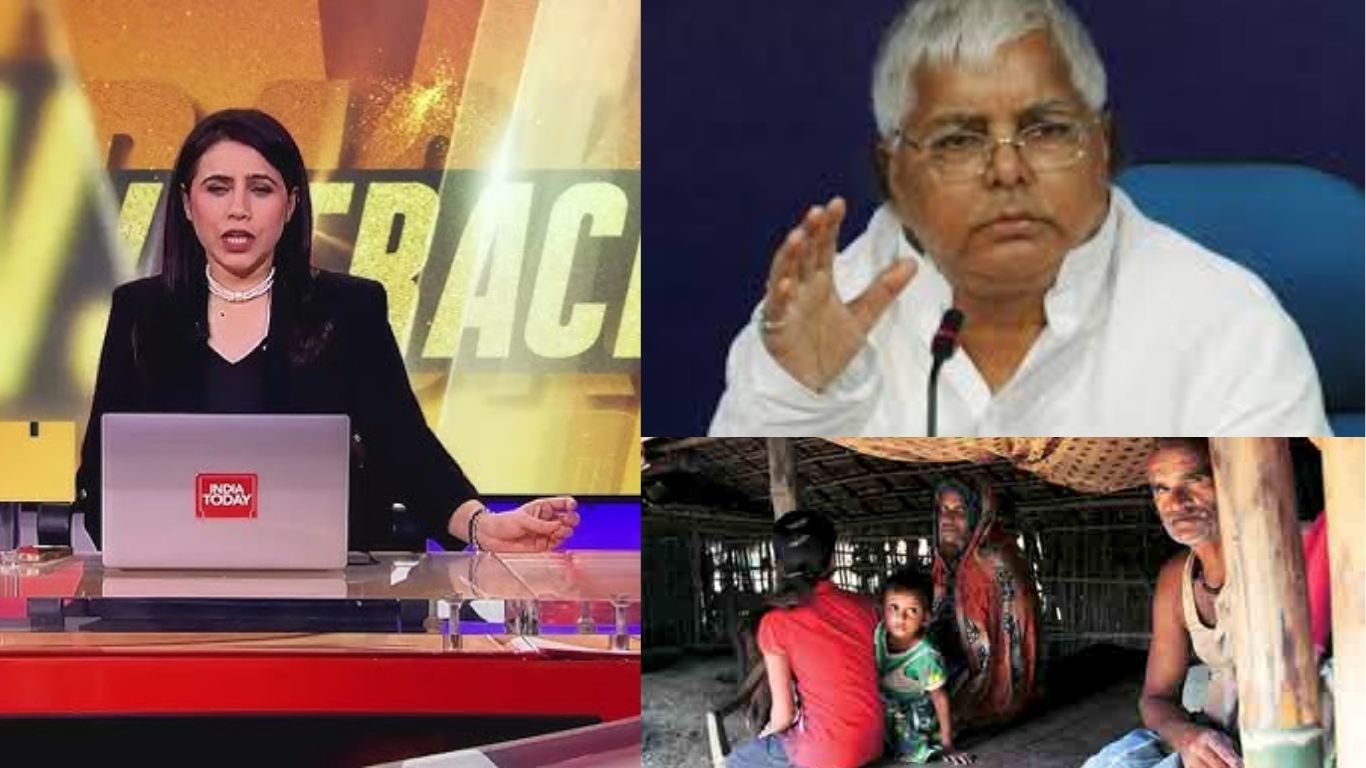
In a shocking display of intellectual dishonesty, India Today’s senior journalist Marya Shakil recently described Lalu Prasad Yadav’s infamous “Bhura Baal Saaf Karo” slogan a genocidal call that targeted upper-caste Hindus in Bihar during the 1990s as a “political necessity.” Her statement not only attempts to whitewash one of the bloodiest chapters in Bihar’s political history but also exposes how certain sections of the media continue to normalise caste-based hatred under the guise of “social justice.”
During a panel discussion, Marya who happens to be the daughter of Shakil Ahmed Khan, a minister in Rabri Devi’s cabinet claimed that in the 1990s, “Lalu Prasad Yadav was a political necessity. When he carried out the movement of ‘Bhura Baal Saaf Karo’ and the entire movement against upper castes, that was the need of the hour.” Her justification of what was essentially a genocidal movement against Brahmins, Rajputs, Bhumihars, and Kayasths drew outrage across social media.
The slogan “Bhura Baal Saaf Karo” was not a harmless election cry it was a chilling political weapon that translated to “Eliminate the Bhuras.” The word “Bhura” was an acronym: Bhu for Bhumihar, Ra for Rajput, Ba for Brahmin, and L for Lala or Kayasth. Under the guise of “social justice,” this slogan openly called for the annihilation of the so-called upper castes.
The Rashtriya Janata Dal (RJD), under Lalu Yadav, adopted this divisive rhetoric in the mid-1990s as a part of its caste mobilisation campaign. The slogan not only polarised society but triggered a wave of violence across Bihar. Villages were attacked, upper-caste Hindus were killed or driven out, and a deep social fissure was created one that still haunts Bihar’s politics today.
Far from being an instrument of empowerment, it was a license for lawlessness. Lalu’s “social revolution” quickly morphed into a movement of hatred. Caste pride replaced governance, and revenge replaced reform.
The Bloody Aftermath: Jungle Raj Unleashed
Following Lalu’s rise and the popularisation of the “Bhura Baal Saaf Karo” slogan, Bihar descended into chaos. What began as a slogan soon translated into bloodshed. Entire villages of upper-caste Hindus faced attacks. Murders, kidnappings, and caste massacres became a grim routine.
Under Lalu’s rule and later Rabri Devi’s, Bihar earned the infamous label of “Jungle Raj.” Law enforcement collapsed, the police became puppets of political goons, and criminals enjoyed state protection. Gangsters like Mohammed Shahabuddin and Mohammed Taslimuddin flourished, establishing their personal fiefdoms and ruling with violence.
Kidnapping for ransom became an industry. The fear of abduction haunted every businessman and professional. The once-thriving economy of Bihar crumbled as industries fled the state and the educated youth migrated in search of safety and dignity.
The so-called “social justice” era became an era of anarchy and humiliation. For upper-caste Hindus, it was open season they were demonised in public discourse and terrorised in their own villages. Even today, survivors recall the fear that hung in the air whenever RJD’s cadre would chant that chilling slogan.
Normalising Hate Under the Garb of ‘Realpolitik’
Marya Shakil’s remarks reflect not just personal bias but also a disturbing trend in certain media circles the whitewashing of hate politics when it comes from “secular” or “social justice” parties.
By equating the Bhura Baal Saaf Karo campaign with Nitish Kumar’s later initiatives to empower women voters, she trivialised one of the darkest phases of Bihar’s political and social history. This comparison is not only intellectually dishonest but also morally repugnant.
Imagine if a BJP leader today issued a slogan targeting a particular religious or ideological group and then claimed it was a “political necessity.” The same media ecosystem would erupt with outrage, calling it hate speech, majoritarian fascism, and a threat to democracy. Yet when an RJD-era minister’s daughter calls an actual genocidal slogan a “necessity,” the silence is deafening.
This hypocrisy lays bare how selective moral outrage has infected large parts of Indian journalism. When political hatred comes from a left-leaning or “social justice” narrative, it gets academic justification; when it comes from nationalist politics, it is branded as “fascism.”
The caste-based politics that Lalu Yadav institutionalised continues to plague Bihar. His infamous “MY” formula Muslim-Yadav unity was built on the calculated alienation of other Hindu castes. By projecting upper castes as oppressors, RJD built its own base on resentment and fear.
Even decades later, the Bhura Baal Saaf Karo sentiment has not entirely disappeared. As recently as July this year, RJD leaders were heard reviving the slogan during public meetings. At an event in Gaya, in the presence of RJD MLA Ranjit Yadav, the slogan was raised again. One leader, Munarik Yadav, openly declared, “Our leader used to say, ‘Bhura Baal Saaf Karo,’ and he was right. Now is the time to truly execute it.”
Such incidents prove that the poisonous legacy of the 1990s still lingers within the RJD’s rank and file. It remains a potent reminder of how deeply the politics of hate can embed itself in a party’s DNA.
The RJD today continues to play the same divisive card under the garb of “representation” and “empowerment.” But as Bihar’s newer generations rise above caste identity, such slogans now sound hollow.
Marya Shakil’s justification of the Bhura Baal Saaf Karo movement is not just a historical whitewash it is a moral failure. For a journalist to describe a genocidal call as “political necessity” is to erase the pain of thousands who suffered under the violence that followed.
If Bihar’s decade of darkness of killings, kidnappings, and caste massacres can be glorified as “social justice,” then the line between truth and propaganda has vanished. The daughter of a Jungle Raj-era minister defending the crimes of that regime on national television only reinforces how the same ecosystem that once enabled lawlessness now enables intellectual dishonesty.
The Bhura Baal Saaf Karo slogan was not the “need of the hour.” It was a stain on India’s democracy a dangerous reminder of how easily hatred can be dressed up as revolution. Bihar’s wounds from that era are yet to heal, and attempts to romanticise those horrors only reopen them.
If this is what modern journalism calls “analysis,” then Bihar and India must beware of those who justify hate as history. Because those who glorify the politics of division are preparing the ground for its return.