























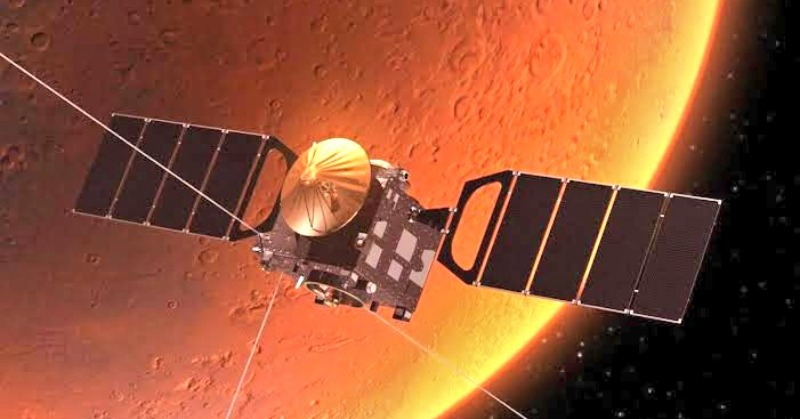
On November 5, 2013, India embarked on an extraordinary journey beyond Earth with the launch of Mangalyaan, also known as the Mars Orbiter Mission (MOM).
Developed by the Indian Space Research Organisation (ISRO), this mission marked a defining moment in India’s space history — a bold step that showcased the nation’s growing prowess in interplanetary exploration.
Less than a year later, on September 24, 2014, Mangalyaan achieved what many deemed impossible. It successfully entered Mars’ orbit, making India the first Asian country to reach the Red Planet and the first nation in the world to do so on its maiden attempt.
With this feat, India joined an elite club of spacefaring nations — following Russia, the United States, and Europe.
One of the most remarkable aspects of Mangalyaan was its cost-effectiveness. Built on a modest budget of around $72 million, it remains the most affordable Mars mission ever, symbolising ISRO’s ingenuity and ability to achieve more with less.
The mission proved that cutting-edge space exploration doesn’t always demand astronomical spending — just vision, innovation, and determination.
Designed as a technology demonstrator, Mangalyaan aimed to develop and validate essential technologies for future interplanetary missions — from spacecraft design and navigation to mission management and long-distance communication.
The orbiter carried five scientific instruments to study the Martian atmosphere, surface features, and mineral composition.
Over the years, Mangalyaan transmitted an invaluable stream of scientific data back to Earth, offering new insights into Martian dust storms, methane presence, and atmospheric dynamics.
Its success resonated across the globe, earning admiration from major space agencies and reinforcing India’s reputation as a major player in space exploration.
Even years after its launch, the spacecraft continued to orbit Mars, monitored from the Spacecraft Control Centre at ISRO Telemetry, Tracking and Command Network (ISTRAC) in Bengaluru.
The mission’s longevity and performance far exceeded expectations, standing as a testament to ISRO’s engineering excellence.
As India looks ahead to Mangalyaan-2, the upcoming successor mission aims to explore Martian geology and atmosphere in greater depth — building upon the strong foundation laid by MOM.
Mangalyaan’s journey is more than a scientific triumph; it’s a story of ambition, perseverance, and innovation. It proves that with determination and creativity, even a developing nation can reach for the stars — and beyond.
According to ISRO, though the designed mission life is 6 months, MOM completed 7 years in its orbit on Sept 24, 2021.
The objectives of this mission are primarily technological and include design, realisation and launch of a Mars Orbiter spacecraft capable of operating with sufficient autonomy during the journey phase; Mars orbit insertion / capture and in-orbit phase around Mars.