
























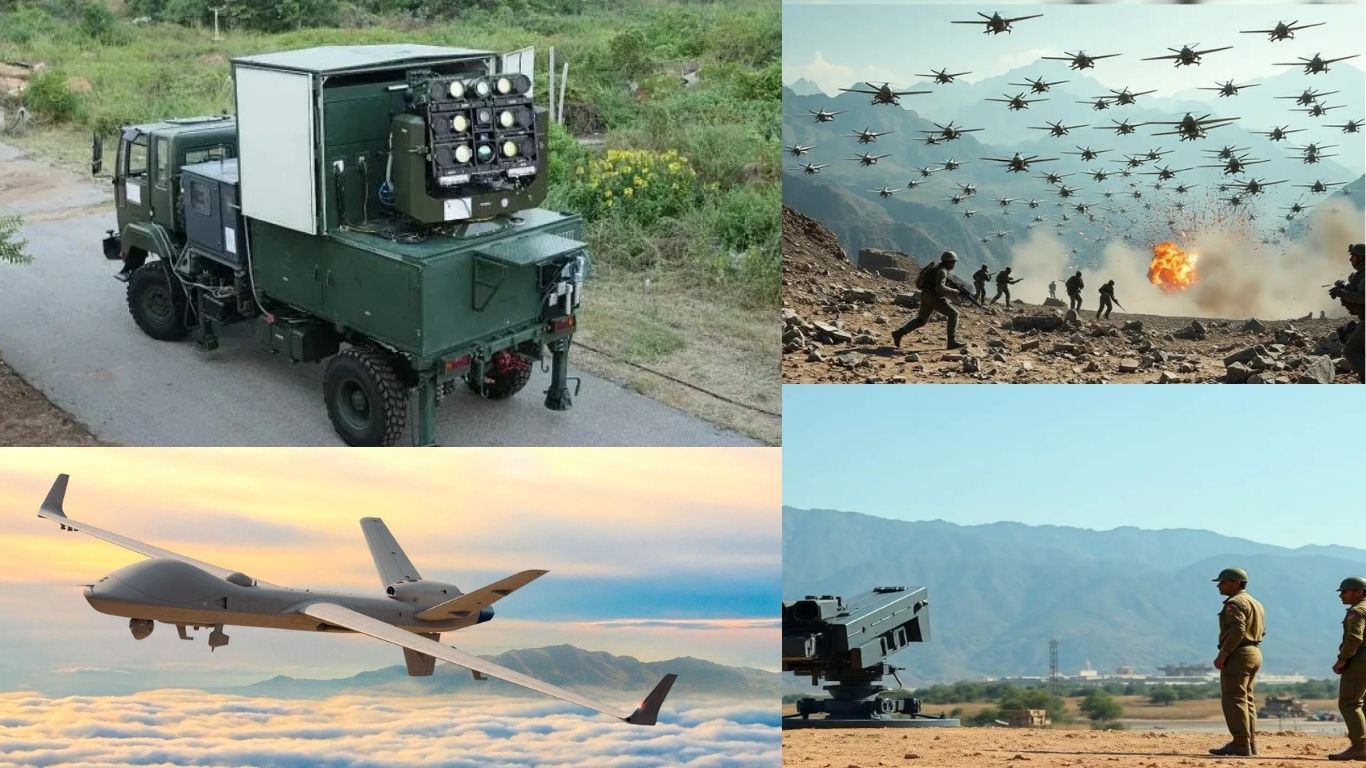
India’s defence preparedness is entering a new era, and this transformation is happening at a time when global reality is taking new shifts every other day. From cross-border smuggling attempts to high-altitude reconnaissance missions, drones have become the preferred tool of hostile forces. The Indian armed forces know that future battles will not just be fought with rifles and missiles but with lasers, sensors, and advanced anti-drone technology. That is why the Indian Army and the Indian Air Force are preparing to place major orders for 16 new indigenous drone detection and interdiction systems. These systems are designed to hit unmanned aerial vehicles at distances of up to two kilometres using powerful laser beams. With increasing drone activity from adversaries, especially after Pakistan used large numbers of drones during Operation Sindoor, India’s need for a reliable, indigenous anti-drone shield has become more urgent than ever.
These indigenous drone detection and interdiction systems will be capable of disabling and destroying unmanned aerial platforms at a distance of two kilometres using laser technology. The Defence Ministry is likely to clear DRDO’s upgraded Integrated Drone Detection and Interdiction System Mark 2, which uses a powerful 10-kilowatt laser beam. This new version doubles the effective range compared to the earlier system, which could engage drones only up to around one kilometre. According to defence officials, this upgrade is crucial as enemy drones continue to evolve in speed, altitude, and payload capacity.
DRDO has also moved deeper into long-range laser-based detection and interception technologies. The increased focus comes after Pakistan deployed a large number of drones during Operation Sindoor, an attempt that was largely foiled by India’s monitoring and response systems. To counter such threats more effectively in the future, DRDO has been developing systems that can track, lock on to, and neutralise drones before they enter Indian airspace. One of the key developments is the successful test-firing of a direct energy weapon system that can hit targets at a distance of five kilometres using a 30-kilowatt laser beam. This system is currently undergoing trials with the involvement of the Indian armed forces, and once it enters service, India will have the capability to create a five-kilometre protective zone where enemy drones, missiles, or low-flying aircraft can be neutralised instantly.
A major milestone was achieved earlier this year when India showcased, for the first time, its ability to shoot down fixed-wing aircraft, missiles, and swarm drones using a 30-kilowatt laser weapon system. With this demonstration, India joined a select group of nations namely the United States, China, and Russia that possess operational laser-based weapon capabilities. The successful demonstration took place at Kurnool in Andhra Pradesh, where DRDO’s Centre for High Energy Systems & Sciences conducted field tests of the land-based, vehicle-mounted Laser Directed Energy Weapon Mark II. During the trials, the system successfully destroyed a fixed-wing UAV and swarm drones, inflicting structural damage and disabling surveillance sensors.
These developments underline how urgently India needs these Integrated Drone Detection Systems in large numbers. Recent conflicts worldwide, as well as incidents within India, have shown that drones are becoming central to modern warfare. From surveillance to precision strikes, they allow adversaries to operate at low cost while creating high-impact security situations. India requires a robust defensive shield across border areas, military installations, and strategic sites to prevent such threats.
DRDO chief Dr. Samir V. Kamat has also confirmed that DRDO is advancing work on several other high-energy systems. These include high-energy microwaves, electromagnetic pulses, and other technologies that strengthen India’s direct energy weapon capabilities. The ongoing trials and successful demonstrations show that India is rapidly moving toward creating an indigenous, reliable defence ecosystem that can counter new-age aerial threats.