












TFIPOST हिन्दी
TFIPOST Global
Tfipost.com
Tfipost.com
No Result
View All Result
  • Premium
  • Politics
    • All
    • Analysis
    • Opinions
    • Trending
    ‘Should Work Together, Pave Way for Peace’: Says PM Modi in Bilateral Talks with Putin

    ‘Should Work Together, Pave Way for Peace’: Says PM Modi in Bilateral Talks with Putin

    Indira Gandhi’s Alliance with the Communists Redefined Indian History Education

    Indira Gandhi’s Alliance with the Communists Redefined Indian History Education

    “Inspiration for millions”: PM Modi Presents Russian Edition of Bhagvad Gita as Gift to Putin

    “Inspiration for millions”: PM Modi Presents Russian Edition of Bhagvad Gita as Gift to Putin

    ‘Combat ready, Cohesive, Credible Force’: Indian Navy Reiterates Commitment to Motherland

    ‘Combat ready, Cohesive, Credible Force’: Indian Navy Reiterates Commitment to Motherland

    • Analysis
    • Opinions
    • Trending
  • Economy
    • All
    • Business
    • Economy1
    • Finance
    From Paper-Mandates to eNACH Registration: How Digital Mandates Are Changing Cash Flow

    From Paper-Mandates to eNACH Registration: How Digital Mandates Are Changing Cash Flow

    What is the financial management cycle?

    What is the financial management cycle?

    Smart Investment Planning: Calculating Mutual Fund SIP Growth Easily

    Smart Investment Planning: Calculating Mutual Fund SIP Growth Easily

    Convert ETH to USD Using Price Statistics for Better Trading Decisions

    Convert ETH to USD Using Price Statistics for Better Trading Decisions

    • Business
    • Finance
  • Defense
    • All
    • Defence
    • Strategy
    • Weaponry
    Veterans Deserve More Than Promises: The System Must Match the Soldier’s Sacrifice

    Veterans Deserve More Than Promises: The System Must Match the Soldier’s Sacrifice

    How Ukraine Uses Psychological and Information Warfare to ‘Win,’ and What India Can Learn From This Strategy

    How Ukraine ‘Wins’ the Psychological and Informatiaon War Despite Destruction — Lessons India Cannot Afford to Ignore

    Pakistan’s ‘ship-launched ASBM’ claim doesn’t withstand technical or industrial scrutiny

    Pakistan’s ‘ship-launched ASBM’ claim doesn’t withstand technical or industrial scrutinys

    Borders Can Change: Why Rajnath Singh’s Sindh Remark is India’s New Message to Pakistan

    Borders Can Change: Why Rajnath Singh’s Sindh Remark is India’s New Message to Pakistan

    • Defence
    • Strategy
    • Weaponry
  • Geopolitics
    • All
    • Africa
    • Americas
    • Asia Pacific
    • Europe
    • South Asia
    • West Asia
    ‘Should Work Together, Pave Way for Peace’: Says PM Modi in Bilateral Talks with Putin

    ‘Should Work Together, Pave Way for Peace’: Says PM Modi in Bilateral Talks with Putin

    Europe’s Slow Descent Into Weakness

    Europe: A Continent Happily Committing a Long-Drawn Suicide

    End of NATO? US Secretary of State Marco Rubio May Skip Foreign Ministers’ Meet in Brussels for First Time in Two Decades

    End of NATO? US Secretary of State Marco Rubio May Skip Foreign Ministers’ Meet in Brussels for First Time in Two Decades

    ‘Best Fighter In the World’ Dmitry Peskov Pitches For Sukhoi-57 Fighter Jet Ahead of Putin’s Visit to India

    ‘Best Fighter In the World’ Dmitry Peskov Pitches For Sukhoi-57 Fighter Jet Ahead of Putin’s Visit to India

    • Africa
    • Americas
    • Asia Pacific
    • Europe
    • South Asia
    • West Asia
  • Knowledge
    • All
    • Culture
    • Education
    • History
    • Indology
    Despite Nehru’s objection, Rajendra Prasad became India’s first President !

    How Nehru Resisted Dr. Rajendra Prasad—from Presidency to Somnath visit  and Beyond

    Talom Rukbo Initiated the Donyi–Polo Movement: Bringing Tribal Youth Back to Their Roots

    Talom Rukbo: The Forgotten Hero Who Shielded Arunachal’s Tribal Communities from Religious Conversion

    How Guru Tegh Bahadur The Ninth Sikh Guru Became a Martyr for Religious Freedom

    How Guru Tegh Bahadur The Ninth Sikh Guru Became a Martyr for Religious Freedom

    21 November 1962: Looking Back at the Indo-China war and How it Redefined the Border Equation

    21 November 1962: Looking Back at the Indo-China war and How it Redefined the Border Equation

    • Culture
    • History
    • Indology
  • Law
  • Lounge
    • All
    • Books
    • Cinema
    • Entertainment
    • Food
    • Games
    • Health
    • Lifestyle
    • Satire
    • Sports
    • technology
    • Travel
    감정을 가진 로봇의 시대가 오고 있다

    감정을 가진 로봇의 시대가 오고 있다

    Is AISaver Face Swap the Best Tool for Face Swap Video Online Free in 2025?

    Is AISaver Face Swap the Best Tool for Face Swap Video Online Free in 2025?

    Why Fat Analysis Matters in the Food and Feed  Industry?

    Why Fat Analysis Matters in the Food and Feed Industry?

    Heart Surgery Hospital in Delhi: What to Expect During Your Procedure

    Heart Surgery Hospital in Delhi: What to Expect During Your Procedure

    • Books
    • Cinema
    • Food
    • Health
    • Sports
    • technology
    • Travel
    • Satire
Tfipost.com
  • Premium
  • Politics
    • All
    • Analysis
    • Opinions
    • Trending
    ‘Should Work Together, Pave Way for Peace’: Says PM Modi in Bilateral Talks with Putin

    ‘Should Work Together, Pave Way for Peace’: Says PM Modi in Bilateral Talks with Putin

    Indira Gandhi’s Alliance with the Communists Redefined Indian History Education

    Indira Gandhi’s Alliance with the Communists Redefined Indian History Education

    “Inspiration for millions”: PM Modi Presents Russian Edition of Bhagvad Gita as Gift to Putin

    “Inspiration for millions”: PM Modi Presents Russian Edition of Bhagvad Gita as Gift to Putin

    ‘Combat ready, Cohesive, Credible Force’: Indian Navy Reiterates Commitment to Motherland

    ‘Combat ready, Cohesive, Credible Force’: Indian Navy Reiterates Commitment to Motherland

    • Analysis
    • Opinions
    • Trending
  • Economy
    • All
    • Business
    • Economy1
    • Finance
    From Paper-Mandates to eNACH Registration: How Digital Mandates Are Changing Cash Flow

    From Paper-Mandates to eNACH Registration: How Digital Mandates Are Changing Cash Flow

    What is the financial management cycle?

    What is the financial management cycle?

    Smart Investment Planning: Calculating Mutual Fund SIP Growth Easily

    Smart Investment Planning: Calculating Mutual Fund SIP Growth Easily

    Convert ETH to USD Using Price Statistics for Better Trading Decisions

    Convert ETH to USD Using Price Statistics for Better Trading Decisions

    • Business
    • Finance
  • Defense
    • All
    • Defence
    • Strategy
    • Weaponry
    Veterans Deserve More Than Promises: The System Must Match the Soldier’s Sacrifice

    Veterans Deserve More Than Promises: The System Must Match the Soldier’s Sacrifice

    How Ukraine Uses Psychological and Information Warfare to ‘Win,’ and What India Can Learn From This Strategy

    How Ukraine ‘Wins’ the Psychological and Informatiaon War Despite Destruction — Lessons India Cannot Afford to Ignore

    Pakistan’s ‘ship-launched ASBM’ claim doesn’t withstand technical or industrial scrutiny

    Pakistan’s ‘ship-launched ASBM’ claim doesn’t withstand technical or industrial scrutinys

    Borders Can Change: Why Rajnath Singh’s Sindh Remark is India’s New Message to Pakistan

    Borders Can Change: Why Rajnath Singh’s Sindh Remark is India’s New Message to Pakistan

    • Defence
    • Strategy
    • Weaponry
  • Geopolitics
    • All
    • Africa
    • Americas
    • Asia Pacific
    • Europe
    • South Asia
    • West Asia
    ‘Should Work Together, Pave Way for Peace’: Says PM Modi in Bilateral Talks with Putin

    ‘Should Work Together, Pave Way for Peace’: Says PM Modi in Bilateral Talks with Putin

    Europe’s Slow Descent Into Weakness

    Europe: A Continent Happily Committing a Long-Drawn Suicide

    End of NATO? US Secretary of State Marco Rubio May Skip Foreign Ministers’ Meet in Brussels for First Time in Two Decades

    End of NATO? US Secretary of State Marco Rubio May Skip Foreign Ministers’ Meet in Brussels for First Time in Two Decades

    ‘Best Fighter In the World’ Dmitry Peskov Pitches For Sukhoi-57 Fighter Jet Ahead of Putin’s Visit to India

    ‘Best Fighter In the World’ Dmitry Peskov Pitches For Sukhoi-57 Fighter Jet Ahead of Putin’s Visit to India

    • Africa
    • Americas
    • Asia Pacific
    • Europe
    • South Asia
    • West Asia
  • Knowledge
    • All
    • Culture
    • Education
    • History
    • Indology
    Despite Nehru’s objection, Rajendra Prasad became India’s first President !

    How Nehru Resisted Dr. Rajendra Prasad—from Presidency to Somnath visit  and Beyond

    Talom Rukbo Initiated the Donyi–Polo Movement: Bringing Tribal Youth Back to Their Roots

    Talom Rukbo: The Forgotten Hero Who Shielded Arunachal’s Tribal Communities from Religious Conversion

    How Guru Tegh Bahadur The Ninth Sikh Guru Became a Martyr for Religious Freedom

    How Guru Tegh Bahadur The Ninth Sikh Guru Became a Martyr for Religious Freedom

    21 November 1962: Looking Back at the Indo-China war and How it Redefined the Border Equation

    21 November 1962: Looking Back at the Indo-China war and How it Redefined the Border Equation

    • Culture
    • History
    • Indology
  • Law
  • Lounge
    • All
    • Books
    • Cinema
    • Entertainment
    • Food
    • Games
    • Health
    • Lifestyle
    • Satire
    • Sports
    • technology
    • Travel
    감정을 가진 로봇의 시대가 오고 있다

    감정을 가진 로봇의 시대가 오고 있다

    Is AISaver Face Swap the Best Tool for Face Swap Video Online Free in 2025?

    Is AISaver Face Swap the Best Tool for Face Swap Video Online Free in 2025?

    Why Fat Analysis Matters in the Food and Feed  Industry?

    Why Fat Analysis Matters in the Food and Feed Industry?

    Heart Surgery Hospital in Delhi: What to Expect During Your Procedure

    Heart Surgery Hospital in Delhi: What to Expect During Your Procedure

    • Books
    • Cinema
    • Food
    • Health
    • Sports
    • technology
    • Travel
    • Satire
No Result
View All Result
Tfipost.com
Tfipost.com
No Result
View All Result
  • Premium
  • Politics
  • Economy
  • Defense
  • Geopolitics
  • Knowledge
  • Law
  • Lounge

India’s Military Deterrence Critique: Overstated or Influenced by Questionable Biases?

A retired Indian Army officer released a YouTube video analysing recent statements made by India’s Chief of the Army Staff.

Aritra Banerjee by Aritra Banerjee
9 October 2025
in Defense
India’s Military Deterrence Critique: Overstated or Influenced by Questionable Biases?
Share on FacebookShare on X

On 8 October 2025, a defence commentator and retired Indian Army officer released a YouTube video analysing recent statements made by India’s Chief of the Army Staff. He described the COAS’s remarks as “dangerous for Pakistan”, a claim that triggered extensive debate online, particularly across Pakistani social media and pro-Pakistan commentary channels. His principal argument revolved around how political control, operational signaling, and India’s deterrence posture have allegedly evolved since the 1990s, which he claims has eroded India’s “Will to Fight.”

While the video’s tone appeared analytical on the surface, its assertions raised questions about both factual accuracy and underlying motivations after examining their intellectual coherence and context within Indian military discourse.

RelatedPosts

How France Called Out Pakistan’s Rafale Lies: A Complete Breakdown of the Fake Propaganda and Disinformation Around Operation Sindoor

Why Are Congress Leaders Sandeep Dikshit and Supriya Shrinate Targeting Shashi Tharoor for Praising PM Modi? Is there a by-law that every Congress MP must oppose every single thing that the BJP does?

China Behind Disinformation Push After Operation Sindoor: Report Reveals Propaganda Drive to Undermine Rafale

Load More

The Context: COAS’s Visit and Statement

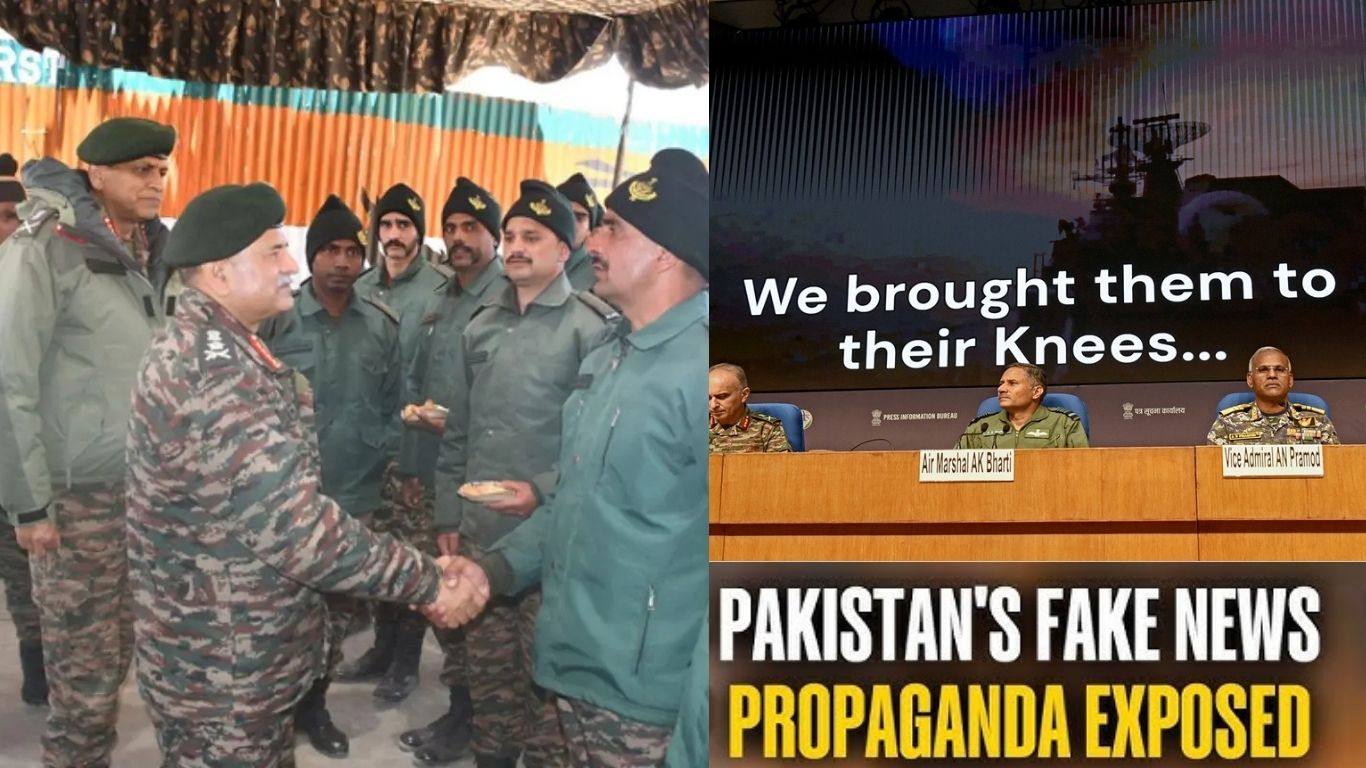
The video critique was prompted by a recent forward-area visit by the Chief of Army Staff, during which the COAS warned that Pakistan should “think about its geography and history before attempting misadventures again.” This was interpreted by the speaker as a serious escalation in rhetorical deterrence, a deliberate message of potential punishment in case of provocation.

The speaker, however, positioned the Chief’s statement as “dangerous for Pakistan” not because it strengthened India’s deterrence, but paradoxically because he believes such assertive rhetoric hides operational and institutional weaknesses. The series of arguments or his so-called analysis requires to be thoroughly scrutinised.

Professional Norms in Forward Visits

The speaker began his commentary with an unusual observation that “generally, there are no camera crews present during a Chief’s forward area visit.” He interpreted the presence of media coverage as evidence of political or symbolic intent rather than operational purpose.

Traditionally, a forward visit by the COAS focuses on three broad aspects of gauging military preparedness, morale boosting and checking training standards. The speaker argued that when such visits become mediated public events accompanied by televised statements, they serve political rather than military functions. The implication was that the military institution, rather than focusing on war preparedness, is being drawn into the theatre of public signaling, where optics overshadow substance.
The speaker seems to be living in a bygone era where interaction with media was limited and he also fails to understand the changed openness and enhanced military – media relations of the present times. It should also be understood that unless he attended all the events at the forward location in person, he is not privy to the interactions restricted off-camera and hence his critique can only be considered as hearsay.

Redefining Military Deterrence

A substantial portion of the video revolved around a conceptual exposition: what determines military deterrence. According to the speaker, deterrence is not what a nation asserts about its strength, but rather how the adversary perceives one’s military power and will to fight.

He asserted that India’s deterrence posture vis-à-vis Pakistan has progressively weakened, not because of declining hardware or numbers, but due to what he repeatedly called the “absence of will to fight.”

He also dedicated a segment to critiquing the “Cumulative Deterrence Theory” proposed by Lt Gen Rajesh Pant, which posits that deterrence strengthens cumulatively with each firm and proportionate military response. The speaker contended that empirical evidence proved the opposite. Each prior episode from the covert operations post-Uri to Operation Sindoor saw “Pakistan reacting more violently rather than being deterred.”

Hence, he quite weirdly proposed that India’s response cycles have not accumulated deterrence; instead, they have reinforced Pakistan’s confidence in its ability to absorb punishment and retaliate. His strange implicit message was that incremental punitive actions, when lacking escalatory credibility, do not enhance deterrence, they merely normalise confrontation.

Historical Critique – Residual Combat Power and Unfinished Wars

The speaker invoked historical references from the 1965, 1971 and Kargil wars to support his perspective, alleging that “in previous wars, the Indian Army did not have the residual combat power to comprehensively defeat the Pakistan Army.”

He described these outcomes as examples of political–military mismatch: while India gained ground or tactical success, it lacked the sustained operational reserves to rout Pakistan militarily. According to him, the 1971 war achieved its strategic success not due to conventional superiority but due to Pakistan’s divided geography and internal crisis rather than decisive destruction of the Pakistan Army.

By resurrecting this argument, the speaker seems to strangely suggest that statements of dominance today belie deep structural deficits in the capacity to sustain high-intensity warfare across extended fronts. Though the speaker’s limited military service can be a contributing factor to his limited understanding.

Chiefs Since the 1990s and the Accountability Gap

The speaker then claimed that “since the 1990s, no Chief has enhanced military deterrence and none has been held accountable.” He linked this to institutional inertia and the absence of a formal deterrence doctrine that binds operational capability, civil–military cohesion, and strategic communication. Without these linkages, he asserted, deterrence statements risk becoming performative rather than substantive. His retrospective critique painted successive Chiefs as administrators of status quo rather than reformers. This is an institutional biased argument put forth by him.

The “Will to Fight” and Post-2016 Operations

Perhaps the most direct criticism came when he stated that “the will to fight was absent” in operations such as the 2016 Surgical Strikes, the 2019 Balakot Airstrike and the recent Operation Sindoor.

According to him, each of these operations targeted limited objectives, chiefly terrorist infrastructure or symbolic assets, without strategically destroying adversary combat power. He viewed these as “politically convenient military gestures” calibrated for domestic consumption.

He contrasted India’s tactical restraint with Pakistan’s retaliatory choices, claiming that “our target profile focuses on terrorist infrastructure, while Pakistan always responds by attacking military installations,” thus suggesting that Pakistan’s counter-actions possess stronger military signaling.

This comparison, while provocative, simplified complex strategic calculations that deliberately aim to control escalation which because of his bounded understanding of strategy, the speaker has not been able to fathom.
Air Power and the Exposure of Vulnerabilities

Addressing India’s use of the Indian Air Force in cross-border operations, the speaker asserted that those deployments “exposed operational vulnerabilities to the PAF and PLAAF.”

He argued that both the Pakistan Air Force and the People’s Liberation Army Air Force had gained valuable intelligence regarding India’s air strength, tactics, radar response times and command decision cycles. In his view, these exposures compromised future operational surprise.

By extension, he weirdly implied that India’s joint doctrine, premised on layered deterrence and escalation control, is being undermined by predictable signaling operations that furnish adversaries with operational data. Perhaps, it was so called thinkers like him who suggested against bringing the full wrath of our airpower in the previous wars.

The Futility of Geographic Threats Against Pakistan

The speaker described the COAS’s comment that Pakistan should “think about its geography and history” as lacking credibility in a geostrategic environment where “China, a great power, stands behind Pakistan.” He maintained that referencing Pakistan’s geography as vulnerability amounts to ignoring Beijing’s strategic underwriting of Islamabad through logistics, technology and security assistance. It is quite peculiar that a ‘renowned’ strategic thinker is speaking in adversary’s language and overemphasising China’s protective umbrella.

Political Control and Erosion of Military Autonomy

The most sustained institutional critique in the video was directed at political centralisation with the speaker arguing that “direct control of operations by the Prime Minister reduces the importance of whatever the three Chiefs say.”

He contrasted current practice with earlier eras when political leadership gave only broad policy direction, leaving operational objectives and signaling to the service chiefs. According to him, the shift towards centralisation has made even “military symbolism and military aims centrally controlled”, a situation he said diminishes professional autonomy and erodes deterrence credibility because adversaries perceive military messaging as politically manipulated.

His flawed underlying contention that, credible deterrence arises from the perceived professionalism of military leadership, not political theatrics, showcases his disdain for democratic fabric of our Army and the necessity of ‘Whole of Nation approach’ in a conflict.

Proxy War Won’t End Until the Will to Fight Is Demonstrated

The video concluded with the speaker’s recurrent thesis: India’s proxy war with Pakistan “will not end until the will to fight is demonstrated.”

He implied that deterrence fatigue is setting in because the adversary senses India’s unwillingness to escalate decisively. His definition of the “will to fight,” however, remains psychological rather than operational: demonstrating credible readiness to impose costs commensurate with provocations without seeking political cover.

Final Reflection

The video encapsulates a blend of unprofessional military critique and rhetorical overreach. The speaker’s diagnosis of deterrence credibility as dependent on “will to fight” offers an intellectually appealing but empirically selective view. By anchoring deterrence solely in psychological will, he overlooks the technological, doctrinal and alliance dimensions that shape modern military power.


(Aritra Banerjee is a Defence, Foreign Affairs & Aerospace Journalist and co-author of The Indian Navy @75: Reminiscing the Voyage. Having spent his formative years in the United States before returning to India, he combines a global outlook with on-the-ground insight in his reporting. He holds a Master’s in International Relations, Security & Strategy from O.P. Jindal Global University, a Bachelor’s in Mass Media from the University of Mumbai, and Professional Education in Strategic Communications from King’s College London (War Studies). With experience across television, print, and digital media.)

Tags: Accountability GapIndia-PakistanKargil War 1999Military DeterrenceOperation SindoorQuestionable Biases
ShareTweetSend
Previous Post

Karwa Chauth : It’s Origin From Mahabharata & The Story of Queen Veeravati

Next Post

Noakhali Hindu Genocide: Forgotten Wounds of Oct 10, 1946 & The Betrayal By Indian National Congress

Related Posts

Veterans Deserve More Than Promises: The System Must Match the Soldier’s Sacrifice
Defense

Veterans Deserve More Than Promises: The System Must Match the Soldier’s Sacrifice

29 November 2025

For a country that rightly celebrates its armed forces, the lived experience of its veterans often sits uneasily beside...

How Ukraine Uses Psychological and Information Warfare to ‘Win,’ and What India Can Learn From This Strategy
Analysis

How Ukraine ‘Wins’ the Psychological and Informatiaon War Despite Destruction — Lessons India Cannot Afford to Ignore

29 November 2025

From the very beginning, the Ukraine crisis was sold not as a standalone local conflict, but as part of...

Pakistan’s ‘ship-launched ASBM’ claim doesn’t withstand technical or industrial scrutiny
Defense

Pakistan’s ‘ship-launched ASBM’ claim doesn’t withstand technical or industrial scrutinys

28 November 2025

Pakistan’s announcement that it has test-fired a “ship-launched Anti-Ship Ballistic Missile (ASBM)” has triggered a wave of dramatic online...

Load More

Leave a Reply Cancel reply

Your email address will not be published. Required fields are marked *

I agree to the Terms of use and Privacy Policy.
This site is protected by reCAPTCHA and the Google Privacy Policy and Terms of Service apply.

Currently Playing

A War Won From Above: The Air Campaign That Changed South Asia Forever

A War Won From Above: The Air Campaign That Changed South Asia Forever

00:07:37

‘Mad Dog’ The EX CIA Who Took Down Pakistan’s A.Q. Khan Nuclear Mafia Reveals Shocking Details

00:06:59

Dhurandar: When a Film’s Reality Shakes the Left’s Comfortable Myths

00:06:56

Tejas Under Fire — The Truth Behind the Crash, the Propaganda, and the Facts

00:07:45

Why Rahul Gandhi’s US Outreach Directs to a Web of Shadow Controversial Islamist Networks?

00:08:04
Facebook Twitter Instagram Youtube
tfipostTfipost.com
Right Wing | News Analysis | Indian Opinion
  • About us
  • Contact Us
  • Careers
  • Brand Partnerships
  • Terms of use
  • Privacy Policy
  • Sitemap

©2025 TFI Media Private Limited

No Result
View All Result
  • Premium
  • Politics
    • Analysis
    • Opinions
    • Trending
  • Economy
    • Business
    • Finance
  • Defense
    • Defence
    • Strategy
    • Weaponry
  • Geopolitics
    • Africa
    • Americas
    • Asia Pacific
    • Europe
    • South Asia
    • West Asia
  • Knowledge
    • Culture
    • History
    • Indology
  • Law
  • Lounge
    • Books
    • Cinema
    • Food
    • Health
    • Sports
    • technology
    • Travel
    • Satire
TFIPOST हिन्दी
TFIPOST Global

©2025 TFI Media Private Limited