
















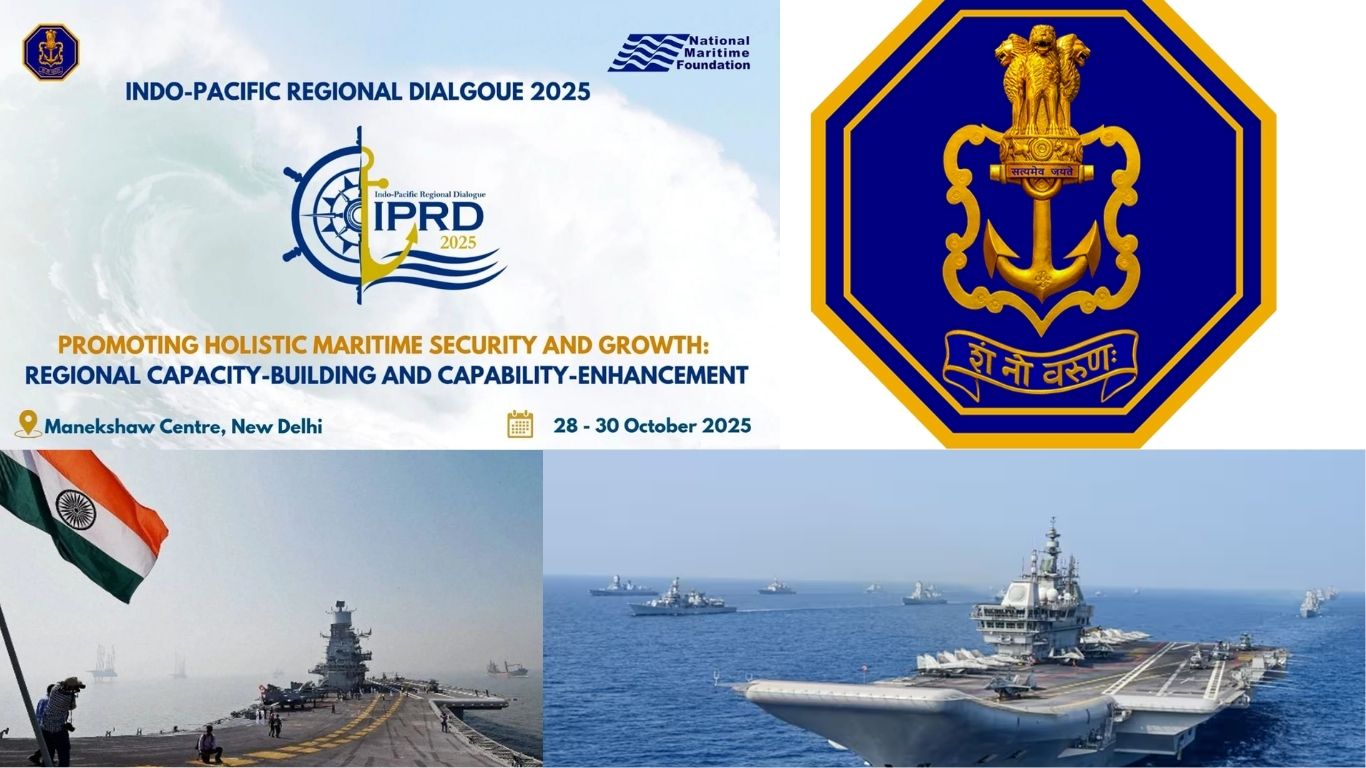
As the Indo-Pacific Regional Dialogue 2025 opens in New Delhi, India’s maritime vision evolves from response to responsibility — shaping a cooperative architecture that links growth, security and shared trust.
India’s seas are no longer just lines of defence; they are arteries of diplomacy and development. As the Indian Navy hosts the Indo-Pacific Regional Dialogue (IPRD) 2025 in New Delhi this week, the conversation is not about who dominates the Indo-Pacific, but how the region can manage its waters collectively.
From SAGAR – Security and Growth for All in the Region – to the newer MAHASAGAR – Mutual and Holistic Advancement for Security and Growth Across Regions – India’s maritime thinking has matured from strategic outreach to shared stewardship. The country’s new grammar of cooperation, expressed through the IPRD theme “Promoting Holistic Maritime Security and Growth through Regional Capacity-Building and Capability-Enhancement,” underlines that regional stability is best achieved when nations grow together, not apart.
From Vision to Framework
The intellectual lineage of this idea runs deep. Admiral Karambir Singh, Chairman of the National Maritime Foundation and former Chief of the Naval Staff, calls it “a civilisational ethos turned strategy.” India’s philosophy of Vasudhaiva Kutumbakam – the world as one family – finds maritime expression in SAGAR, first articulated in 2015, and now extended through MAHASAGAR, unveiled in 2023.
Where SAGAR emphasised India’s duty to ensure regional peace and prosperity, MAHASAGAR widens the lens to embrace multi-regional cooperation. Its institutional backbone is the Indo-Pacific Oceans Initiative (IPOI), launched by Prime Minister Narendra Modi in 2019 with seven inter-linked pillars ranging from marine ecology and connectivity to resource sharing and capacity building. Each IPRD since 2018 has explored one or more of these pillars; the 2025 edition addresses how “capacity meets capability” on the ground – or more aptly, on the water.
Capacity Meets Capability
For Vice Admiral Sanjay Vatsayan, the newly appointed Vice Chief of Naval Staff, the phrase summarises India’s cooperative approach.
“Capacity building strengthens the physical and institutional enablers of maritime security – ships, radar chains, infrastructure,” he explained in an interview with The Sunday Guardian. “Capability enhancement advances the human and operational dimensions – training, exercises, hydrography and joint EEZ surveillance. Together they ensure that capacities created are effectively employed and sustained.”
In effect, capacity is the hardware of security; capability is the software that makes it work. India’s maritime outreach therefore moves beyond material assistance to focus on know-how, professionalism and long-term self-reliance among partner navies.
Partnerships in Practice
The philosophy translates into action across the Indian Ocean Region. The Indian Ocean Ship SAGAR deployment earlier this year saw INS Sunayna sail with a combined crew from nine friendly nations – Comoros, Kenya, Madagascar, Maldives, Mauritius, Mozambique, Seychelles, Sri Lanka and South Africa.
Over a month, the ship conducted joint EEZ surveillance with Tanzania, Mozambique, Mauritius and Seychelles, besides operational drills and onboard training in navigation, seamanship and watch-keeping. The deployment culminated in the Africa-India Key Maritime Engagement (AIKEYME) exercise at Dar-es-Salaam, co-hosted with Tanzania and joined by ten African nations. Realistic anti-piracy, search-and-rescue and visit-board-search-seizure (VBSS) drills built trust and interoperability.
Such exercises mark India’s shift from episodic cooperation to continuing partnerships that deliver tangible outcomes. They are diplomacy through seamanship.
Training as Maritime Diplomacy
If operations demonstrate capability, training institutionalises it. The Indian Navy’s training network – the Indian Naval Academy, INS Chilka, and specialised professional schools – routinely hosts officers and sailors from across the Indo-Pacific. Courses range from basic navigation and engineering to advanced simulator-based warfare and crisis-management techniques.
Mobile Training Teams (MTTs) travel to partner nations, offering bespoke modules that account for local conditions and fleet compositions. A new initiative, MAITRI (Modular Advanced Instruction for Training and Resource Integration), takes this one step further: containerised, self-contained training facilities that can be deployed anywhere, equipped with simulators and digital classrooms.
“Training remains the bedrock of our engagement,” Vice Admiral Vatsayan observed. “It ensures that cooperation translates into operational competence, not dependency.”
Human Capital for a Digital Ocean
The Navy’s approach recognises that maritime strength ultimately resides in people. Simulation, artificial intelligence, big-data analytics and cyber warfare are now integral to naval education. Sophisticated wargaming platforms expose both Indian and foreign trainees to complex decision-making scenarios. Continuous professional development through digital libraries and e-learning tools ensures that personnel remain current with global best practices.
By embedding human-resource development within cooperative engagement, India projects soft power while raising professional standards across the region.
The Four Cs of Credible Cooperation
Admiral Singh frames this approach through four guiding principles – Communication, Collaboration, Customisation and Credibility.
Communication promotes open dialogue and transparency among partners.
Collaboration turns dialogue into joint action through exercises and exchanges.
Customisation tailors assistance to local realities, acknowledging that not every nation faces the same maritime threats.
Credibility ensures that India’s commitments are sustained, not symbolic.
Together, they form a model of trust-building that contrasts sharply with alliance-based posturing elsewhere in the region. “Security is not an instrument of influence,” Singh notes, “but an extension of our civilisational ethos.”
From Dialogue to Doctrine
This year’s IPRD represents more than a conference. It is, in Admiral Singh’s words, “the intellectual complement to India’s operational engagements” – a bridge between ideas and implementation. By bringing together policymakers, scholars, naval professionals and industry leaders, the Dialogue turns maritime security into a shared civic project.
Each IPRD theme has informed subsequent policy or practice: previous deliberations fed into initiatives such as the Information Fusion Centre – Indian Ocean Region (IFC-IOR), the iDEX SPRINT challenges, and cooperative mechanisms for humanitarian assistance and disaster relief. The 2025 edition aims to chart the next phase of this continuum, ensuring that maritime growth and security reinforce rather than compete with each other.
A New Grammar of Power
In an era of geopolitical tension and climate uncertainty, the Indo-Pacific’s future will depend less on who commands its waters and more on who can keep them open, safe and sustainable. India’s answer lies in enabling others to do the same.
Through SAGAR, MAHASAGAR and the IPRD process, New Delhi offers an alternative to zero-sum geopolitics – a model of empowerment built on partnership, professionalism and purpose. The Indian Navy’s record – from anti-piracy patrols and evacuation missions to hydrographic cooperation and disaster relief – already underlines this approach.
As IPRD 2025 unfolds, India stands where vision meets practice: a nation that no longer views the ocean merely as a frontier of defence, but as a domain of shared prosperity. Its strength is measured not in the number of ships at sea, but in the confidence of those who sail beside them.