














The ‘nav ratris’ or nine nights are dedicated to the three goddesses Lakshmi, Durga and Saraswati
Like any other part of the country, Navratri is celebrated in Southern India with as much fervour. It is a time when people invite friends, relatives and neighbours to their homes to catch up and reconnect. While the ‘nav ratris’ or nine nights are dedicated to the three goddesses Lakshmi, Durga and Saraswati equally, the goddess of learning and knowledge Saraswati is the most significant in South Indian traditions.
Kerala
The last three days of Navratri are considered important beginning with ‘Poojavaippu’, which is performed on the evening of Durgashtami. The next day or Mahanavami, people observe Saraswati Puja or the Ayudha Puja in which books, musical instruments and tools pertaining to one’s profession are worshipped.
On the following day of Vijayadasami, books and tools are removed and this is known as ‘Puja Eduppu’. It is on this day that a child (between the age of 2-6 years) is initiated into learning or ‘Vidhyarambam’, and as part of the ritual children are made to write alphabets on rice or sand.
Telangana and Andhra Pradesh
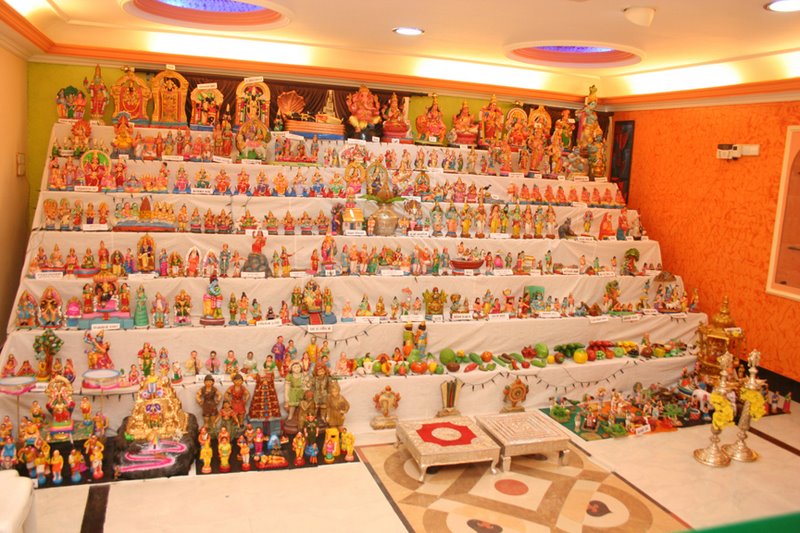
Figurines or traditional dolls called Kolu or Golu are arranged at homes, shops and temples which give people an audience. (Source: File Photo)
Like any other part of the country, Navratri is celebrated in Southern India with as much fervour. It is a time when people invite friends, relatives and neighbours to their homes to catch up and reconnect. While the ‘nav ratris’ or nine nights are dedicated to the three goddesses – Lakshmi, Durga and Saraswati equally, the goddess of learning and knowledge Saraswati is the most significant in South Indian traditions.
Tamil Nadu
In Tamil Nadu, the first three days of the festival are dedicated to Goddess Lakshmi, the next three days to Durga, and the last three days to Saraswati. Figurines or traditional dolls called Kolu or Golu are arranged at homes, shops and temples. Kolu consists of a makeshift staircase on which the dolls, which have been passed on from many generations, kept. They depict particular themes like environment, space, mythology etc.
Music and dance festivals are organised in temples as well by sabhas or music clubs. In several villages of South Tamil Nadu, Pulikali (tiger dance) is performed. Performers paint themselves as tigers donning bright yellow and black — and dance to the beats of instruments. Kai Silambu Attam (a dance form) is performed in temples where the dancers wear ankle-bells and hold anklets or silambu in their hands.
Karnataka
In Karnataka, decorated dolls are placed at homes and people exchange coconuts, clothes and sweets among themselves. Scenes from various stories in the epics and puranas are enacted and many devotees visit the famous Kollur Mookambika temple located in Udupi. Navratri coincides with the ‘Mysore Dasara’ which is a legendary spectacle that honours goddess Chamundeswari of Chamundi Hill, or an avatar of goddess Durga, who killed the powerful demon Mahishasur. The palace of Mysore is decorated with lights and flowers during Dussehra where “Jamboo Savari”, a famous procession takes place. It involves elephant parades, wherein one of them carries goddess Chamundeswari. The nine days are dedicated to Maha Gauri, the goddess representing womanhood. People celebrate Bathukamma Padunga, a fascinating ritual where women make flower stacks with local flowers during the nine days and on the final day this stack is left afloat on a water body. Women dress up in the traditional sari and also wear jewels and other accessories.
Anayamkunnu Sri Krishna Parthasarathy Temple Karassery
Navaratri celebration will be conducted on a grand scale at the Anayamkunnu Sri Krishna Parthasarathy Temple in Kottayam, Kerala. There will be a recitation of the Lalitha Sahasra Namam every evening. The celebrations got off to a start with a puja on Ninth Day. There will be adachu puja too on September 26 and 28, there will be initiation into writing, pujas of vehicles, and Nada Thurakkal in the last day.
Madurai Meenakshi Amman Temple
In Tamil Nadu’s Madurai Meenakshi Amman Temple a Golu mandapam was built by Thittiyappa Chetti, a common man, in 1565 during the rule of Krishnappa Nayakkar. This mandapam is used during the Navaratri festival every year when goddess Meenakshi is decorated like a golu doll, in nine different forms on each of the nine days of the autumn festival.
Sri Venkateswara Swamy Temple Tirupati
Navratri in Tirupati is primarily observed as part of the Srivari Brahmotsavam, an annual nine-day festival dedicated to Lord Venkateswara, coinciding with the Navratri period. While traditional Navratri practices like Goddess Durga worship and garba are common in other regions, Tirupati’s Navratri is centered on the Srivari Brahmotsavam, featuring elaborate rituals, daily processions, and the hoisting of the Garuda flag at the Tirumala temple. Devotees throng the Lord Balaji temple for this significant festival.
Kollur Mookambika Temple
Navaratri in the Udupi region of Karnataka is celebrated in the famous Mookambika Temple at Kollur and Uchila Sri Mahalaxmi Temple, featuring special poojas, Chandika Homa, daily cultural programs, and the Vidyarambha ceremony, where children are taught their first alphabets. The celebrations include elaborate decorations and processions with various cultural groups.