



















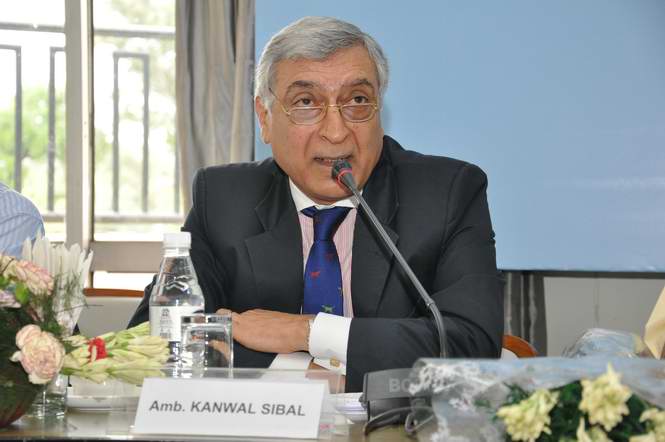
In a scathing rebuttal to White House counsellor for trade and manufacturing Peter Navarro’s recent comments blaming India for the ongoing war in Ukraine, former Indian Foreign Secretary Kanwal Sibal has slammed the accusations as a “vicious attack animated by India hate.”
This comes after Peter Navarro accused India of enabling Russia’s war in Ukraine by acting as a “global clearinghouse” for Russian oil, while continuing to block American exports with high tariffs.
In a sharply worded opinion piece published in the Financial Times on Monday, Navarro called on the US to get tough with New Delhi, warning that India’s policies undermine American workers and bankroll Vladimir Putin’s war machine.
“No normal person capable of basic reasoning would hold India responsible for the continuing killings in Ukraine,” said Sibal, who also served as India’s ambassador to Turkey, Egypt, France, and Russia, and is now the Chancellor of Jawaharlal Nehru University.
He pointed out that while Western nations continue to supply arms, funds, and real-time battlefield intelligence to Ukraine, they are simultaneously engaged in active trade with Russia — including in sectors they claim to have sanctioned.
https://x.com/KanwalSibal/status/1957371836691546412?t=RoK4gAcmkI6vRrNYPLXu5A&s=08
“Europe is doing everything to prevent peace except on its own terms. The US is still buying uranium, palladium and other critical resources from Russia. Putin himself noted from Alaska that US-Russia trade had increased by 20 per cent after Trump took office,” he said in a post on X.
Citing 2024 data, Sibal underscored that China imported approximately 108 million metric tons of crude oil from Russia — making Moscow its largest oil supplier — while Turkey has emerged as the world’s top buyer of Russian refined petroleum products, effectively acting as a hub for sanctions circumvention. Even close US allies like Japan continue to import Russian LNG.
Against this backdrop, Sibal dismissed Navarro’s criticism of Indian companies purchasing discounted Russian oil as not only hypocritical, but deeply misinformed.
“Navarro deprecates earnings by a couple of Indian business houses from refined oil products, but chooses to ignore the vast profits American multinational corporations earn globally,” he said.
According to estimates, US companies earn around 85 billion USD annually from Indian consumers through sales, investments, and services. However, this figure does not capture income from sectors like education, defense, digital services, consulting, and intellectual property. When these are included, the US surplus with India is believed to be between 35 and 40 billion USD.
“Navarro should examine the profit structure of US multinationals before throwing stones,” Sibal added.
Sibal pointed out that many of America’s largest corporations generate the majority of their revenue overseas.
For example, Intel earns 78.3% of its total revenue outside the U.S., Mondelez 74.4%, Coca-Cola 68.6%, and Apple 60.7%. Similarly, firms like Chevron (53.9%), Pfizer (53.9%), Alphabet (53.8%), General Electric (58.7%), Procter & Gamble (57.8%), and IBM (53.0%) all derive over half their sales from foreign markets.
“The economic interdependence between the U.S. and the rest of the world, including India, is substantial. To single out India for a policy that many others — including US allies — also follow, is not just biased but factually indefensible,” Sibal concluded.
Navarro, known for his strong advocacy of protectionist economic policies, particularly his focus on reducing the US trade deficit, is a key trade advisor to US President Donald Trump.
He has played a significant role in shaping the administration’s approach to tariffs, trade agreements, and economic nationalism, often emphasizing the idea that economic strength is linked to national security.