














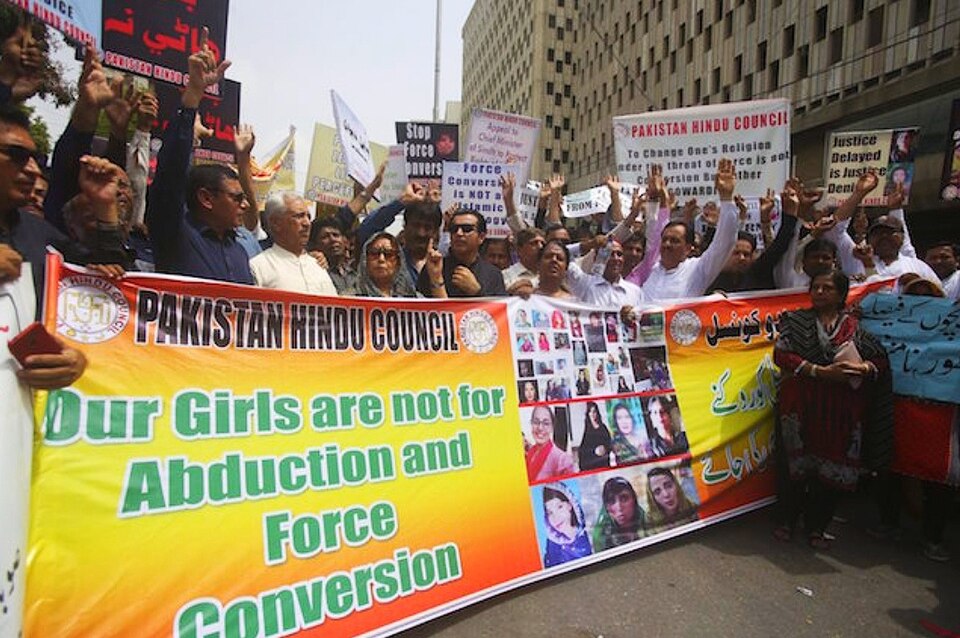
Every year, over a thousand Hindu and Christian girls in Pakistan disappear into the shadows of forced conversions and marriages. These are not isolated crimes but a systematic campaign against minorities, sanctioned by silence and complicity of the state. Behind Pakistan’s rhetoric of “religious tolerance,” lies a chilling reality temples desecrated, families shattered, and minor girls torn away from their homes. Human rights bodies have repeatedly raised alarms, yet the cries of these victims remain unheard globally. This is not just a human rights issue it is a slow cultural genocide targeting Pakistan’s last remaining non-Muslims.
The Scale of the Crisis
According to the Movement for Solidarity and Peace (MSP), nearly 1,000 Hindu and Christian girls aged between 12 and 25 are abducted every year in Pakistan. Most victims are underage, taken from Sindh, Punjab, and Khyber Pakhtunkhwa. Once abducted, they are subjected to mental and physical torture, forced conversions, and marriages to older Muslim men often with the help of fabricated documents. Courts, instead of providing justice, frequently validate these marriages after coercing the victims into giving “confession” statements. Families who dare to resist are threatened with violence or false blasphemy charges.
Complicity of State and Clerics
Forced conversions in Pakistan are not random crimes they are enabled by a network of Islamist clerics, madrassas, and a complicit state machinery. Extremist clerics like Mian Abdul Haq (Mian Mithu) openly run conversion centres such as Dargah Bharchundi Sharif in Sindh’s Ghotki, infamous for abducting Hindu girls and producing fake conversion certificates. In Mirpur Khas, entire Hindu families have been targeted, with some forced into mosque-cum-training centres where they undergo “Islamisation programs.” Shockingly, even ministers’ families have attended such conversion ceremonies as “chief guests,” legitimising this abuse. Police often refuse to file FIRs or threaten the families into silence.
Real Faces Behind the Numbers
The statistics mask horrifying stories of human suffering. In 2023, Muskan, a Christian minor, was kidnapped at gunpoint, forced to marry her abductor, and repeatedly subjected to sexual abuse. Another girl, Shifa, just 14 years old, was declared the wife of a 48-year-old man using fake documents, while a police officer told her father bluntly: “Your daughter will never return to you, Inshallah.” In June 2025, four Hindu siblings Jiya (22), Diya (20), Disha (16), and Ganesh Kumar (14) were abducted from Sindh. Days later, videos surfaced of them performing namaz with new Muslim names. Such chilling cases are not exceptions but the norm in Pakistan.
A Systematic Attack on Identity
The issue of forced conversions cannot be separated from Pakistan’s deep-rooted hatred towards Hindus and other minorities. Textbooks openly demonise Hindus, mobs frequently attack temples, and blasphemy laws are weaponised against Christians. Human rights reports reveal that girls as young as 12 are targeted, and most victims never return to their families. Parents, fearing abduction, have stopped sending daughters to schools in Sindh and Punjab. The National Commission on the Rights of the Child (NCRC) in 2025 confirmed severe discrimination faced by minority children, proving that systemic religious apartheid exists in Pakistan. What is unfolding is nothing short of cultural erasure of the Hindu and Christian identity.
A Genocide in Slow Motion
The forced conversion of Hindu and Christian girls in Pakistan is not just a law-and-order issue it is a calculated assault on religious freedom and human dignity. The perpetrators enjoy political protection, the judiciary turns a blind eye, and the international community maintains a dangerous silence. For Pakistan’s minorities, survival itself has become resistance. Under General Asim Munir’s Islamist regime, radicalisation has only deepened, leaving Hindus and Christians with two grim choices: convert or flee. The plight of these girls is a reminder that while Pakistan cries victimhood on the world stage, it continues to preside over one of the most chilling humanitarian crises in South Asia. Until the global community confronts this issue head-on, the slow genocide of Pakistan’s minorities will continue unchecked.