






















TFIPOST हिन्दी
TFIPOST Global
Tfipost.com
Tfipost.com
No Result
View All Result
  • Premium
  • Politics
    • All
    • Analysis
    • Opinions
    • Trending
    Chief Minister Yogi Adityanath speaking during the special session of the Uttar Pradesh Assembly

    Yogi Exposes Opposition’s ‘Anti-Women’ Politics as UP Assembly Session on Reservation Turns Into Reality Check for SP-Congress

    Countdown to May 4: NDA Projects Gains Across Crucial States

    BJP Signals Broad NDA Upswing as Poonawalla Foresees Wins Across Key States

    Calcutta High Court Rebuke: Border Fencing Delay Puts Bengal Government Under Fire

    Calcutta High Court Rebuke: Border Fencing Delay Puts Bengal Government Under Fire

    West Bengal On Alert After High-Turnout Polls As CEO Urges: ‘ No Post-Poll Violence Should Happen’

    West Bengal On Alert After High-Turnout Polls As CEO Urges: ‘ No Post-Poll Violence Should Happen’

    • Analysis
    • Opinions
    • Trending
  • Economy
    • All
    • Business
    • Economy1
    • Finance
    AI, access, and accountability: Goyal’s push to transform India’s procurement system through GeM

    Goyal Speeds Up GeM Revamp, Pushes AI Tools and Wider Access to Reform Procurement System

    What are the Benefits of Critical Health Insurance in Serious Illness Cases?

    What are the Benefits of Critical Health Insurance in Serious Illness Cases?

    How Digital Verification Works In Online Personal Loan Applications

    How Digital Verification Works In Online Personal Loan Applications

    Top Features to Look for in the Best Health Insurance Plan

    Top Features to Look for in the Best Health Insurance Plan

    • Business
    • Finance
  • Defense
    • All
    • Defence
    • Strategy
    • Weaponry
    Why is Making a Jet Engine so Hard | The failure of Kaveri

    Why is Making a Jet Engine so Hard | The failure of Kaveri

    Rajnath Singh at SCO, reaffirming India’s zero-tolerance stand on terrorism.

    “No More Double Standards”: Rajnath Singh’s SCO Message Rewrites India’s Terror Response Playbook

    Recovered arms and arrests have intensified scrutiny on a suspected cross-border terror network.

    Pakistan’s Proxy War Faces a Setback as Delhi Terror Plot is Crushed, 18 Weapons Seized

    The scars of Pahalgam endure, even as the nation moves forward

    Pahalgam Anniversary: Modi Signals Firm National Stand as India Reasserts Anti-Terror Resolve

    • Defence
    • Strategy
    • Weaponry
  • Geopolitics
    • All
    • Africa
    • Americas
    • Asia Pacific
    • Europe
    • South Asia
    • West Asia
    Karachi Pact 1949: How Pakistan Cemented Control Over Gilgit-Baltistan Without Its People’s Consent

    Karachi Pact 1949: How Pakistan Cemented Control Over Gilgit-Baltistan Without Its People’s Consent

    When law becomes an instrument of exclusion, persecution moves far beyond the courtroom.

    Ahmadis in Pakistan: From Faith to Marginalisation Under Law and Society

    When uranium becomes strategy, India moves first.

    India’s $4 Billion Uranium Coup with Kazakhstan Rewrites the Global Nuclear Balance

    “Fixing the World”: What a Century of Big Ideas Reveals About Us

    “Fixing the World”: What a Century of Big Ideas Reveals About Us

    • Africa
    • Americas
    • Asia Pacific
    • Europe
    • South Asia
    • West Asia
  • Knowledge
    • All
    • Culture
    • Education
    • History
    • Indology
    Chants of ‘Jai Badri Vishal’ Echo as Badrinath Portals Open; All Four Dhams Now Accessible to Pilgrims

    Chants of ‘Jai Badri Vishal’ Echo as Badrinath Portals Open; All Four Dhams Now Accessible to Pilgrims

    Kedarnath Dham Portals Open for Devotees After 181 Days Amid Vedic Chants, Traditional Rituals

    Kedarnath Dham Portals Open for Devotees After 181 Days Amid Vedic Chants, Traditional Rituals

    Sardar Patel and Amit Shah

    Sardar Patel’s 1947 Blueprint on Minority Quotas Resurfaces as Reservation Debate Returns to Centre Stage

    The 1973 Constitution and ‘Bhutto’ the Man Who Made It: What Pakistan Owes and What It Destroyed

    The 1973 Constitution and ‘Bhutto’ the Man Who Made It: What Pakistan Owes and What It Destroyed

    • Culture
    • History
    • Indology
  • Law
  • Lounge
    • All
    • Books
    • Cinema
    • Entertainment
    • Food
    • Games
    • Health
    • Lifestyle
    • Satire
    • Sports
    • technology
    • Travel
    594 km of speed, scale and connectivity; the Ganga Expressway opens a new development corridor across Uttar Pradesh.

    Modi Opens 594-Km Ganga Expressway, Unveils Uttar Pradesh’s New High-Speed Growth Corridor

    When regulation meets the algorithm

    India Tightens Digital Control as Online Blocking Orders Surge to 24,300 Amid AI Deepfake Trend

    Digital Data Collection In India

    India’s Data Reset Begins: Census 2027 to Become First Fully Digital Population Count

    5 Facilities in Bengaluru Specializing in Mental Health Treatment for Those with Cancer

    5 Facilities in Bengaluru Specializing in Mental Health Treatment for Those with Cancer

    • Books
    • Cinema
    • Food
    • Health
    • Sports
    • technology
    • Travel
    • Satire
Tfipost.com
  • Premium
  • Politics
    • All
    • Analysis
    • Opinions
    • Trending
    Chief Minister Yogi Adityanath speaking during the special session of the Uttar Pradesh Assembly

    Yogi Exposes Opposition’s ‘Anti-Women’ Politics as UP Assembly Session on Reservation Turns Into Reality Check for SP-Congress

    Countdown to May 4: NDA Projects Gains Across Crucial States

    BJP Signals Broad NDA Upswing as Poonawalla Foresees Wins Across Key States

    Calcutta High Court Rebuke: Border Fencing Delay Puts Bengal Government Under Fire

    Calcutta High Court Rebuke: Border Fencing Delay Puts Bengal Government Under Fire

    West Bengal On Alert After High-Turnout Polls As CEO Urges: ‘ No Post-Poll Violence Should Happen’

    West Bengal On Alert After High-Turnout Polls As CEO Urges: ‘ No Post-Poll Violence Should Happen’

    • Analysis
    • Opinions
    • Trending
  • Economy
    • All
    • Business
    • Economy1
    • Finance
    AI, access, and accountability: Goyal’s push to transform India’s procurement system through GeM

    Goyal Speeds Up GeM Revamp, Pushes AI Tools and Wider Access to Reform Procurement System

    What are the Benefits of Critical Health Insurance in Serious Illness Cases?

    What are the Benefits of Critical Health Insurance in Serious Illness Cases?

    How Digital Verification Works In Online Personal Loan Applications

    How Digital Verification Works In Online Personal Loan Applications

    Top Features to Look for in the Best Health Insurance Plan

    Top Features to Look for in the Best Health Insurance Plan

    • Business
    • Finance
  • Defense
    • All
    • Defence
    • Strategy
    • Weaponry
    Why is Making a Jet Engine so Hard | The failure of Kaveri

    Why is Making a Jet Engine so Hard | The failure of Kaveri

    Rajnath Singh at SCO, reaffirming India’s zero-tolerance stand on terrorism.

    “No More Double Standards”: Rajnath Singh’s SCO Message Rewrites India’s Terror Response Playbook

    Recovered arms and arrests have intensified scrutiny on a suspected cross-border terror network.

    Pakistan’s Proxy War Faces a Setback as Delhi Terror Plot is Crushed, 18 Weapons Seized

    The scars of Pahalgam endure, even as the nation moves forward

    Pahalgam Anniversary: Modi Signals Firm National Stand as India Reasserts Anti-Terror Resolve

    • Defence
    • Strategy
    • Weaponry
  • Geopolitics
    • All
    • Africa
    • Americas
    • Asia Pacific
    • Europe
    • South Asia
    • West Asia
    Karachi Pact 1949: How Pakistan Cemented Control Over Gilgit-Baltistan Without Its People’s Consent

    Karachi Pact 1949: How Pakistan Cemented Control Over Gilgit-Baltistan Without Its People’s Consent

    When law becomes an instrument of exclusion, persecution moves far beyond the courtroom.

    Ahmadis in Pakistan: From Faith to Marginalisation Under Law and Society

    When uranium becomes strategy, India moves first.

    India’s $4 Billion Uranium Coup with Kazakhstan Rewrites the Global Nuclear Balance

    “Fixing the World”: What a Century of Big Ideas Reveals About Us

    “Fixing the World”: What a Century of Big Ideas Reveals About Us

    • Africa
    • Americas
    • Asia Pacific
    • Europe
    • South Asia
    • West Asia
  • Knowledge
    • All
    • Culture
    • Education
    • History
    • Indology
    Chants of ‘Jai Badri Vishal’ Echo as Badrinath Portals Open; All Four Dhams Now Accessible to Pilgrims

    Chants of ‘Jai Badri Vishal’ Echo as Badrinath Portals Open; All Four Dhams Now Accessible to Pilgrims

    Kedarnath Dham Portals Open for Devotees After 181 Days Amid Vedic Chants, Traditional Rituals

    Kedarnath Dham Portals Open for Devotees After 181 Days Amid Vedic Chants, Traditional Rituals

    Sardar Patel and Amit Shah

    Sardar Patel’s 1947 Blueprint on Minority Quotas Resurfaces as Reservation Debate Returns to Centre Stage

    The 1973 Constitution and ‘Bhutto’ the Man Who Made It: What Pakistan Owes and What It Destroyed

    The 1973 Constitution and ‘Bhutto’ the Man Who Made It: What Pakistan Owes and What It Destroyed

    • Culture
    • History
    • Indology
  • Law
  • Lounge
    • All
    • Books
    • Cinema
    • Entertainment
    • Food
    • Games
    • Health
    • Lifestyle
    • Satire
    • Sports
    • technology
    • Travel
    594 km of speed, scale and connectivity; the Ganga Expressway opens a new development corridor across Uttar Pradesh.

    Modi Opens 594-Km Ganga Expressway, Unveils Uttar Pradesh’s New High-Speed Growth Corridor

    When regulation meets the algorithm

    India Tightens Digital Control as Online Blocking Orders Surge to 24,300 Amid AI Deepfake Trend

    Digital Data Collection In India

    India’s Data Reset Begins: Census 2027 to Become First Fully Digital Population Count

    5 Facilities in Bengaluru Specializing in Mental Health Treatment for Those with Cancer

    5 Facilities in Bengaluru Specializing in Mental Health Treatment for Those with Cancer

    • Books
    • Cinema
    • Food
    • Health
    • Sports
    • technology
    • Travel
    • Satire
No Result
View All Result
Tfipost.com
Tfipost.com
No Result
View All Result
  • Premium
  • Politics
  • Economy
  • Defense
  • Geopolitics
  • Knowledge
  • Law
  • Lounge

Beyond Feminism: When Misusing the Woman Card Becomes Corporate Sabotage

So, are women free after half a century of feminism in India? Or has it only worsened for women, both on the personal and professional fronts?

Abhishek Kumar Singh by Abhishek Kumar Singh
9 March 2023
in Opinions
Beyond Feminism: When Misusing the Woman Card Becomes Corporate Sabotage
Share on FacebookShare on X

Women’s Day 2023 has passed. Like every year, lots of showpieces were organized. Big speeches were made for empowering women, both socially and economically. Advertisers jumped on the bandwagon to teach women what empowerment means in the truest sense’. Some claim empowerment lies in freedom from patriarchy.

Some claim empowerment lies in joining the workforce. Some claim empowerment lies in having the choice to wear whatever she wants. Others interpret it as feeling empowered to wear patriarchy-imposed clothes like the hijab. There is one common denominator in all of this. That is decisional autonomy. Make no mistake about it: decisional autonomy comes mainly from financial freedom.

RelatedPosts

Bengal Election Turns Sharper: Modi Escalates TMC Attack as Women’s Safety and Welfare Dominate Narrative

Remembering Social Reformer Jyotirao Phule on his Death Anniversary: The Visionary Who Fought for Equality and Education

HIV- Positive Teen Raped, Forced into Abortion at Maharashtra’s Sevalay

Load More

So, are women free after half a century of feminism in India? Or has it only worsened for women, both on the personal and professional fronts? And if it is, what are the reasons behind it?

No company for women 

According to the latest study by IBM and Chief, despite all the rhetoric, women in this generation are less likely to repeat the miracles of the previous generation. What I mean by it is that the chances that India will produce the next Indra Nooyi or Kiran Mazumdar Shaw are diminishing day by day.

Women have simply bailed out of corporations in the last few years. Previously, women made up 18-19% of middle management in 2019. The number has come down to 14–16 percent in 2023. The problem is worsened by the fact that only 39 percent of companies would prefer to promote these women to leadership roles. The global average is 45.

Also read: How fake news is polarising opinion and making us blind to progress

This is just a part of the larger pattern. Let me ask you a question. When do you think was the right and safer time for women to join the workforce, 1990 or 2021? Of course, the answer will be 2021. We have a much more sincere and sensitive population when it comes to respecting women.

We have an empathetic workplace. Companies ideally prioritize hiring women. They have specific mechanisms in place for women’s security. Cabs are available for transportation. There are many more other facilities. Many states provide them with free bus rides. Result?

Contrary to expected trends, these measures have not resulted in increased female workforce participation. It has declined from 30 percent in 1990 to 19 percent in 2021. Compared to 32 percent in 2005, the decline is steeper.
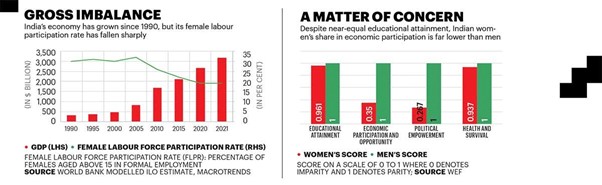
 PC: Businesstoday

That is a shocker. Wrong word. It is horror. The data is pretty clear on that front. India can add more than 26.4 crore women to the workforce. It could lead to a 27 percent increase in GDP, or, in plain words, Rs 70,000 crores.

Also read: Modern feminism is teaching to not copy men, but copy bad boys

Questions galore

It’s puzzling to many. The lack of a wholesome explanation for this phenomenon causes activists to invent absurd reasons for it. On TV channels, they can easily be found blaming society, patriarchy, lack of laws, lack of women’s security, and even company policies. What they don’t talk about is how far society has come in ensuring women’s safety. Sure, problems are there, but the situation is far better. So, whose fault, is it?

It’s the fault of the structure on which pro-women activists are relying to ensure that women join the workforce. Knowingly or unknowingly, what they have done is inherited the same patriarchal structure that they bash all around, packed it up in a new form, and sold it to women, eventually becoming the new patriarchal head.

The allegation against patriarchy is that, under the guise of protecting women, it discriminates against them. Accepted. But what are our laws supposed to do to free them of this phenomenon? Nothing; they do the same. Article 15(3) of the Indian Constitution empowers states to make special laws and provisions for women and children. Unfortunately, the special provisions manifest in restricting women from joining the workforce.

Also read: Feminism, Marital rape and “Gupt Sutra” – A dangerous trio

Are we patronizing women?

In March 2022, Trayas, an independent regulatory research and policy advisory organization, published a report titled State of Discrimination Report. It analyzed legal provisions with respect to women joining the workforce. Both central acts like the Factories Act and state-level acts were taken into consideration.

The report highlights that 5 of 6 union acts, namely the Factories Act and Rules, Shops and Establishment Act, Contract Labour Act and Rules, Inter-state Migrant Workmen Act and Rules, and Plantation Labour Act, prohibit women from working at night. The Factories Act outperformed all of them in overall restrictions. Apart from working at night, the act also restricts women from working in hazardous atmospheres. Taking into account both state-level laws and central ones, in Indian labor laws, a total of 650 provisions were found to be restricting women’s entry into the workforce.

Also read: Feminism, Atheism and Homosexuality declared “extremism” in Saudi as global liberal fraternity snoozes peacefully

Less business sense and more coercion

Last year, a few changes were introduced. The government has proposed to amend Section 66 of the Factories Act to ensure that women are able to work between 7 p.m. and 6 a.m. Again, the solution to the problem sounds virtuous and easy. And that is exactly where the problem lies. There are imminent dangers for female travelers traveling around sunset and sunrise.

The onus of ensuring that nothing happens to these women would certainly lie on the management of the factory and company in which they are working. Surely, it makes sense for management to provide these facilities between work hours.

However, the problem arises when these women travel to work. Companies have to spend a bit extra on hiring security personnel and cabs. They may get ready to do that to sound virtuous, but ultimately it would lead to indirect discrimination against women. Spending on them brings a lower return on investment as compared to men, and no business would like that.

It would be much better if the authorities would take care of extra expenses. Because this amendment is not the only one that hurts a company’s finances. The Maternity Benefits Act provides for 26 weeks of paid maternity leave as well as one month of paid leave for illness caused by pregnancy or miscarriage. Earlier, it was only for 12 weeks. Once again, the problem is that the act lacks nuances.

It gives absolute rights to women without any corresponding responsibility. For a company to provide women with benefits, there has to be a quid pro quo. So, for instance, if the woman has worked for a company for years and has contributed significantly towards value creation, it is the moral responsibility of the company to provide her with these benefits.

However, if she has just joined a company and wants to take a leave, the company is legally bound to do that, but at the end of the day, management will feel only cheated. Then there is a new demand for paid menstrual leave. A petition in the Supreme Court was filed regarding that. The Honourable CJI rightly inferred that it would only lead to discrimination against women.

More demands are in the pipeline. These things are literally eroding the gains made by women. Studies after studies are being published, showcasing women as better leaders than men. Indian society has been able to respect this trait. In families, women have been equal decision-makers from time immemorial. In religious functions, women are more preferred over men. Somehow, we are just not able to make it easier for our women to take their place in the workforce.

Also read: ‘Feminism in India’ celebrates Hijab, calls Ghoonghat a practise of patriarchal control

Coercion never works

The primary reason for this is to ape the western idea of pushing women into the workforce through coercion. It does not work in modern capitalist societies. At the end of the day, businesses run on profits. It is literally the definition of business. They are amoral, which means that businesses don’t consider the social definition of morality. If they benefit from it, businesses will spend billions of dollars to make such stuff acceptable in society.

Businesses will hire and promote women only when they benefit from it. They benefit from abortion more than motherhood, so they are promoting it more in recent times. That has not always been the case. Companies have been quite apprehensive of hiring western women in the past due to an excessive emphasis on the rights and privilege aspects of jobs rather than responsibility.

To avoid it in India, the drumbeat needs to slow down. It could slow down only when the government, businesses, and women themselves join hands. Responsible and upright women would have to step forward to balance rights and responsibilities. For instance, they could take women on board to make alternate arrangements like taking medication or working from home rather than taking absolute leave.

On their part, companies should ask the government what it needs to ensure equality at the workplace. They could ask the government to subsidize maternity leave and other kinds of privileges available to them purely for biological reasons.

Collaboration and vigorous deliberation are the needs of the hour. There are way too many advantages to miss out on. Integration of women in the workforce is beneficial for both the workforce and family. If women go to work, it will create a need for alienated old parents to rejoin their kids’ families as they will be required to take care of the child. It is already happening, but more needs to be done.

Support TFI:

Support us to strengthen the ‘Right’ ideology of cultural nationalism by purchasing the best quality garments from TFI-STORE.COM

Also Watch:

Tags: AbortionCorporate cultureIBM and ChiefIndian SocietyIndra NooyiKiran Mazumdar ShawMaternity leaveMensuration leaveWomen Empowerment
ShareTweetSend
Previous Post

Was Dilip Kumar a Pakistani spy?

Next Post

When foreigners saw Indian cotton for the first time, they couldn’t believe their eyes

Related Posts

Resolve of a Changing Bengal: Youth, Potential, and Call for Transformation
Opinions

Resolve of a Changing Bengal: Youth, Potential, and Call for Transformation

21 April 2026

The yearning for change in the soil of Bengal is not a sudden wave, it is a convergence of...

Redefining Terms of Truly Mutual Trade Deal: Sovereignty and Strategy in the US–Bangladesh Framework
Economy

Redefining Terms of Truly Mutual Trade Deal: Sovereignty and Strategy in the US–Bangladesh Framework

15 April 2026

The debate around Bangladesh’s emerging trade framework with the United States cannot be reduced to a binary choice of...

Race Against Iran Deadline: Was Pakistan’s Ceasefire Bid Driven by the White House?
Geopolitics

Race Against Iran Deadline: Was Pakistan’s Ceasefire Bid Driven by the White House?

9 April 2026

Pakistan attempted to position itself as a peacemaker in the escalating tensions involving Iran, but the reality behind the...

Load More

Leave a Reply Cancel reply

Your email address will not be published. Required fields are marked *

I agree to the Terms of use and Privacy Policy.
This site is protected by reCAPTCHA and the Google Privacy Policy and Terms of Service apply.

Currently Playing

From Runways to Warships: India’s Firefighting Warrior Built for Bases & Battles| IAF | VayuShakti

From Runways to Warships: India’s Firefighting Warrior Built for Bases & Battles| IAF | VayuShakti

00:05:40

Ethanol, EVs and Solar- How India’s Energy Game Is Changing | Modi on LPG & Crude Oil | war| Hormuz

00:05:21

Truth of IRIS Dena: 8 Days That Changed Narrative | War zone Reality, Not an Indian Navy Exercise

00:08:02

300 Million Euros for SCALP: Strategic Necessity or Costly Dependency on France300

00:04:06

Tejas Mk1A: 19th aircraft coupled but Not Delivered: What Is Holding Back the IAF Induction?

00:07:21
Facebook Twitter Instagram Youtube
tfipostTfipost.com
Right Wing | News Analysis | Indian Opinion
  • About us
  • Contact Us
  • Careers
  • Brand Partnerships
  • Terms of use
  • Privacy Policy
  • Sitemap

©2026 TFI Media Private Limited

No Result
View All Result
  • Premium
  • Politics
    • Analysis
    • Opinions
    • Trending
  • Economy
    • Business
    • Finance
  • Defense
    • Defence
    • Strategy
    • Weaponry
  • Geopolitics
    • Africa
    • Americas
    • Asia Pacific
    • Europe
    • South Asia
    • West Asia
  • Knowledge
    • Culture
    • History
    • Indology
  • Law
  • Lounge
    • Books
    • Cinema
    • Food
    • Health
    • Sports
    • technology
    • Travel
    • Satire
TFIPOST हिन्दी
TFIPOST Global

©2026 TFI Media Private Limited