












TFIPOST हिन्दी
TFIPOST Global
Tfipost.com
Tfipost.com
No Result
View All Result
  • Premium
  • Politics
    • All
    • Analysis
    • Opinions
    • Trending
    From pilgrimage to metros, now without the wait

    From Kashi to Mumbai and Ayodhya to Pune: Modi Expands Rail Network with New Amrit Bharat Express Services

    Why is Making a Jet Engine so Hard | The failure of Kaveri

    Why is Making a Jet Engine so Hard | The failure of Kaveri

    Rajnath Singh at SCO, reaffirming India’s zero-tolerance stand on terrorism.

    “No More Double Standards”: Rajnath Singh’s SCO Message Rewrites India’s Terror Response Playbook

    Nepal PM Faces Fresh Controversy as Church Demolition Row Triggers Political Storm

    Nepal PM Faces Fresh Controversy as Church Demolition Row Triggers Political Storm

    • Analysis
    • Opinions
    • Trending
  • Economy
    • All
    • Business
    • Economy1
    • Finance
    India–New Zealand FTA signed in New Delhi, marking a “once in a lifetime” moment in trade ties.

    India, New Zealand Seal Fast-Tracked Trade Pact to Expand Duty-Free Access, Jobs and $5 Billion Trade Target

    Ahmadis in Pakistan: From Faith to Marginalisation Under Law and Society

    Ahmadis in Pakistan: From Faith to Marginalisation Under Law and Society

    Open Demat Account with Zero Annual Maintenance Charges What to Look For

    Open Demat Account with Zero Annual Maintenance Charges What to Look For

    Blood in the Meadows: How the Pahalgam Terror Attack Exposed Calculated Targeting of Civilians in Kashmir

    Blood in the Meadows: How the Pahalgam Terror Attack Exposed Calculated Targeting of Civilians in Kashmir

    • Business
    • Finance
  • Defense
    • All
    • Defence
    • Strategy
    • Weaponry
    Why is Making a Jet Engine so Hard | The failure of Kaveri

    Why is Making a Jet Engine so Hard | The failure of Kaveri

    Rajnath Singh at SCO, reaffirming India’s zero-tolerance stand on terrorism.

    “No More Double Standards”: Rajnath Singh’s SCO Message Rewrites India’s Terror Response Playbook

    Recovered arms and arrests have intensified scrutiny on a suspected cross-border terror network.

    Pakistan’s Proxy War Faces a Setback as Delhi Terror Plot is Crushed, 18 Weapons Seized

    The scars of Pahalgam endure, even as the nation moves forward

    Pahalgam Anniversary: Modi Signals Firm National Stand as India Reasserts Anti-Terror Resolve

    • Defence
    • Strategy
    • Weaponry
  • Geopolitics
    • All
    • Africa
    • Americas
    • Asia Pacific
    • Europe
    • South Asia
    • West Asia
    When law becomes an instrument of exclusion, persecution moves far beyond the courtroom.

    Ahmadis in Pakistan: From Faith to Marginalisation Under Law and Society

    When uranium becomes strategy, India moves first.

    India’s $4 Billion Uranium Coup with Kazakhstan Rewrites the Global Nuclear Balance

    “Fixing the World”: What a Century of Big Ideas Reveals About Us

    “Fixing the World”: What a Century of Big Ideas Reveals About Us

    Pakistan Tried to Bury an NYT Report. It Only Exposed Asim Munir’s Panic

    Pakistan Tried to Bury an NYT Report. It Only Exposed Asim Munir’s Panic

    • Africa
    • Americas
    • Asia Pacific
    • Europe
    • South Asia
    • West Asia
  • Knowledge
    • All
    • Culture
    • Education
    • History
    • Indology
    Chants of ‘Jai Badri Vishal’ Echo as Badrinath Portals Open; All Four Dhams Now Accessible to Pilgrims

    Chants of ‘Jai Badri Vishal’ Echo as Badrinath Portals Open; All Four Dhams Now Accessible to Pilgrims

    Kedarnath Dham Portals Open for Devotees After 181 Days Amid Vedic Chants, Traditional Rituals

    Kedarnath Dham Portals Open for Devotees After 181 Days Amid Vedic Chants, Traditional Rituals

    Sardar Patel and Amit Shah

    Sardar Patel’s 1947 Blueprint on Minority Quotas Resurfaces as Reservation Debate Returns to Centre Stage

    The 1973 Constitution and ‘Bhutto’ the Man Who Made It: What Pakistan Owes and What It Destroyed

    The 1973 Constitution and ‘Bhutto’ the Man Who Made It: What Pakistan Owes and What It Destroyed

    • Culture
    • History
    • Indology
  • Law
  • Lounge
    • All
    • Books
    • Cinema
    • Entertainment
    • Food
    • Games
    • Health
    • Lifestyle
    • Satire
    • Sports
    • technology
    • Travel
    When regulation meets the algorithm

    India Tightens Digital Control as Online Blocking Orders Surge to 24,300 Amid AI Deepfake Trend

    Digital Data Collection In India

    India’s Data Reset Begins: Census 2027 to Become First Fully Digital Population Count

    5 Facilities in Bengaluru Specializing in Mental Health Treatment for Those with Cancer

    5 Facilities in Bengaluru Specializing in Mental Health Treatment for Those with Cancer

    UNESCO World Book Day and Copyright Day

    World Book Day 2026: UNESCO’s Multilingual Push Aligns with India’s Deep Literary Continuum

    • Books
    • Cinema
    • Food
    • Health
    • Sports
    • technology
    • Travel
    • Satire
Tfipost.com
  • Premium
  • Politics
    • All
    • Analysis
    • Opinions
    • Trending
    From pilgrimage to metros, now without the wait

    From Kashi to Mumbai and Ayodhya to Pune: Modi Expands Rail Network with New Amrit Bharat Express Services

    Why is Making a Jet Engine so Hard | The failure of Kaveri

    Why is Making a Jet Engine so Hard | The failure of Kaveri

    Rajnath Singh at SCO, reaffirming India’s zero-tolerance stand on terrorism.

    “No More Double Standards”: Rajnath Singh’s SCO Message Rewrites India’s Terror Response Playbook

    Nepal PM Faces Fresh Controversy as Church Demolition Row Triggers Political Storm

    Nepal PM Faces Fresh Controversy as Church Demolition Row Triggers Political Storm

    • Analysis
    • Opinions
    • Trending
  • Economy
    • All
    • Business
    • Economy1
    • Finance
    India–New Zealand FTA signed in New Delhi, marking a “once in a lifetime” moment in trade ties.

    India, New Zealand Seal Fast-Tracked Trade Pact to Expand Duty-Free Access, Jobs and $5 Billion Trade Target

    Ahmadis in Pakistan: From Faith to Marginalisation Under Law and Society

    Ahmadis in Pakistan: From Faith to Marginalisation Under Law and Society

    Open Demat Account with Zero Annual Maintenance Charges What to Look For

    Open Demat Account with Zero Annual Maintenance Charges What to Look For

    Blood in the Meadows: How the Pahalgam Terror Attack Exposed Calculated Targeting of Civilians in Kashmir

    Blood in the Meadows: How the Pahalgam Terror Attack Exposed Calculated Targeting of Civilians in Kashmir

    • Business
    • Finance
  • Defense
    • All
    • Defence
    • Strategy
    • Weaponry
    Why is Making a Jet Engine so Hard | The failure of Kaveri

    Why is Making a Jet Engine so Hard | The failure of Kaveri

    Rajnath Singh at SCO, reaffirming India’s zero-tolerance stand on terrorism.

    “No More Double Standards”: Rajnath Singh’s SCO Message Rewrites India’s Terror Response Playbook

    Recovered arms and arrests have intensified scrutiny on a suspected cross-border terror network.

    Pakistan’s Proxy War Faces a Setback as Delhi Terror Plot is Crushed, 18 Weapons Seized

    The scars of Pahalgam endure, even as the nation moves forward

    Pahalgam Anniversary: Modi Signals Firm National Stand as India Reasserts Anti-Terror Resolve

    • Defence
    • Strategy
    • Weaponry
  • Geopolitics
    • All
    • Africa
    • Americas
    • Asia Pacific
    • Europe
    • South Asia
    • West Asia
    When law becomes an instrument of exclusion, persecution moves far beyond the courtroom.

    Ahmadis in Pakistan: From Faith to Marginalisation Under Law and Society

    When uranium becomes strategy, India moves first.

    India’s $4 Billion Uranium Coup with Kazakhstan Rewrites the Global Nuclear Balance

    “Fixing the World”: What a Century of Big Ideas Reveals About Us

    “Fixing the World”: What a Century of Big Ideas Reveals About Us

    Pakistan Tried to Bury an NYT Report. It Only Exposed Asim Munir’s Panic

    Pakistan Tried to Bury an NYT Report. It Only Exposed Asim Munir’s Panic

    • Africa
    • Americas
    • Asia Pacific
    • Europe
    • South Asia
    • West Asia
  • Knowledge
    • All
    • Culture
    • Education
    • History
    • Indology
    Chants of ‘Jai Badri Vishal’ Echo as Badrinath Portals Open; All Four Dhams Now Accessible to Pilgrims

    Chants of ‘Jai Badri Vishal’ Echo as Badrinath Portals Open; All Four Dhams Now Accessible to Pilgrims

    Kedarnath Dham Portals Open for Devotees After 181 Days Amid Vedic Chants, Traditional Rituals

    Kedarnath Dham Portals Open for Devotees After 181 Days Amid Vedic Chants, Traditional Rituals

    Sardar Patel and Amit Shah

    Sardar Patel’s 1947 Blueprint on Minority Quotas Resurfaces as Reservation Debate Returns to Centre Stage

    The 1973 Constitution and ‘Bhutto’ the Man Who Made It: What Pakistan Owes and What It Destroyed

    The 1973 Constitution and ‘Bhutto’ the Man Who Made It: What Pakistan Owes and What It Destroyed

    • Culture
    • History
    • Indology
  • Law
  • Lounge
    • All
    • Books
    • Cinema
    • Entertainment
    • Food
    • Games
    • Health
    • Lifestyle
    • Satire
    • Sports
    • technology
    • Travel
    When regulation meets the algorithm

    India Tightens Digital Control as Online Blocking Orders Surge to 24,300 Amid AI Deepfake Trend

    Digital Data Collection In India

    India’s Data Reset Begins: Census 2027 to Become First Fully Digital Population Count

    5 Facilities in Bengaluru Specializing in Mental Health Treatment for Those with Cancer

    5 Facilities in Bengaluru Specializing in Mental Health Treatment for Those with Cancer

    UNESCO World Book Day and Copyright Day

    World Book Day 2026: UNESCO’s Multilingual Push Aligns with India’s Deep Literary Continuum

    • Books
    • Cinema
    • Food
    • Health
    • Sports
    • technology
    • Travel
    • Satire
No Result
View All Result
Tfipost.com
Tfipost.com
No Result
View All Result
  • Premium
  • Politics
  • Economy
  • Defense
  • Geopolitics
  • Knowledge
  • Law
  • Lounge

All you need to know about the Anti-Sterlite protest in Thoothukudi, Tamil Nadu

Shubham Singh by Shubham Singh
27 May 2018
in Analysis
Sterlite Tamil Nadu, thoothukudi, violence, CBI, STERILITE

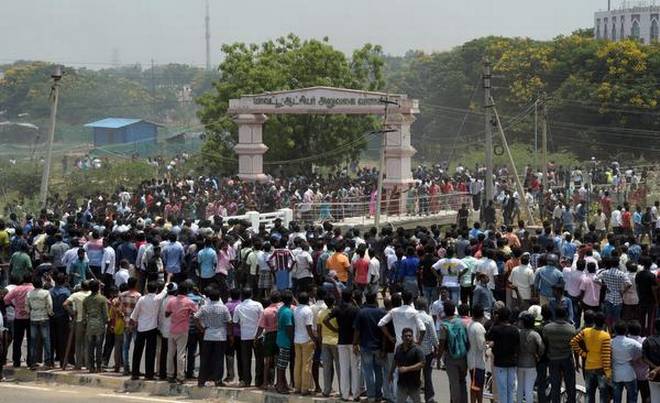
PC: Anti-Sterlite protesters laying siege to the Collectorate, demanding the closure of the copper manufacturing unit in Thoothukudi on May 22 | Photo Credit: N. Rajesh

Share on FacebookShare on X

The Sterlite protest took an ugly turn on the completion of its 100th day on 22th May. The protesters clashed with the police and burned down vehicles.  The police too opened fire in which more than 10 people were killed while several others were severely injured. The protesters in Thoothukudi, Tamil Nadu have been demanding to shut down the operations of the UK-based Vedanta Resources’ Sterlite Copper plant, since it’s causing serious environmental damages to its surroundings. After the incident Rahul Gandhi was quick enough to make baseless allegations against the RSS. He claimed that the protesters were killed for not following the ideology of the RSS. However his allegation is far from the truth. The copper plant which blatantly defied environmental regulations was allowed to function and survive, with the help of DMK, AIADMK and Congress throughout the years.

What is Sterlite India Copper Plant?

RelatedPosts

Kharge’s ‘Terrorist’ Jibe at PM Modi Triggers Political Uproar Ahead of Tamil Nadu Polls

‘Tamil Nadu Will Not Forgive’: Piyush Goyal Predicts NDA Surge, Intensifies Attack on Stalin

Women’s Reservation Bill Defeated, PM Modi Accuses Opposition of Sabotaging Reform and Failing India’s Women

Load More

It is a subsidiary of the London based Vedanta group. The company was founded in 1975 by Anil Agarwal. In India its head quarter is in Mumbai. The company mainly produces non-ferrous metals like copper, aluminium, zinc, sulphuric acid, phosphoric acid and is also engaged in the mining of bauxite, zinc ore, production of various aluminum products, manufacture of zinc ingots and lead ingots. It has two plants in India, one is in Silvassa, Daman & Diu and the other one is in Tuticorin, Tamil Nadu.

 Controversies around the Sterlite Plant

Recent controversy around the sterlite plant is not something new. It has been long opposed by the locals for causing hazardous damage to the environment and health of the people. In 1993, the construction of the plant in Ratnagiri, Maharashtra was demolished by the angry locals but even after the protest the company carried on with their construction work. The locals demanded its construction to be closed after they got to know about the damages the emissions from such plants causes. The Sterlite stopped their construction work only after the district collector and the Maharashtra government intervened. They still occupy the 500 acre land that has been allotted to them for the construction. The locals are now demanding the company to surrender the control of the land.

After the Ratnagiri fiasco, Sterlite moved to Tamil Nadu which was under the corrupt government of Jayalalitha. The locals protested there also but the protest was crushed down by the government and within a year they got all the clearance. The Tamil Nadu Pollution Control Board (TNPCB) in 1994 granted ‘No Objection Certificate’ (NOC) for construction of the plant. In 1995, the Ministry of Environment granted Environment Clearance without Environment Impact Assessment (EIA) and TNPCB also did the similar thing.

In 1996, Sterlite obtained permission from TNPCB to begin the production. During that time DMK was in power. Deve Gowda Government of third front was ruling at the Centre which was supported by the Congress party. The Protests erupted this time as well but the political manoeuvre of the ruling party ensured the continuation of the plant. Throughout the year, locals complained about air and water pollution with the District Collectorate. A case was filed by the National Trust for Clean Environment (NTCE) for the permanent shutdown of the Sterlite plant.

In 1997, agitations erupted again when the news of gas leak broke out. People complained of headache, coughing and choking due to smoke emanating from the Sterlite plant. Many of the locals fainted and were hospitalized. But still the TNPCB again gave the clean chit to the company. In the same year, George Fernandes and Vaiko launched protests organized by NTCE demanding permanent shutdown of the operations of the plant.

In the year 1998, the Madras High Court ordered the stay on the plant’s operation on the grounds that Sterlite plant had not met a single condition of conserving the environment. The court’s order was based on the study on Sterlite’s pollution conducted by National Environmental Engineering Research Institute (NEERI). In the study carried out by NEERI, it was found that the Sterlite plant, had failed to develop a greenbelt. The plant was indulged in producing the products it was not authorized to; it contaminated the groundwater with arsenic, lead, selenium, arsenic, aluminium and copper. On these grounds, Madras High court on November 23, 1998 ordered to shutdown the company. However, a week later court made a U-Turn and asks NEERI to do another study. In its second report NEERI gave clean chit to the company. In 1999, TNPCB under M. Karunanidhi allowed Sterlite plant to increase its production to 70,000 tonnes per annum; earlier it was 40,000 tonnes per annum.

In 2001, Locals complained about the release of arsenic laced toxic waste water by Sterlite. According to some reports arsenic laced wastewater released by Sterlite flooded the Silverpuram, Meelavittan and Kaluthaikuttan tanks. The locals complained to the TNPCB but there was no action taken against them.

In 2004, the Supreme Court Monitoring Committee (SCMC) team inspected Sterlite expansion and in its study it opposed its expansion. Even then sterlite was already using expanded units violating the environment rules, laws and regulations. The Committee directed the Pollution control board to take action against the expanded units under the various environment laws. It also directed TNPCB to carry on further investigation but the then UPA government headed by Manmohan Singh gave clearance for the expansion. A. Raja of DMK was heading the environment ministry during that time. TNPCB in its investigation found that Sterlite was operating over its production limit of 70,000 tonnes (165, 000 tonnes produced in a year) without caring about its harmful impacts on the environment. During the investigation it was found that many other plants were under construction and some of them didn’t even have any permission or license.  In the same year P. Chidambaram contested to become the Finance Minister of India before that he served as the non-executive director of Vedanta, the parent company of Sterlite Copper.

In 2005, both SCMC and Ministry of Environment and Forest directed TNPCB to give consent to operate all illegally constructed units within the plant. And Sterlite continued to expand and pollute. In 2007, Sterlite plant got the clearance from the Manmohan Singh government to expand its operational capacity to produce 4.2 lakh tonnes a year. In 2009, the company got the environment clearance to expand its capacity.

In 2010, On 28 September, the Madras High Court ordered the shutdown of operations of Sterlite’s company citing violations of law and for polluting the environment.  The company went to Supreme Court and only three days later, the Supreme Court ordered stay on the High Court’s order. This allowed the company to continue with its operations.

In 2013, the Supreme Court in its final order found the company guilty of violation of environmental norms. And the SC imposed Rs 100 crore fine on the Sterlite company and allowed it to continue with its operations. This judgment was illogical on the basis that how can a fine of 100 crore can undone the immense damage done by the company to the environment.

The two main parties of Tamil Nadu DMK and AIADMK have made sure that the Sterlite Company could continue with its operations without any problem. They turned a blind eye to the violation and the environmental damages done by the company. The company deserved to be shut down for the immense damage that it has caused to the environment. But the company continued to flourish under political patronage of both the parties.

TNPCB last year found that the Sterlite plant of violating six parameters of Air (Prevention and Control of) Pollution Act, 1981, and 11 parameters of the Water (Prevention and Control of) Pollution Act, 1974 (amended in 1988).

In 2018, fresh round of protests against the Sterlite firm began in the month of February. On 22 May protestors wanted to mark the 100th day of the protest. Their peaceful protest turned violent.  In order to stop them the police opened fired and more than 10 protestors lost their lives.

But, why did the protest turned violent?

Indications were plenty that violence could take place on 22nd May. Vedanta filed a petition on 16 May demanding section 144 to be imposed over one km radius area of the sterlite plant in Thoothukudi, Tamil Nadu, as some organization were planning to get violent during the protest.

On 18th May, the Court agreed to their demands as many pamphlets and provocative posters instigating protestors to commit violence were found. On 20th May, Thoothukudi district officers entered into talks with many organizations asking them to drop the idea of storming the Collecttorate. Most of the organizations boycotted the meeting; however, few businesses and trade organization and other organizations attended the meeting.

According to swarajya report, all those who attended the meeting agreed to organize the protests at SAV High School  instead of converging on the collectorate office. One of the leaders of anti-sterlite forum, Fathima babu attended the meeting after that the forum expelled her and decided to go ahead with its plan. After that the police arrested eight people including Fathima Babu as a preventive measure. But surprisingly police did not arrested anyone from organizations like Makkal Adhigaram (People’s Rights), Puratchi Illaignar Munnani (Revolutionary Youth Front),Naam Tamizhar.  It is reported that naxals have penetrated in these organizations.

Churches also played a great role in provoking the protestors in getting violent. The Church asked its followers to gather in large number to celebrate the 100th day of the protest. Atleast 5,000 people gathered in front of the Church of the Lady of Snow in Thoothukudi and they all marched towards the collector’s office. 

The March started from four different places. One group of protestors was led by the Geetha Jeevan, DMK member of legislative the assembly. She along with her followers was successfully stopped by the police at the gate of Sterlite and was arrested. Another group, comprising mainly of villagers were successfully stopped by the police again. They began their march from Madathur village.

The trouble was created by those who began their march from the Church. The strength of the protestor was around 10,000. The police stopped the protestors near the warehouse of Food Corporation of India but then the crowd overpowered the police and began marching ahead towards the collectorate’s office. The Police with all its limited strength gathered and began to retaliate. A fraction of the protestor consisting of 250 people entered into the quarter of Sterlite employees’ and set the vehicles on fire. When the police called the fire engines from the plant to extinguish the fire, the mob set fire on the fire engines as well. A war like situation was created in the Thoothukudi. The police took four hours to bring the situation under control.

While the protests have been taking place since the month of February, on 10th April TNPCB rejected the application of Sterlite’s for renewal of consent to operate the copper plant. On 23rd May, Madras High Court, citing the possibility of violence put a stay on the expansion of the Sterlite plant. The Intelligence Bureau of Tamil Nadu also shared the details of violence being planned by the organization like Makkal Adhigaram and Puratchi Makkal Munnai organisations on 22 May. Naxals in these organizations penetrated into the protest and hijacked it completely. There was ample information available about the plan to unleash the violence on 22nd May. But still the state government chose to neglect it. There were hardly 1,500 policemen to manage the crowd of protestors consisting of over 10,000 people.

After this incident there are many points to ponder upon such as why the bullets were fired on the chest and the face? Why did the police not opt to fire from a lying prone position? When they already had information that violence would take place then why didn’t they make proper arrangements to counter or dilute it? Were sufficient warnings were given before the open fire? Why they haven’t learned anything from the Jallikaatu protests in Chennai? And lastly why Tamil Nadu is not banning the Naxal organizations?

Tamil Nadu government has ordered an investigation into the incident but the thing is Jallikattu case investigation is still not ever. No one knows how long it will take to complete the investigation of the sterlite case.

Until then Rahul Gandhi should do some research about his party and its dirty politics before pointing finger at RSS and the BJP. Most of the problems in this country are the results of the policies led by his government and the sterlite issue in Tamil Nadu is one of them.

Tags: Environment PollutionRahul GandhiTamil Nadu
Share8TweetSend
Previous Post

What a prank! After making North Korea destroy nuclear facility, President Trump pulls out of Singapore bilateral talks

Next Post

PM Modi takes on the Gandhi family like never before.

Related Posts

‘Draft’ Slip Lands Postman Pakistan PM in Trouble, Sparks US Influence Debate During West Asia Crisis
Analysis

‘Draft’ Slip Lands Postman Pakistan PM in Trouble, Sparks US Influence Debate During West Asia Crisis

9 April 2026

Pakistan Prime Minister Shehbaz Sharif, already known for sparking controversy and often becoming the subject of online ridicule, has...

Iran Slaps $2 Million Toll on Strait of Hormuz, Global Oil Market Now Up for Access for Tehran
Analysis

Iran Slaps $2 Million Toll on Strait of Hormuz, Global Oil Market Now Up for Access for Tehran

8 April 2026

Iran announced that it will charge a $2 million fee on foreign vessels traversing the strategically vital Strait of...

France’s Rafale Strategy Faces Global Pushback: UAE Walks Away, India Presses for Access, Germany Challenges FCAS
Analysis

France’s Rafale Strategy Faces Global Pushback: UAE Walks Away, India Presses for Access, Germany Challenges FCAS

7 April 2026

France’s reputation as a fiercely independent military aviation power is now facing a new kind of test, not on...

Load More

Leave a Reply Cancel reply

Your email address will not be published. Required fields are marked *

I agree to the Terms of use and Privacy Policy.
This site is protected by reCAPTCHA and the Google Privacy Policy and Terms of Service apply.

Currently Playing

From Runways to Warships: India’s Firefighting Warrior Built for Bases & Battles| IAF | VayuShakti

From Runways to Warships: India’s Firefighting Warrior Built for Bases & Battles| IAF | VayuShakti

00:05:40

Ethanol, EVs and Solar- How India’s Energy Game Is Changing | Modi on LPG & Crude Oil | war| Hormuz

00:05:21

Truth of IRIS Dena: 8 Days That Changed Narrative | War zone Reality, Not an Indian Navy Exercise

00:08:02

300 Million Euros for SCALP: Strategic Necessity or Costly Dependency on France300

00:04:06

Tejas Mk1A: 19th aircraft coupled but Not Delivered: What Is Holding Back the IAF Induction?

00:07:21
Facebook Twitter Instagram Youtube
tfipostTfipost.com
Right Wing | News Analysis | Indian Opinion
  • About us
  • Contact Us
  • Careers
  • Brand Partnerships
  • Terms of use
  • Privacy Policy
  • Sitemap

©2026 TFI Media Private Limited

No Result
View All Result
  • Premium
  • Politics
    • Analysis
    • Opinions
    • Trending
  • Economy
    • Business
    • Finance
  • Defense
    • Defence
    • Strategy
    • Weaponry
  • Geopolitics
    • Africa
    • Americas
    • Asia Pacific
    • Europe
    • South Asia
    • West Asia
  • Knowledge
    • Culture
    • History
    • Indology
  • Law
  • Lounge
    • Books
    • Cinema
    • Food
    • Health
    • Sports
    • technology
    • Travel
    • Satire
TFIPOST हिन्दी
TFIPOST Global

©2026 TFI Media Private Limited