














Everyone among the so called Hindu right wing, a large number of who can give a run for the money to the left for half baked knowledge and clichéd repetition, love to cite this Thomas Macaulay quote:-
“In one point I fully agree with the gentlemen to whose general views I am opposed. I feel with them, that it is impossible for us, with our limited means, to attempt to educate the body of the people. We must at present do our best to form a class who may be interpreters between us and the millions whom we govern; a class of persons, Indian in blood and colour, but English in taste, in opinions, in morals, and in intellect.
This quote is used, shared and ruminated upon by the so called right wingers who are ever so eager to bring out how British ruined education in India ,but get their children educated in the same schools they criticize and gloat about the marks that they get in the same examination system.
But this quote above is just half of the quote. Lets look at its subsequent part:-
To that class we may leave it to refine the vernacular dialects of the country, to enrich those dialects with terms of science borrowed from the Western nomenclature, and to render them by degrees fit vehicles for conveying knowledge to the great mass of the population.”
Anglophiles and British raj romanticizers will be very quick to jump in and say that this proves Macaulay’s love and concern for Indians to get them to ‘civilize’ and get educated. But this infact is what the evil genius British Raj was, this is all about creating a race of ‘brown sahibs’ who will speak the master’s language, and see the world with the master’s eyes, develop a life long aversion to their own language, act as a ‘safety valve’ between the masters and the ‘unwashed’ natives that could turn violent, and also act as the tool to subjugate the natives and ‘condition’ them into nothing more than beasts of burden.
The total number of Sati cases at the time of British Raj were next to negligible, and least of all in Bengal, which fell under the rule of the East India Company first. A long dead tradition had to be brought back to life in their narrative.
We must remember that for a colonial power to ascertain and legitimise its rule over its subjects, it needs to form a narrative that will legitimise their rule. A narrative, that will proclaim that the ‘natives’ need to be ‘saved’ from their backward beliefs and superstitions and given a just and equal society which only the coloniser is capable of, given his ‘superior’ culture and race.
The easiest way of doing it is to produce a class of the local population, educated in the colonizer’s ethos, who will always look upto him and will hate their native culture and the working class. Its good if the ‘brown sahib’ converts to Christianity. But its even better if the brown sahib retains his Hindu name, because that will give him a smokescreen to do his master’s will of ‘reconstruction’ and social engineering.
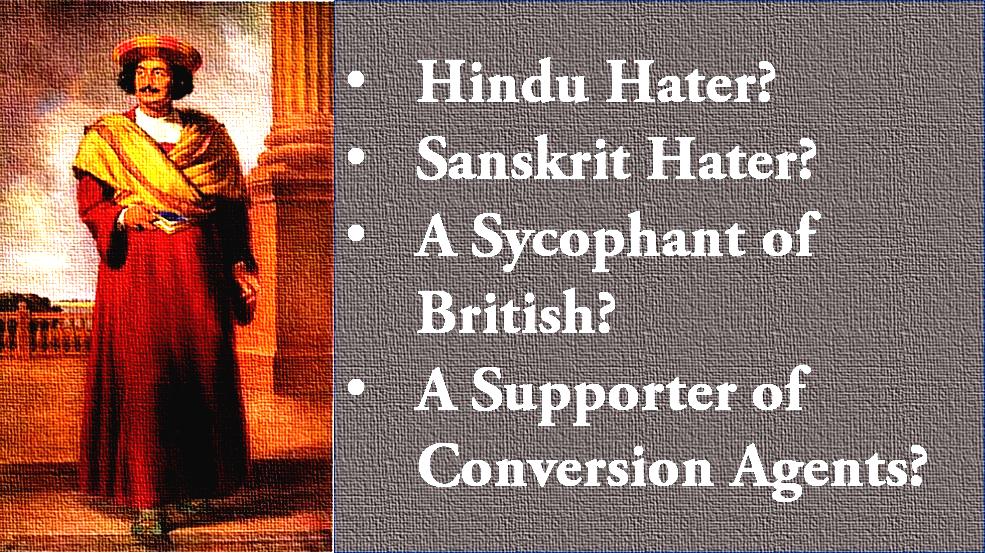
Let’s have a look at a very prominent name among them, Raja Ram Mohun Roy. A name that is hailed as pioneer of modernity in India by Hindu-bashing left-liberal quarters.
He was monumental in successfully convincing the British Parliament and the East India Company of the inferiority as well as worthlessness of Sanskrit education while at the same time championing the cause of English schooling for Indians. Macaulay himself would have been proud.
But how is he a villain? Wasnt he a reformer who helped abolished ‘’sutee” with mai baap governor general William Bentick?
For those who fall into this lie of sati being a norm in Hindus forget this logic that had it been the standard practice, Hindus would have died out in a few hundred years as there would be noone left to procreate. Nine out of ten times, it is the wife that survives the husband. Women on an average, live more than men by 5-10 years. So if every woman kills herself on her husband’s funeral pyre without exception, its a recipe for demographic suicide, especially in olden times when most today’s curable diseases were deadly and took away a huge amount of population regularly.
Sati was practiced very sporadically , mostly among the ruling class, where the childless widow of the deceased king ascended the funeral pyre with him. This decision was voluntary and the woman in question was always discouraged from carrying it out. Its Ram Mohun’s making a case against several ‘defects’ of Hinduism such as the custom of sati (thanks to which Hinduism is still viewed, by the less knowledgeable person feeding on left controlled media in the west or elsewhere, as a religion and culture which burns its widowed women – a notion popularised by Roy’s exaggeration of a statistically insignificant phenomenon in India).
The British Empire had scant interest in social and educational reforms. Ram Mohun Roy’s biggest ‘’reform’’ was to reject polytheism, traditional Hindu education system, and to push monotheism. His Persian and Arabic education had influenced his monotheistic idea of god,even before he learnt a word of English. His aim was to replace Sanskrit based education by English based one, via the schools that he built.
“Nowadays many acknowledge it for a fact that Thomas Babington Macaulay, whose passionate, long-drawn and scathing attack on Hindu knowledge systems in particular and the Hindu culture in general – popularly known as “Macaulay’s Minute on Education” – was the ultimate instrument that sealed the fate of India as an essentially westernised nation and society in its post-independent republican avatar.
As a member of the Council of India, Macaulay had presented his minute on education before the Committee on Public Instruction, on February 2, 1835, decisively altering the mood of the Council and Committee members in his favour and clearing the path for the English Education Act 1835.
So far the story of the paradigm change in Indian education systems is quite a common knowledge. However, what many may not know is that even before Macaulay could present his infamous Minute, Raja Ram Mohun Roy had already written a lengthy memorial to Lord Amherst, the then Governor-General of India on December 11, 1823 (12 years before Macaulay’s Minute made its appearance in the scene), launching a vicious attack on the traditional Sanskrit education system prevalent at that time in India.
Ram Mohun Roy questioned the effectiveness of imparting traditional education through the Sanskrit language. He contended that the amount of funds (which was somewhere around one lakh rupees at that time) channelized for educating Indians (in accordance with the Parliament’s agreement in the East India Company’s charter, 1813) should instead be invested in employing “European gentlemen of talents and education to instruct the natives of India in mathematics, natural philosophy, chemistry, anatomy, and other useful sciences which the nations of Europe have carried to a degree of perfection that have raised them above the inhabitants of the other parts of the world” (Roy’s letter to Amherst, 1823). In his memorial to Governor-General Lord Amherst, Roy attacked the policy of the General Committee of Public Instruction, which, led by H. H. Wilson, had established a Sanskrit College in Calcutta in January 1824. Roy, on the other hand, batted for founding a college devoted completely to the European system of learning instead of a spending the government’s money on yet another Sanskrit college (the first of its kind had already come up in Varanasi in the year 1791).
The General Committee on Public Instruction had allocated funds for the establishment of a Sanskrit College in Calcutta, finally opening the same in the year 1823 on the grounds opposite to the Hindoo College (now Presidency University), bastion of European education that used English as its medium of instruction and where the maverick teacher Henry Derozio was leading a band of young students, in thought and deed, towards radical thinking which made their parents fear, not without good reason, that their wards would eventually “reject the Hinduism of their forefathers convert to Christianity or join the Brahmo Samaj” (Seely 2004).”
Ram Mohan Roy acted as a political agitator and agent, representing Christian missionaries whilst employed by the East India Company and simultaneously pursuing his vocation as a Pandit. One of them was William Carey, a Baptist shoemaker turned missionary who landed in India in 1793, with the main objective to translate, publish and distribute the Bible in Indian languages and propagate Christianity to the Indian people.He realised the “mobile” (i.e. service classes) Brahmins and Pundits were most able to help him in this endeavour, and he began gathering them. He learnt the Buddhist and Jain religious works to better argue the case for Christianity in the cultural context.In 1795, Carey made contact with a Sanskrit scholar, the Tantric Hariharananda Vidyabagish, who later introduced him to Ram Mohan Roy, who wished to learn English. Between 1796 and 1797, the trio of Carey, Vidyavagish and Roy created a religious work known as the “Maha Nirvana Tantra” (or “Book of the Great Liberation”) and positioned it as a religious text to “the One True God”. Rammohan was clever enough to understand that his ideas were more welcome if only people looked at it as age old wisdom rather than a revolutionary new idea. “Maha Nirvana Tantra” therefore supported monotheism and had sections masking prevailing progressive judicial thoughts as ancient discourse on law. In 1797, Ram Mohan reached Calcutta and became a moneylender, mainly to impoverished Englishmen of the Company living beyond their means. Ram Mohan also continued his vocation as pundit in the English courts and started to make a living for himself.
Ram Mohun Roy began learning Greek and Latin. From 1803-15, he was a clerk with East India Company’s “Writing Service”. During this time, he also wrote Tuḥfat al-Muwaḥḥidīn, he championed the cause of Monotheism.” Roy protested against the idolatries and superstitions of Hinduism and tried to identify a common religious foundation based on the doctrine of the unity of God. He advocated for the supremacy of human reason and conscience over all outside authority whether of scripture, priest or prophet.” He also opposed the principle of Trinitariasm’ (God, Son Jesus and the holy spirit) of the Christianity (which would be his reason to fall out with William Carey in 1819). He rejected polytheism, idol-worship and rituals of different religions. He advocated monotheism or unity among gods. He also advised people to be guided by the conscience. He inspired men to cultivate rationality. To all he appealed to observe the principle of unity of God.
http://perso-indica.net/work/tuhfat_al-muwahhidin
Ram Mohun Roy mainly attacked his own community, the Kulin Brahmins, and this target was understandable, as they were then in control of the many temples of Bengal. With Dwarkanath’s backing, he launched a series of attacks against Baptist “Trinitarian” Christianity and was now considerably assisted in his theological debates by the Unitarian faction of Christianity.”
In 1828, Ram Mohun Roy founded the Brahmo Samaj, which according to eminent historians was a social reform movement. Its core beliefs were:-
- Brahmo Samaj believe that the most fundamental doctrines of Brahmoism are at the basis of every religion followed by man.
- Brahmo Samaj believe in the existence of One Supreme God — “a God, endowed with a distinct personality & moral attributes equal to His nature, and intelligence befitting the Author and Preserver of the Universe,” and worship Him alone.
- Brahmo Samaj believe that worship of Him needs no fixed place or time. “We can adore Him at any time and at any place, provided that time and that place are calculated to compose and direct the mind towards Him.”
So reform= monotheism?? “If not in practice, in theory the Brahmo ‘religion’ – that grew out of Roy’s monotheistic, Unitarian Church-inspired theology – has been as intolerant and as violent toward the idol-worshipping Hindu as any Christian or Muslim zealot would be. One of the victims of this zealotry of the Brahmo-s was none other than Swami Vivekananda, who was ridiculed, maligned, and obstructed in every possible way during his mission to the USA in 1893, both in the USA and back at home. Swami ji writes in one of his letters: “I could do much more work but for the Brahmos and missionaries who have been opposing me unceasingly.” (Vivekananda, Volume 6, Epistles – Second Series)”
The idol worship denigration that Ram Mohun Roy showed is not very different from the mentality of the Islamist or Church agents who devote their entire life to the ‘holy’ cause ‘cleanse’ the world of ‘heathenism’.
Also a fact which is not much spoken about is that, his disrespectful speech and actions towards the Hinduism that was so dear to his parents finally broke their patience and he was driven out of his house in teens due to his relentless offensive attitude towards Hinduism.
Ram Mohun Roy started roaming around the country and even went to Tibet, and was promptly shown the door after criticizing idol worship by the lamas! He could finally return to his native place only after the demise of his father.
In 1830, Ram Mohun Roy travelled to the United Kingdom as an ambassador of the Mughal Empire, to supposedly ensure that Lord William Bentinck’s Bengal Sati Regulation, 1829 banning the practice of Sati was not overturned. But his real motive was to successfully persuade the British government to increase the stipend of the Mughal Emperor by £30,000! Roy also petitioned the King to increase his allowance and perquisites! Also on the list was his lifelong passion, the campaign against Sanskrit education and for English education.
It was no secret that the loot the British Empire was carrying out of India. Ram Mohun Roy’s solution to it? Unrestricted English immigration to India! “Ram Mohun Roy appeared in 1831 before a parliamentary committee in England studying the renewal of the company’s charter. While giving testimony on the question of free European emigration to India, Roy expressed the opinion that English emigration should be unrestricted since English settlers in India ‘from motives of benevolence, public spirit, and fellow feeling toward their native neighbors, would establish schools and other seminaries of education for the cultivation of the English language throughout the country, and for the diffusion of a knowledge of European arts and sciences.”
Lets have a look at Ram Mohun Roy’s mausoleum:-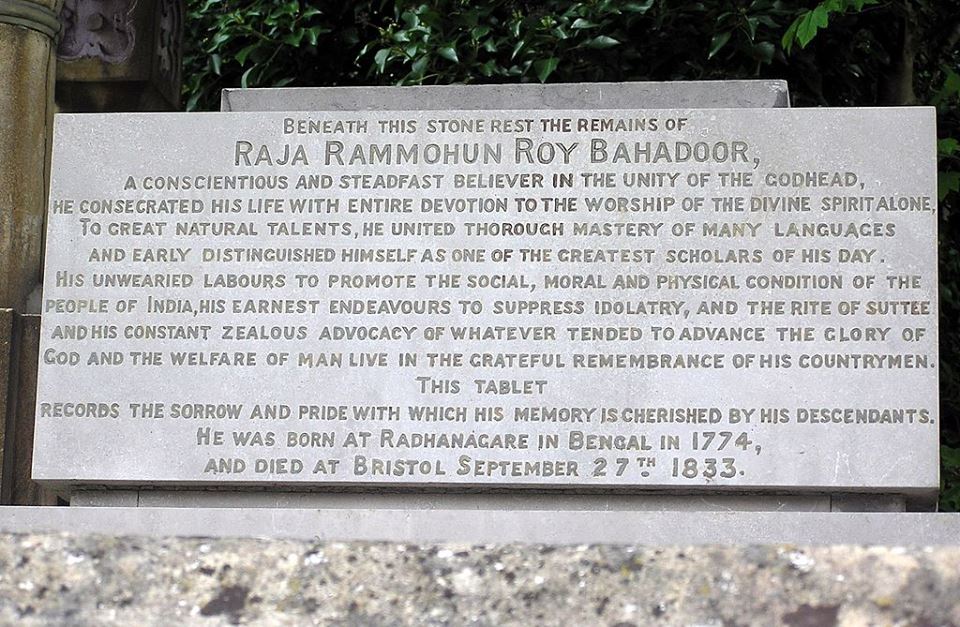
Pay attention to the words “endeavours to suppress idolatry”. In simple language it means missionary work. 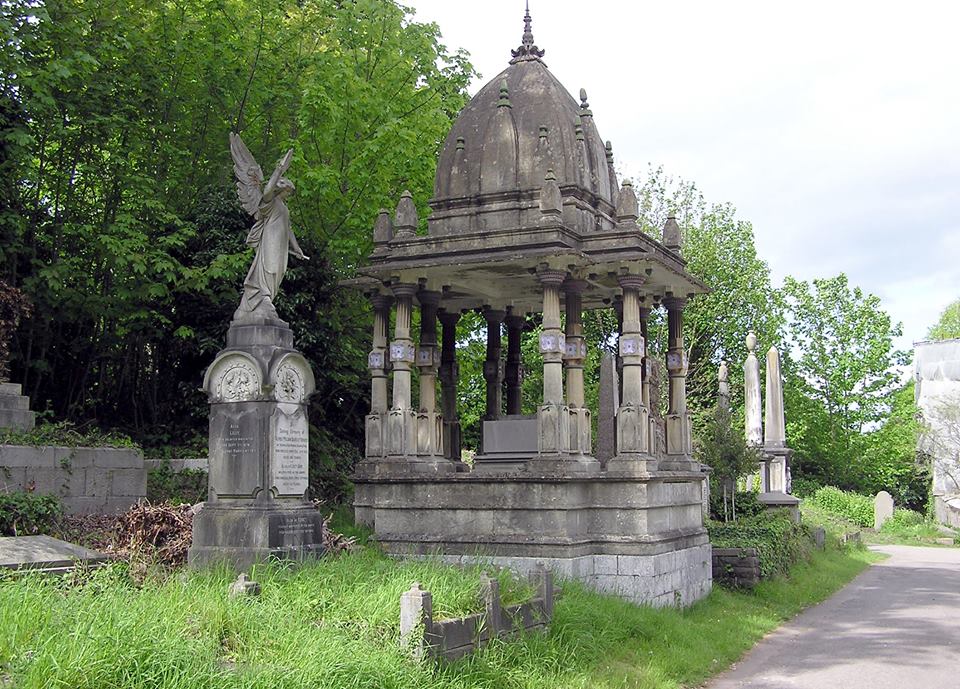
Why will the British give such an honourable burial to an Indian patriot (in their own country, and that too at a time when dark skinned humans were not even considered humans by the white colonial overlords), if Ram Mohun Roy was one , as the progressive and western historians tell us? And why will they give an Indian patriot a title (Raja is a title)?
If Ram Mohun Roy was a linguist, why couldn’t he use his knowledge to bring about a perfect synchrony of the eastern and western media of education rather than wanting to purge Sanskrit and other indic languages from the curriculum? What kind of linguist wants to import and impose a foreign language that would eventually erode the spiritual-cultural ethos of the country?
Ironically, Ram Mohun Roy was not even accepted fully by the European Christian missionaries for which he strived so hard all his life. He was, on the contrary, called by the same derogatory names that the Christian missionaries reserve for all Hindus. He was ‘rediscovered’ in the late 19th century by the pro British Indian elite and Western left-liberals via the Hindu-hating Brahmo samajists in the late 19th to 20th century, and started projecting him as the “Father/Maker of Modern India”.
Ram Mohun Roy died in England in 1833, of meningitis and was buried in southern Bristol. Its a fitting divine justice that a person like him did not get a place in his motherland even after death. Who says there is no justice in the world?
http://koenraadelst.blogspot.in/2013/03/the-rg-vedic-reference-to-sati.html