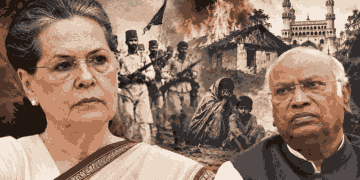





















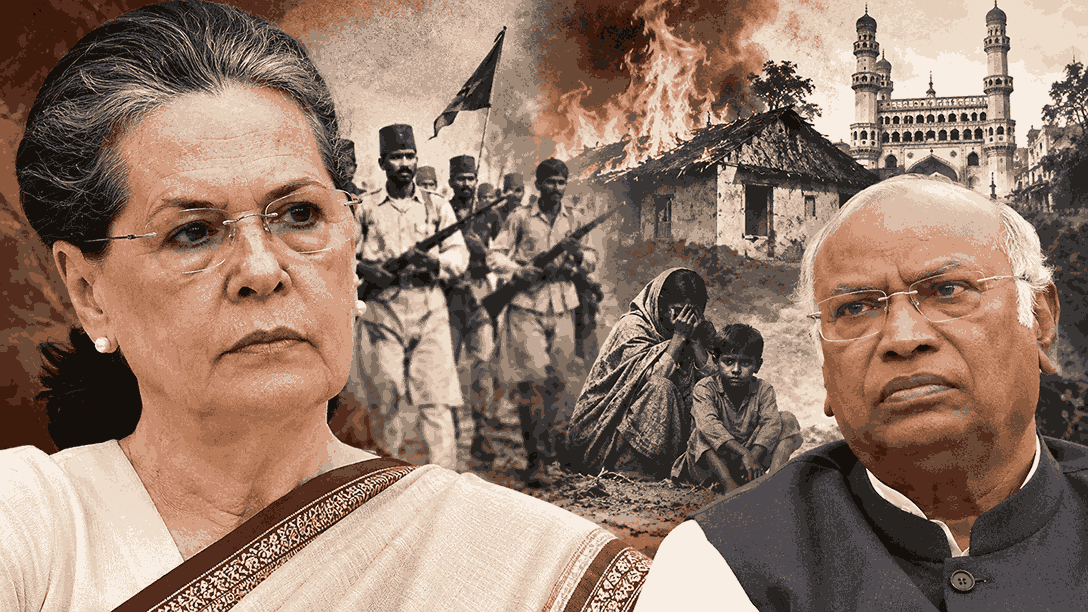
A fresh controversy has erupted over Congress Parliamentary Party chairperson Sonia Gandhi newly released memoir, Belonging: A Journey of Love, after critics accused her of misrepresenting the circumstances surrounding the killing of Congress president Mallikarjun Kharge’s family in 1948. The controversy centres on description by Sonia Gandhi of the tragedy as an incident of “caste riots”, despite Kharge himself having previously identified the Razakars, the armed militia of the Nizam of Hyderabad, as the perpetrators of the attack that claimed several members of his family.
The disputed passage appears on page 484 of the memoir, which was released on November 10, 2026. Recounting Kharge’s childhood tragedy, Sonia Gandhi writes that when he was approximately seven years old, his home and family were set on fire during caste riots, leaving him and his father as the survivors. However, the passage has attracted considerable criticism because it does not identify the Razakars or explain their role in the violence.
The omission has raised questions about historical accuracy and the responsibility of political leaders when documenting painful episodes from India’s past. Critics argue that describing the incident simply as caste violence changes the context of an attack that Kharge had himself associated with the Razakars.
Kharge had previously spoken about the incident during a conversation with senior advocate Kapil Sibal. Recalling the horrific events of his childhood, he explained how the Razakars attacked his village and set his family home on fire. His mother, brother, sister and uncle were killed in the attack. His father, who was away working in the fields, managed to save him.
Kharge’s account is particularly significant because it comes from someone who personally experienced the tragedy. He also recalled the wider atmosphere of terror in the surrounding villages, describing how the Razakars carried out attacks and killed people. His recollection directly raises questions about why Sonia Gandhi’s memoir chose to characterise the episode as caste riots without mentioning the militia.
The Razakars were associated with the Hyderabad State under the Nizam, Mir Osman Ali Khan. Led by Qasim Razvi, the organisation opposed the integration of Hyderabad into the Indian Union and became notorious for its violent activities during the final years of princely rule. Its armed members were accused of intimidation, killings, looting and arson, particularly against people resisting the Nizam’s continued rule.
Hyderabad’s political crisis reached its conclusion in September 1948, when the Indian government launched Operation Polo. The military operation resulted in the integration of Hyderabad State into India and ended the Nizam’s rule. The violence surrounding this period remains an important and painful chapter in the history of the region.
The controversy surrounding Sonia Gandhi has also drawn attention to the apparent contradiction between her account and the recollections of the Congress president himself. BJP leader Priti Gandhi questioned the description in the memoir, arguing that the victims of the Razakars deserved historical recognition rather than an account that obscured the identity of their attackers. She demanded an explanation and called for the historical record to be presented accurately.
The criticism is not merely about the choice of terminology. It concerns whether a specific episode of organised violence should be reduced to a broad description of social conflict. If the Razakars were responsible for the attack, as Kharge has stated, their role deserves explicit acknowledgement. Replacing that context with a generic reference to caste riots risks leaving readers with an incomplete understanding of what happened.
For Sonia Gandhi, the controversy presents an uncomfortable question about the historical narrative offered in her memoir. A personal account can understandably reflect an author’s recollections and perspective, but when it discusses the suffering of another prominent political figure, accuracy becomes particularly important. The fact that Kharge remains an active leader of the Congress makes the discrepancy even more striking.
The episode has also revived a wider debate about how the Congress approaches sensitive historical questions involving the Nizam’s rule, the Razakars and Hyderabad’s integration into India. Political disagreements should not prevent an honest examination of historical violence, irrespective of the identity of those responsible.
Ultimately, Kharge’s family tragedy should not become another casualty of contemporary political messaging. The deaths of his mother, siblings and uncle deserve to be remembered with dignity, and the circumstances surrounding their deaths deserve an accurate account. Sonia Gandhi’s memoir has now brought an important historical question back into public discussion: why does its description differ from the account given by the man who survived the attack?