
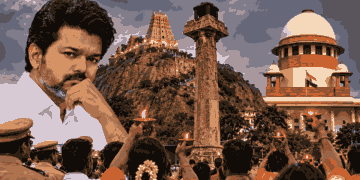















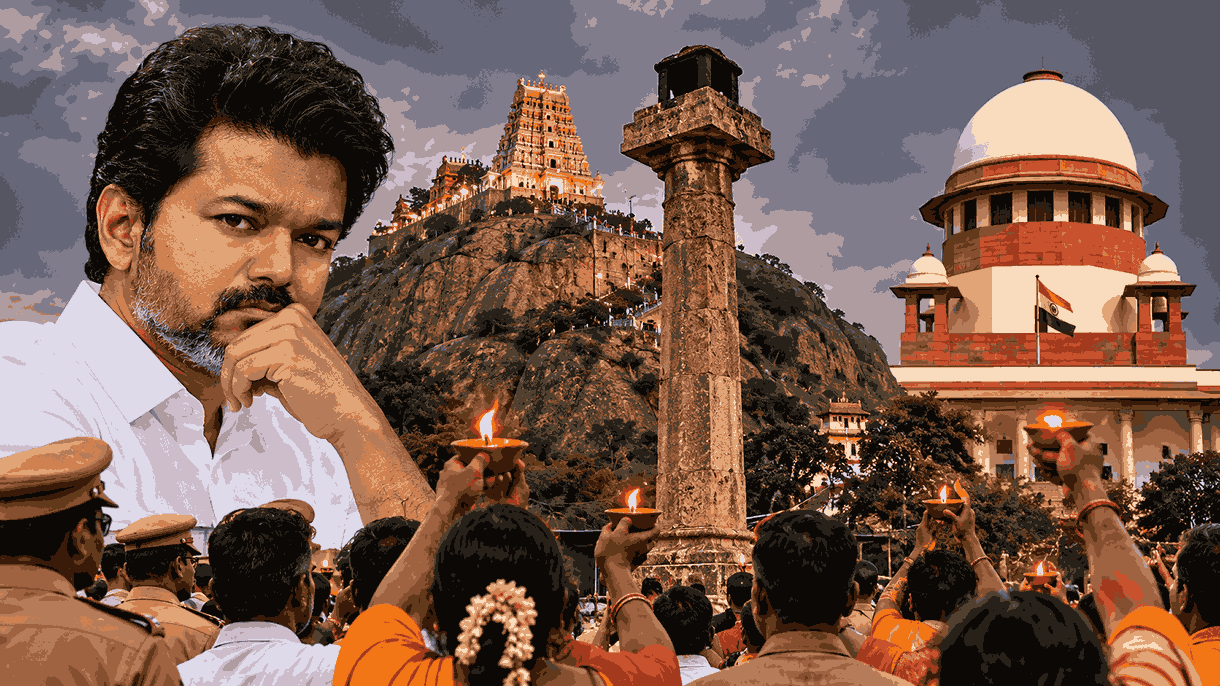
The Deepathoon controversy in Tamil Nadu has escalated into a major political and constitutional confrontation, with Chief Minister C. Joseph Vijay’s TVK government facing mounting criticism over its handling of the traditional Karthigai Deepam ritual at Thiruparankundram hill in Madurai. A series of decisions, legal challenges and administrative developments between May and November 2026 has prompted Hindu organisations and devotees to question whether the new government is displaying an increasingly hostile attitude towards Hindu religious practices. The controversy reached a dramatic turning point after the Supreme Court criticised the authorities for failing to implement its November 20 directive.
Vijay assumed office as Tamil Nadu Chief Minister on May 10, 2026, following TVK’s formation of the government. However, barely a month into its tenure, the administration took a significant decision concerning the ongoing religious dispute. On June 11, the government approached the Supreme Court through a Special Leave Petition challenging the Madras High Court’s January 6 judgment, which had upheld the direction permitting the ceremonial lamp to be lit at the disputed pillar. The decision was particularly notable because the TVK administration chose to continue the legal battle initiated by the previous DMK government rather than reconsider its position.
The dispute centres on the location of the Karthigai Deepam, an important Hindu festival during which devotees light lamps to celebrate the divine light of Lord Shiva. While the temple administration traditionally conducts the ceremony at the Deepa Mandapam near the Uchipillaiyar Temple, devotees have demanded that the ritual also be performed at the historic stone pillar identified as the Deepathoon. The location’s proximity to the Sikandar Badusha Dargah has made the matter particularly sensitive, with competing claims involving religious traditions, access and administration of the hill.
On November 12, the TVK government submitted an affidavit opposing a fresh plea seeking broader relief, including permanent arrangements for lighting the ceremonial lamp at the disputed location and greater Archaeological Survey of India control over the hill. The government maintained that the established religious custom placed the ceremonial lamp at the Deepa Mandapam. Critics, however, viewed the administration’s repeated opposition as evidence of an unwillingness to accommodate the demands of Hindu devotees.
A significant development followed on November 20, when the Supreme Court permitted the ceremonial lamp to be lit at the Deepathoon on November 24 as a one-time arrangement. The court imposed safeguards to prevent confrontation, including restricting access to an authorised team, prohibiting public processions and demonstrations, and placing the District Collector in charge of coordination. The court also clarified that its interim permission did not amount to a final recognition of any permanent customary or proprietary rights.
Yet, the government’s response intensified the controversy. On November 21, just a day after the Supreme Court’s decision, the state’s Hindu Religious and Charitable Endowments Department filed a review petition challenging the permission. It argued that the customary location was the Deepa Mandapam and that conducting the ritual at the disputed pillar could disturb communal harmony. Hindu organisations questioned why the government continued opposing the arrangement despite the Supreme Court having imposed restrictions specifically intended to maintain peace.
November 24 became the defining moment of the controversy. Despite the Supreme Court’s directive, the ceremonial lamp was lit at the traditional Deepa Mandapam, while the Deepathoon remained dark. Devotees who gathered at the foothills to protest the non-implementation of the order were removed by police. For critics, the incident represented a serious failure of the administration to protect the religious aspirations of Hindu devotees and uphold judicial authority.
The following day, Madurai District Collector Nishant Krishna apologised before the Supreme Court. He explained that the temple’s Board of Trustees had not authorised the team required to conduct the ceremony and had instead resolved to follow the traditional location. This explanation complicated allegations of direct government interference, although it did not resolve questions about the administration’s responsibility for implementing the court’s directive.
On November 26, Governor Rajendra Vishwanath Arlekar sought a comprehensive report from Vijay under Article 167(b) of the Constitution. Hindu Munnani separately petitioned the Governor, demanding action against the administration and even seeking the government’s dismissal. The organisation accused the TVK administration of adopting an anti-Hindu position more aggressive than its predecessor.
The Supreme Court subsequently took a stronger position on November 27, describing the failure to implement its earlier order as prima facie wilful and flagrant disobedience. It suspended the temple’s Board of Trustees, appointed former High Court judges S. Vaidyanathan and V. Parthiban as receivers, and transferred security of the hill to the Central Reserve Police Force. The court also directed that the ceremonial lamp be lit at the Deepathoon on November 28 and issued contempt notices to officials concerned.
The Deepathoon controversy has consequently become a major test of the Vijay government’s commitment to religious freedom, constitutional accountability and the rule of law. While the government maintains that its position concerns established temple customs and communal harmony, critics see a troubling pattern of resistance to Hindu religious demands. The Supreme Court’s intervention has made one issue unmistakable: an elected government cannot disregard judicial directions while claiming to uphold constitutional governance. The political consequences of this confrontation could extend well beyond Thiruparankundram.