



















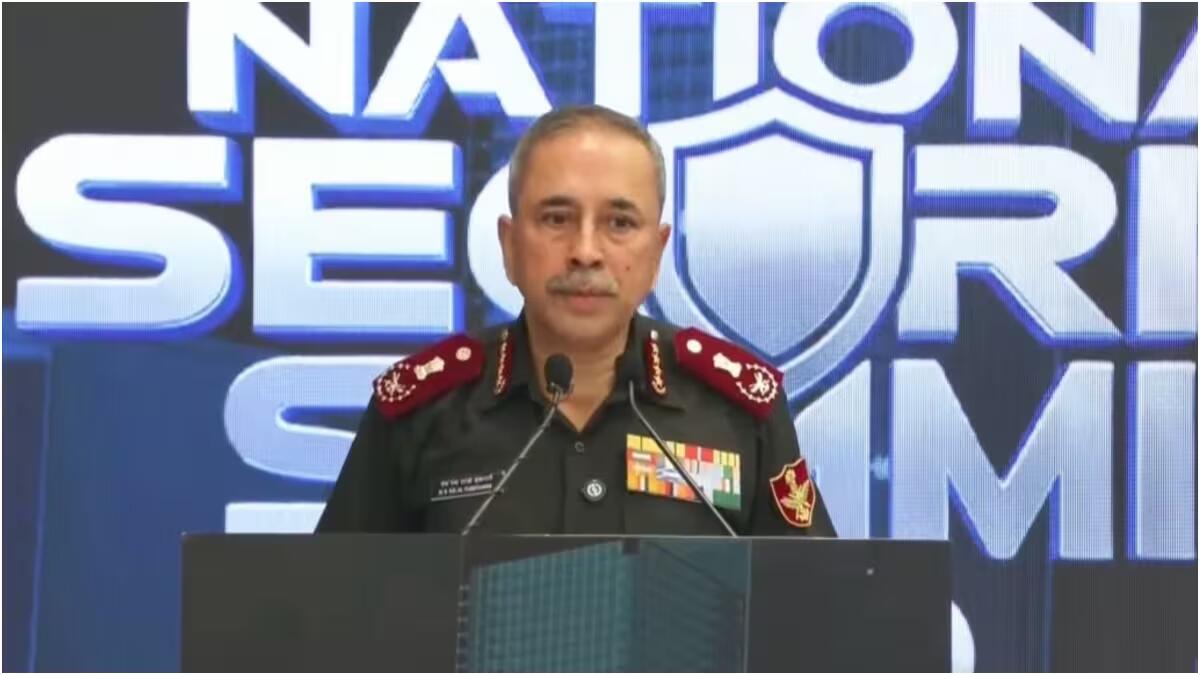
Chief of Defence Staff General NS Raja Subramani said on Monday that the line between front and rear areas has effectively vanished in modern conflict, putting factories, power grids, data networks and civilians within range of attack.
Speaking at the ANI National Security Summit 3.0 in the national capital, in a session titled “Preparing India’s Armed Forces & Future Wars”, the CDS said AI, satellite-based intelligence and cheap, mass-produced drones are changing how wars are fought.
He identified three trends shaping future conflicts: the changing economics of warfare, a sharpening contest for technological control, and an expanding battle space.
Cost of defence
On economics, General Subramani said inexpensive weapons can now overwhelm costly defences. Using a million-dollar interceptor against a drone worth a few thousand dollars, he argued, is a losing trade. He pointed to the rapid depletion of US Patriot missile stocks, which he said will take years to replenish. Countries, he said, need affordable mass-produced systems alongside advanced platforms.
Tech contest
He said control over AI, data and critical minerals will decide which nations stay economically and militarily strong. The contest is currently centred on the United States and China, he noted, but other countries are working to close the gap. Any nation seeking strength, he said, must control the technologies underpinning its economy and its military.
No front, no rear
On the battle space, he said the entire territory of a country is now exposed, and the divide between military and commercial infrastructure is blurring. Industry, networks, energy sources and the data used for decision-making can all be targeted, he said, as the range of both cheap and sophisticated weapons grows.
Lessons from current wars
Drawing on the Russia-Ukraine war and the US-Israel-Iran conflict, the CDS listed five determinants of future warfare. He stressed mass, meaning cheap weapons fielded in numbers alongside high-end systems, and the need to adapt quickly as adversaries find counters. Engineers, he said, should be deployed close to the field to devise fixes in real time.
He also warned against planning for short wars. Nations cannot decide how long a war lasts because the enemy has a say, he said, and that makes manufacturing capacity, speed of production and resilient supply chains critical. He tied this to Aatmanirbharta, or self-reliance, in defence production.
Role of space
The CDS said space-based information has proved decisive, citing the use of satellite imagery and AI in Ukraine and in the US campaign against Iran, where it helped enable precise strikes. He referred to reports that satellite imagery had been made available to Iran with Chinese help, saying such access could improve its ability to target US bases. He added that he was unsure about any similar support to the Houthis.