
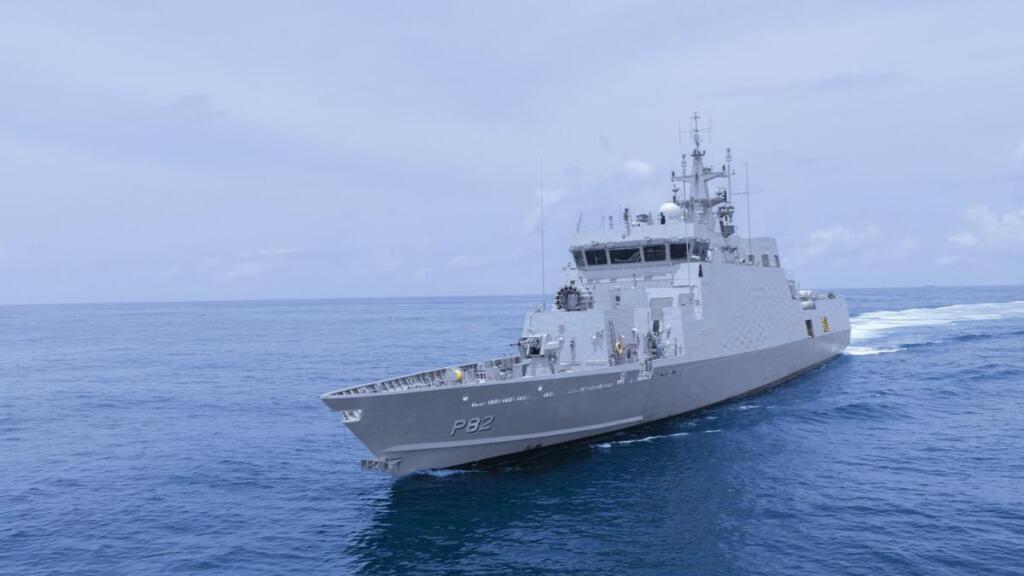
The Indian Navy today commissioned INS Mangrol at the Naval Dockyard in Mumbai. It is the third Anti-Submarine Warfare Shallow Water Craft (ASW-SWC) built by Cochin Shipyard Limited, Kochi. I couldn’t find reporting on the ceremony itself, such as who presided, so this piece covers the ship and the background.
Cochin Shipyard delivered INS Mangrol on August 21, one of eight indigenously designed and built ASW shallow water craft. The ship is designed mainly for anti-submarine operations in shallow coastal waters, where submarines are especially hard to detect and track.
The name comes from the past. It carries forward the legacy of INS Mangrol (M85), a minesweeper that served until April 7, 2004, and the town of INS Mangrol, a fishing harbour in Gujarat’s Junagadh district. The Navy often revives the names of retired ships this way.
Where INS Mangrol fits
The programme exists to replace an ageing fleet. The Ministry of Defence approved sixteen shallow-water ASW vessels to replace the Abhay-class corvettes, which were commissioned between 1989 and 1991. The contract for eight ships with Cochin Shipyard was signed on April 30, 2019.
INS Arnala, the first ASW-SWC of the programme, was commissioned on June 18, 2025 at Visakhapatnam. INS Mahe, the lead ship of the class, followed on November 24, 2025, and INS Malvan in July 2026. Malpe, Mulki, Magdala and Machilipatnam are still to come.
INS Mangrol runs on three diesel engines and waterjet propulsion. Waterjets let a ship operate in shallower water than a conventional propeller. Official statements say its induction will strengthen the Navy’s ability to safeguard ports, harbours and coastal approaches, and they point to India’s growing shipbuilding self-reliance.
What is anti-submarine warfare?
Anti-submarine warfare, or ASW, is everything a navy does to find, track and, if necessary, destroy or neutralise enemy submarines. It is arguably the hardest job at sea, because a submarine’s main advantage is that nobody can see it. Radar and cameras are useless underwater, since radio waves and light don’t travel far in seawater. Sound does, so ASW is mostly about listening and “pinging.”
Submarines are found in several ways. Passive sonar listens for the noise a submarine makes, from engines, propellers and machinery, without revealing the listener. It is stealthy, but modern submarines are very quiet. Active sonar sends out a sound pulse and listens for the echo, which gives precise range and bearing but also tells the submarine it is being hunted. Aircraft and helicopters add to this by dropping sonobuoys, which are floating listening devices, and by lowering dipping sonar into the water, while maritime patrol aircraft cover large areas quickly. Other ships, and even other submarines, join the search too, since a submarine is often the best hunter of another submarine.
Once a submarine is located, a navy can attack it with lightweight torpedoes, depth charges, anti-submarine rockets, or weapons delivered by helicopters and aircraft. Often the aim is simply to force the submarine away or make it abandon its mission. ASW is usually layered: aircraft and submarines cover the open ocean, frigates and destroyers escort the main fleet, and smaller craft guard the coast.
Why shallow water is a special problem
Shallow coastal water is much harder to search than the deep ocean. Fishing boats, merchant traffic, waves, marine life and port activity all add noise, making it harder to pick out a submarine. Sound also bounces between the seabed and the surface, creating false contacts and distorting signals. Temperature and salinity changes near rivers and coasts bend and trap sound unpredictably. On top of this, large ships can’t safely operate close to shore, which is why a compact, shallow-draught vessel like INS Mangrol is useful. A big destroyer is built for the open sea, and a small ship with the right sonar fills the gap near the coast.
Why India needs it
India’s trade moves overwhelmingly by sea, so a few submarines near key ports or shipping lanes could cause serious disruption. More navies in and around the Indian Ocean now operate or are acquiring submarines, a trend commonly cited in Indian defence discussion, though the specifics are best checked against official and independent sources. Ports such as Mumbai, Kochi and Visakhapatnam handle commerce, energy and naval operations, and need protection from underwater threats. Meanwhile, the Abhay-class corvettes are about 35 years old and due for replacement. Building the replacements at Cochin Shipyard also serves India’s goal of domestic defence production.
INS Mangrol is one modest ship in a class of eight. Together they are meant to give India a layer of coastal anti-submarine defence, which matters because submarines are hard to see and are best countered by many ships watching the water.