
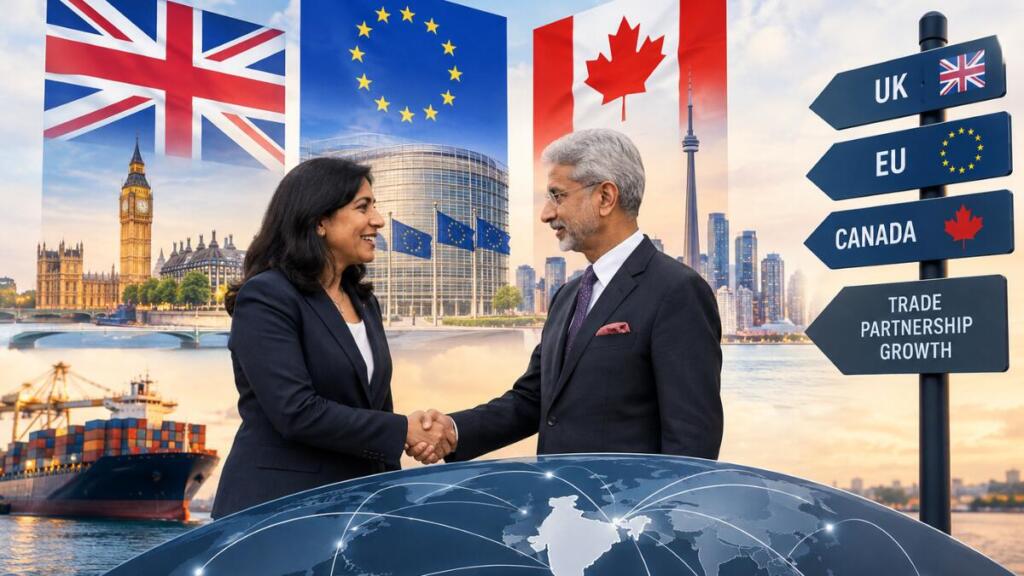
Canada’s Foreign Minister Anita Anand arrives in New Delhi this week for her 11th meeting with S. Jaishankar since September 2025. The two will talk trade, energy, security and people-to-people ties, and Anand will speak at the Bloomberg New Economy Forum on the role of middle powers in a changing world. The visit shows how much India’s standing has grown. Major economies are lining up for deeper partnerships, and India’s trade agreements with the UK, the EU and Canada could reshape its economy.
The UK: India’s exporters get a head start
The India-UK Comprehensive Economic and Trade Agreement (CETA) was signed in July 2025 and entered into force on 15 July 2026. Indian businesses are already working with it.
The headline gain is market access. Indian exporters get zero-duty access on around 99 per cent of tariff lines, covering almost the entire value of India’s exports to the UK. The biggest winners are the sectors that employ the most people. Textiles, leather, footwear, marine products, gems and jewellery, sports goods and toys are all expected to gain. Engineering goods, auto components and organic chemicals also benefit.
Indian professionals gain too. A companion social security convention exempts Indian professionals and their employers from UK social security payments for up to three years. That makes it cheaper for Indian IT and services companies to place talent in Britain.
The ambition is large. The target is to double bilateral trade in goods and services to $120 billion by 2030, from $56.9 billion in 2024-25. India’s Commerce Minister Piyush Goyal has called it “the most comprehensive trade deal India has negotiated.” Indian consumers also gain, with cheaper imports such as chocolates, biscuits and cosmetics arriving over time.
The EU: opening the world’s largest single market
The India-EU agreement is the biggest of the three. It was finalised on January 27 this year. India secures preferential access on 97% of tariff lines, covering 99.5% of its export value to the EU.
Ratification is still ahead, but the path looks smooth. The agreement covers only trade matters, so it needs approval just from the European Parliament and Council, not from all 27 national parliaments. The same report expected ratification around November.
For India, the deal brings several advantages:
- Competitive footing in Europe. Indian textile, apparel and leather exporters can compete on equal terms with rivals that already have preferential access.
- A stronger place in global supply chains. Companies looking to diversify their sourcing have another reason to choose India.
- Investment and technology. Closer ties with Europe’s industrial base support India’s manufacturing ambitions.
Canada: a fast-moving partnership with big potential
The Canada deal is the newest, and it is gaining speed. The fifth round of CEPA negotiations began in Ottawa on October 5 and ran through October 9. Goyal called the next 90 days a “defining period” for bilateral ties, and both sides aim to finish by the end of 2026. Modi is expected to visit Canada around December.
The room for growth is large. Goods trade stood at $8.66 billion in 2024-25, with India’s exports at $4.22 billion. The leaders have set a target of C$70 billion in bilateral trade by 2030. That would be a major jump, and India’s strengths in services are well placed to capture much of it. The IT sector is already the main contributor to India’s services exports to Canada.
Canada also offers what India’s growth story needs. Energy and critical minerals are on the agenda, which supports India’s clean-energy and battery goals. The large Indian-origin community in Canada strengthens business, education and cultural ties. A trade pact would also anchor a relationship that has been rebuilding since talks resumed in November 2025.
The big picture
Together these three agreements give India preferential access to some of the world’s wealthiest consumer markets. They create opportunities for exporters, jobs in labour-intensive industries, new markets for services, and a more diversified trade profile. They also show that India is a partner of choice for advanced economies in a changing global order, which is the theme of Anand’s panel this week.
With the UK deal live, the EU deal on its way to ratification and Canada’s talks on a year-end deadline, India’s trade network is growing quickly. Anand’s visit helps keep that momentum going.