
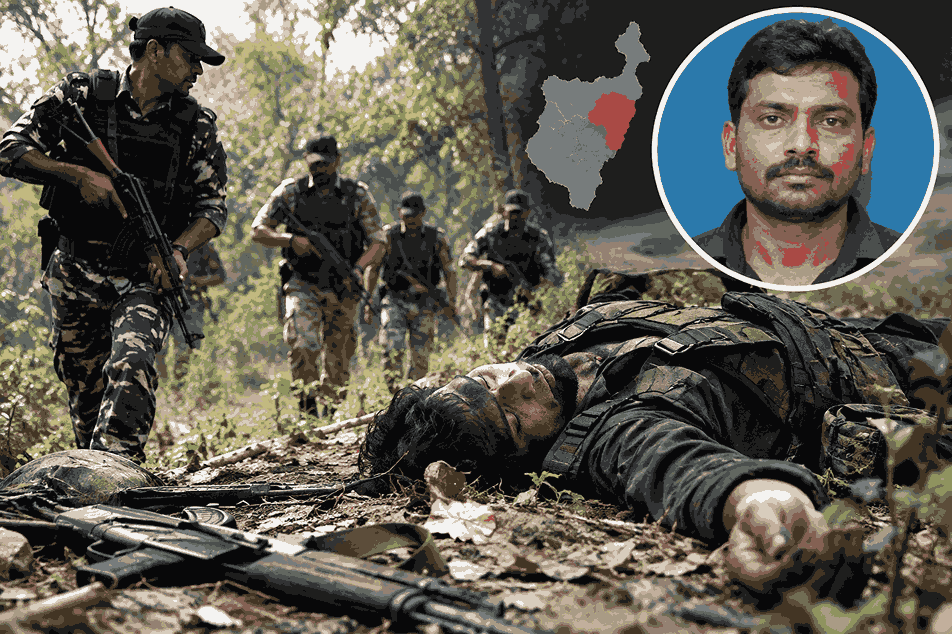
A Naxalite commander carrying a combined bounty of ₹30 lakh was killed in an encounter with the Uttar Pradesh Anti-Terrorist Squad (ATS) and Ramnagar police in Varanasi on Sunday, September 20. The deceased was identified as Brijesh Ganjhu alias Gopal Singh Bhokta, a resident of Chatra district in Jharkhand and a commander associated with the banned Tritiya Prastuti Committee (TPC), according to officials and police reports.
The encounter took place near Lanka Maidan in the Ramnagar area after security personnel received information about Ganjhu’s movement towards Mughalsarai. According to the police account, Ganjhu was travelling on a motorcycle with an associate when an ATS team attempted to intercept him. Police said that he opened fire at the personnel, leading to an exchange of gunfire.
During the encounter, Ganjhu sustained bullet injuries. He was subsequently taken to a nearby hospital, where doctors declared him dead. Authorities began examining the encounter site and collecting evidence as part of the investigation into the circumstances of the operation.
The operation also involved a narrow escape for two members of the Uttar Pradesh ATS. Deputy Superintendent of Police Vipin Rai and Head Constable Nitendra Krishna came under fire during the exchange, with bullets reportedly striking their bulletproof jackets. The protective equipment prevented the officers from suffering serious injuries, according to police officials.
The financial reward attached to the Naxalite commander reflected the extent of the security agencies’ interest in locating him. The Jharkhand government had announced a reward of ₹25 lakh for information leading to his arrest, while the National Investigation Agency had separately announced ₹5 lakh. Together, the two rewards brought the total bounty to ₹30 lakh.
Ganjhu was reportedly associated with the TPC, a banned armed organisation that emerged as a splinter group of the CPI (Maoist) and has operated primarily in Jharkhand. Security agencies had been monitoring his activities and movements, with investigators linking him to multiple cases involving alleged violence, extortion and levy collection. These allegations form part of agency and police records and remain subject to the applicable legal process. (OpIndia)
The death of the Naxalite commander in Varanasi is significant because the operation took place outside Jharkhand, where the TPC has traditionally maintained its presence. The movement of individuals associated with left-wing extremism into neighbouring states has remained an area of concern for security agencies. Uttar Pradesh authorities have previously monitored possible movement through areas connecting eastern Uttar Pradesh with Naxal-affected regions of neighbouring states.
According to reports, the Naxalite had been wanted for several years in connection with cases registered in Jharkhand. An ATS criminal-history annexure reportedly lists dozens of cases against him, while investigators have described a longer record involving alleged armed activities and extortion. Authorities will now examine the available records, evidence from the encounter site and other material connected with the operation.
The operation also highlights the increasingly coordinated role of state police and specialised agencies in tracking wanted members of banned organisations. The Naxalite was reportedly under surveillance before the ATS team acted on information about his movement. The Uttar Pradesh government subsequently announced a ₹2 lakh reward for the ATS personnel involved in the operation, according to Hindustan Times.
For investigators, the Naxalite’s death is unlikely to mark the end of the inquiry. Police procedures require the circumstances of an encounter, the sequence of firing and the evidence recovered from the location to be examined. Such investigations are important in establishing the factual sequence of events and documenting the actions of everyone involved.
The encounter has brought renewed attention to the continuing efforts of security agencies to locate members of banned extremist organisations who remain wanted in criminal cases. The Naxalite’s movement from Jharkhand to Uttar Pradesh also illustrates the importance of information-sharing between agencies operating across state boundaries. As the investigation progresses, authorities are expected to examine the circumstances of the encounter as well as Ganjhu’s alleged links and activities over the years.