
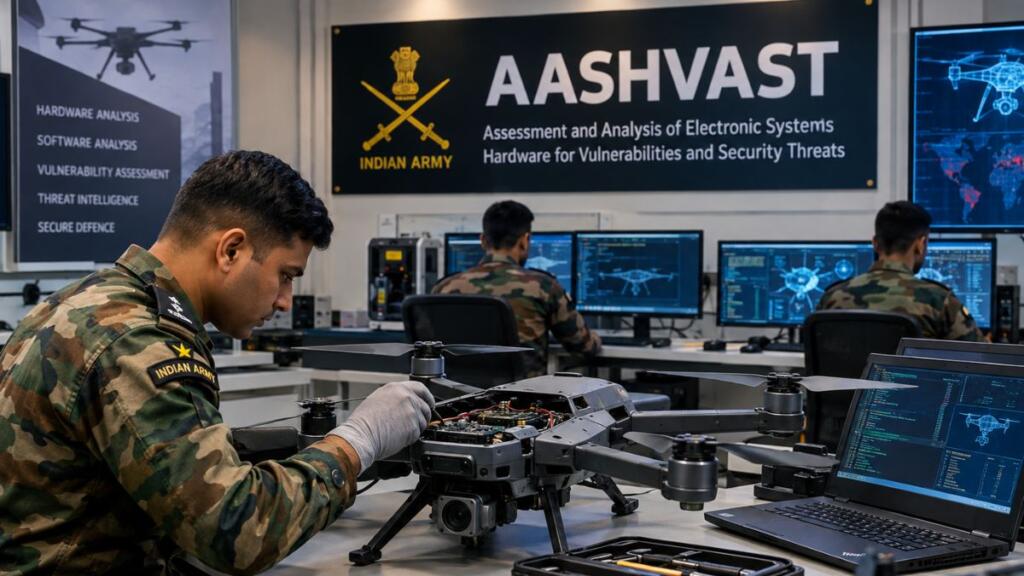
The Indian Army has begun rolling out a network of specialised cyber laboratories, named AASHVAST, to inspect military drones for concealed hardware and software vulnerabilities, amid mounting concern over Chinese-origin components in defence electronics.
AASHVAST stands for Assessment and Analysis of Electronic Systems Hardware for Vulnerabilities and Security Threats. The first facility was inaugurated on August 14, 2026, by Army Chief General Dhiraj Seth at the Directorate General of Electronics and Mechanical Engineering (DG EME) headquarters in Delhi Cantonment, alongside a Wireless & Security Anti-Drone Laboratory. Reports indicate the Army plans to eventually set up six such labs across the country, with five more locations still to come.
Unlike conventional checks that rely on physical inspection, weight analysis, and bench testing, AASHVAST is built to dig into a drone’s firmware and embedded systems — the layer of code that physical inspection can’t reach. The suite, developed by QuickPay Pvt Ltd for DG EME under a request for proposal issued in April 2026, is designed to detect roughly 14 categories of vulnerabilities. These include hidden code or commands that could interfere with a drone’s functioning, embedded passwords and encryption keys, unauthorized remote-access tools, and faults — including time-delayed or location-based triggers — that could stop a drone from completing its mission. The system also checks whether a drone’s navigation and location-security safeguards can withstand GPS spoofing or jamming, and verifies whether devices are running only manufacturer-approved software updates.
The initiative is directly tied to the Army’s concerns about foreign-made electronics — particularly Chinese-origin parts — entering the defence supply chain, sometimes through Indian suppliers using such components without adequate scrutiny. Even unintentional flaws, like counterfeit parts or undisclosed backdoors, could compromise entire operations in contested environments, which is the core risk AASHVAST is meant to close off.
In its initial phase, the labs will focus exclusively on drones, given their expanding role in surveillance, reconnaissance, logistics and combat. But the scope is expected to widen: CCTV cameras procured by the Army are reportedly next in line for similar screening, extending the initiative beyond unmanned aerial systems into other sensitive defence electronics.
Officials have framed AASHVAST as part of a broader push under the government’s Atmanirbhar Bharat (self-reliant India) initiative, aimed at strengthening indigenous defence technology, reducing dependence on external suppliers, and improving the overall cyber resilience and operational readiness of India’s military hardware.