
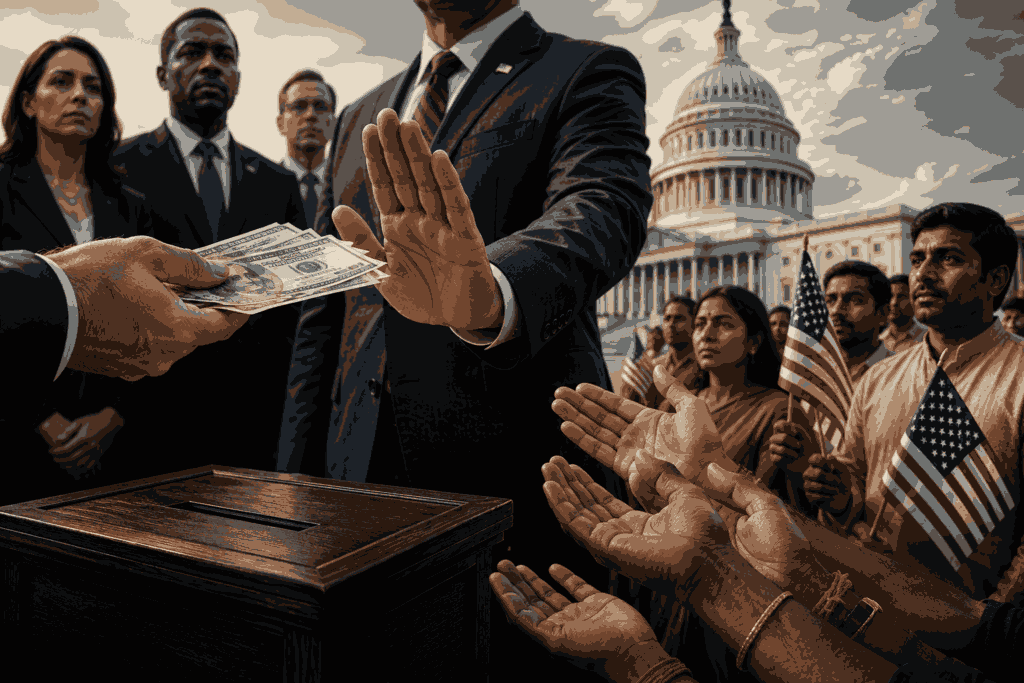
A political controversy is unfolding in the United States after the Hindu American Political Action Committee (PAC) accused political activists of pressuring candidates to reject donations from Hindu Americans on the grounds of alleged links to the Rashtriya Swayamsevak Sangh (RSS). The controversy follows a pledge reportedly signed by nearly 100 US political figures, who committed to refusing contributions associated with the RSS and its affiliates.
According to the report, the pledge was promoted by Hindus for Human Rights Action and the South Asian American Coalition to Renew Democracy Acts (SACRED Acts). The organisations announced the initiative on August 31, describing it as a commitment against what they characterised as an anti-democratic movement. The RSS, however, has become the central focus of a wider political dispute involving questions of Indian-American identity, political participation and allegations of discrimination.
The Hindu American PAC has strongly objected to the initiative, arguing that the pledge risks treating an entire religious and ethnic community as politically suspect because of perceived associations with an organisation in India. The committee said that mainstream Hindu temples, religious organisations and advocacy groups are frequently subjected to allegations of having divided loyalties or being influenced by entities based in India.
The organisation characterised the development as an attempt to impose what it described as a loyalty test on American Hindus. It argued that donors should not have to establish their political credentials or prove their independence from Indian organisations before participating in the American political process.
The Hindu American PAC also urged Hindu-American voters and donors to examine the list of politicians who signed the pledge. It called on them to reconsider political contributions to those candidates and demanded that politicians reject what the committee described as an anti-Hindu campaign. The organisation further asked supporters to report instances in which political campaigns allegedly refuse donations from Hindu Americans because of unsupported accusations concerning their affiliations. (
The controversy has also drawn attention to the names appearing on the list. The PAC specifically called upon Congressman Ro Khanna and Democratic nominee Dr. Abdul El-Sayed to clarify their positions, noting that both names appeared among the signatories. The committee said it had heard that some candidates felt they had been misled about the initiative and were reconsidering their participation.
Another issue raised by the Hindu American organisation concerns the status of the politicians included in the pledge. According to its statement, around two-thirds of the federal candidates who signed the document had already lost their primary contests and were therefore no longer candidates. The PAC questioned whether the number of signatories accurately reflected the pool of active candidates and criticised what it regarded as attempts to inflate the initiative’s political significance.
The Hindu American PAC’s intervention comes amid heightened political activity surrounding RSS chief Mohan Bhagwat’s international engagements. Bhagwat’s tour has attracted considerable attention among Indian-American and broader South Asian communities, while organisations critical of the RSS have campaigned against his appearances in the United States, Canada and the United Kingdom.
The dispute therefore extends beyond campaign donations. At its heart is a broader argument over whether political participation by Hindu Americans can be separated from debates surrounding organisations, movements and political developments in India. The Hindu American PAC maintains that individual citizens should not be collectively judged because of their religion, cultural background or alleged association with an Indian organisation.
For candidates, the controversy presents a complicated political choice. Rejecting donations from a particular group could be viewed by supporters as a principled stand against an organisation they oppose. Critics, however, argue that such a policy could create a precedent in which donors are excluded because of perceived ideological, religious or national associations rather than their individual conduct.
The Hindu American PAC has said it will continue monitoring the situation and has urged members of the community to remain alert while participating confidently in American political life. Whether candidates ultimately retain their names on the pledge, withdraw them or clarify their positions could determine how significantly the controversy develops in the coming weeks.
The episode also highlights the growing political influence of Indian-American communities in the United States. As Hindu Americans become increasingly active as voters, donors, organisers and candidates, disputes involving India, the RSS and American political movements are likely to receive greater attention. The latest confrontation demonstrates how questions about foreign political affiliations can quickly become intertwined with domestic debates over representation, religious identity and political participation.