
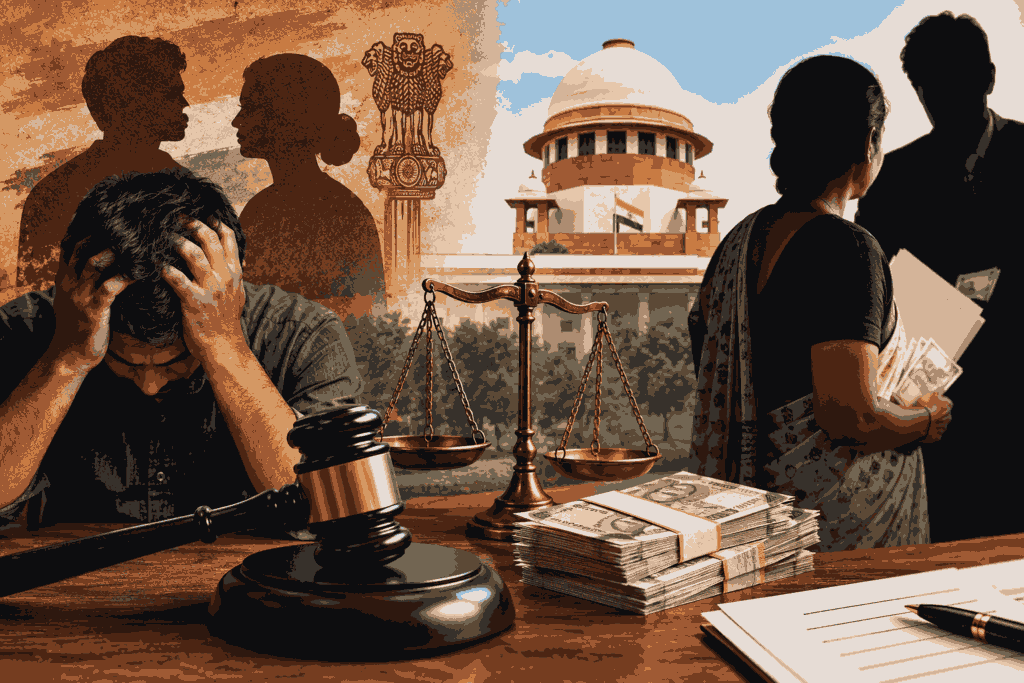
The debate over Fake SC/ST Cases has returned to the forefront after renewed scrutiny of the compensation system linked to complaints filed under the Scheduled Castes and Scheduled Tribes (Prevention of Atrocities) Act. While the law remains a vital safeguard against caste-based violence and discrimination, court observations and documented cases have raised serious questions about whether financial relief available at the early stages of a case can sometimes create an incentive for abuse.
The SC/ST (Prevention of Atrocities) Act was enacted to provide stronger protection to members of Scheduled Castes and Scheduled Tribes against discrimination, humiliation, exploitation and violence. Its stringent provisions reflect the seriousness of caste-based crimes in India. However, the growing controversy surrounding Fake SC/ST Cases centres on the difficult challenge of protecting genuine victims while ensuring that innocent people are not falsely implicated.
Under the SC/ST Rules, victims can receive monetary relief at different stages of the legal process. According to the framework highlighted in recent reports, a portion of the prescribed compensation can be released soon after the registration of an FIR, with further amounts becoming available after a chargesheet is filed and the remaining relief linked to the final outcome of the case.
Critics argue that this structure requires closer scrutiny because financial assistance may begin before a court has examined the evidence or determined whether the allegations are true. The central concern is not with compensation for genuine victims, which remains essential, but with the possibility that Fake SC/ST Cases could be encouraged if early payments are obtained through allegations that later fail to stand judicial scrutiny.
The issue of possible misuse of the Act is not new. In 2018, the Supreme Court acknowledged concerns that the stringent legislation could potentially be invoked for reasons unrelated to genuine caste atrocities. The debate that followed exposed the deep divide surrounding the law: one side warned against weakening protections for historically vulnerable communities, while the other stressed that legal safeguards must also prevent wrongful prosecution.
Government and crime data add further complexity to the debate. FIR statistics record complaints filed under the Act, but registration itself does not establish that every allegation ultimately represents a proven caste-based atrocity. Cases can later result in acquittal, closure reports, insufficient evidence or findings that the dispute did not meet the legal requirements of the Act.
This distinction has become central to discussions surrounding Fake SC/ST Cases. Supporters of reform argue that a legal system must be capable of distinguishing genuine atrocities from personal disputes involving property, employment, relationships or local rivalries. At the same time, activists caution that low conviction rates alone cannot automatically prove that complaints were false, as poor investigations, hostile witnesses and other weaknesses can also affect criminal trials.
Several court cases have nevertheless highlighted instances where allegations under the Act were found to be malicious, unsupported or unrelated to caste discrimination. Courts have intervened in disputes involving workplaces, personal relationships and repeated complaints, emphasising that ordinary disagreements cannot automatically be converted into caste-atrocity cases without evidence of a specific offence under the law.
The human consequences of Fake SC/ST Cases, when courts establish that allegations were malicious or false, can be devastating. An accused person may face arrest, social stigma, legal expenses and years of litigation. Families can also suffer reputational and financial damage long before a court reaches a final decision. For those eventually cleared, an acquittal does not always restore the years, relationships and professional opportunities lost during the legal battle.
The compensation issue has added another dimension to the controversy. Reports have highlighted cases in which courts raised concerns about repeated claims for financial relief by individuals or family members. The Allahabad High Court has called for scrutiny of how benefits under the SC/ST Act and its associated rules are claimed and disbursed, particularly in cases involving repeated compensation claims.
Judicial concerns have also focused on allegations involving middlemen and brokers. A Madhya Pradesh High Court judge previously warned about the possibility of intermediaries exploiting compensation provisions by encouraging frivolous complaints and seeking a share of the financial relief. Such allegations have strengthened calls for better verification without creating barriers for genuine victims seeking urgent assistance.
The question surrounding Fake SC/ST Cases is therefore not simply about changing a law. It is about improving the system around it. Genuine victims of caste-based violence need immediate protection, financial assistance and confidence that the justice system will take their complaints seriously. At the same time, allegations that are deliberately fabricated must be identified quickly to prevent innocent people from being trapped in lengthy legal battles.
Some legal observers believe the answer lies in stronger investigations, greater accountability and more effective review of repeated or suspicious compensation claims. Any reform, they argue, should preserve the protective purpose of the SC/ST Act while introducing safeguards against deliberate abuse.
The debate has gained further urgency as the Centre reportedly considered increasing compensation for victims of atrocities to account for inflation. While higher relief could provide greater support to genuine victims, critics argue that stronger monitoring mechanisms must accompany any expansion of financial benefits.
Ultimately, Fake SC/ST Cases present a difficult test for India’s justice system. A law designed to protect the vulnerable must remain strong enough to punish genuine atrocities, but no legal framework should become a weapon for personal revenge or financial fraud. Protecting victims and protecting the innocent are not opposing goals. Both are essential to ensuring that justice retains the credibility and moral authority it was meant to have.