
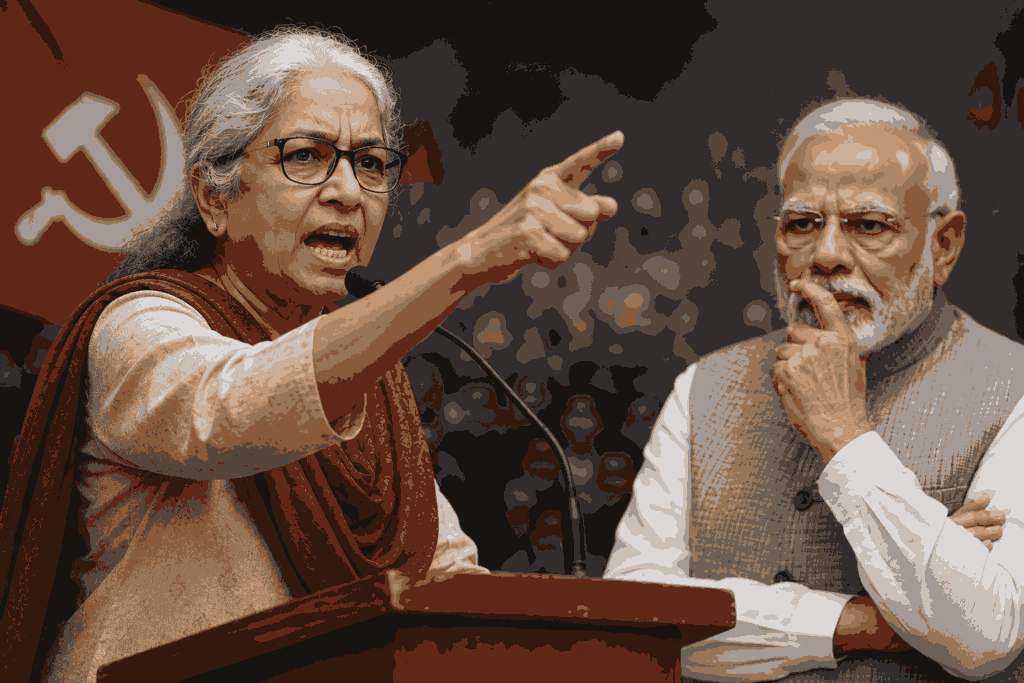
A fresh political controversy has erupted after CPI national secretary Amarjeet Kaur allegedly told a gathering at Delhi’s Ramlila Maidan that Prime Minister Narendra Modi would be “finished off”. Kaur made the remark while addressing party cadres at the conclusion of the Communist Party of India’s nationwide “Badlaav Zaroori Hai” campaign on September 1. Her statement, which quickly attracted political attention, has triggered criticism from the BJP and raised questions about the language used in political mobilisation.
According to the report, Kaur referred to an alleged earlier statement by Prime Minister Modi concerning communists and their red flags. She claimed that Modi had described communists as a serious threat and had spoken about dealing with them within the country. Responding to those alleged remarks, she told the gathering, “Tumko nipta denge,” which translates broadly to “we will finish you off.” The statement was made while she was speaking to party supporters and appeared to be directed at the Prime Minister.
The remarks immediately drew criticism from BJP leaders, who accused the CPI leadership of crossing the boundaries of political discourse. BJP national spokesperson Pradeep Bhandari described Kaur’s comments as reflecting what he called a “Naxal mindset”. He also linked the statement to the broader criticism frequently directed at communist parties over their ideological positions and historical association with left-wing politics.
The controversy intensified after Kaur reportedly refused to withdraw her words. Speaking to News18, she defended the statement and said that she stood by what she had said. She questioned why she should apologise if the Prime Minister could allegedly use similar language against communists. Her refusal to apologise has ensured that the episode remains a political talking point rather than ending with a clarification or withdrawal.
Political rhetoric in India has often become increasingly confrontational during periods of intense ideological competition. Leaders across parties regularly use sharp language to attack opponents, particularly at rallies where speeches are designed to energise supporters. However, the CPI controversy has highlighted the distinction between aggressive political criticism and language that can be interpreted as threatening a political opponent.
The timing of Kaur’s remarks is also significant. The speech came as the CPI concluded its nationwide campaign seeking political change and sought to consolidate its cadre around an anti-BJP message. The party has historically positioned itself as a major ideological opponent of the BJP and has consistently criticised the Modi government on economic, social and political issues. The Delhi rally therefore served as an opportunity for its leadership to reinforce that opposition before its supporters.
The reference to communists being a threat also brought the issue of left-wing extremism into the political debate. The central government has for years pursued security and development measures aimed at tackling Naxal violence in affected parts of India. According to the government, the geographical footprint of Left Wing Extremism has been dramatically reduced, with violence and affected districts falling sharply.
That background makes the choice of words particularly sensitive. While the CPI is a mainstream political party participating in India’s democratic system, Naxal and Maoist organisations are separate entities associated with armed insurgency. Conflating electoral communist politics with armed extremism can therefore oversimplify a complicated political landscape. At the same time, statements that appear to threaten elected leaders can generate legitimate concern regardless of ideological affiliation.
The episode also illustrates the pressures facing political parties attempting to maintain a balance between forceful opposition and responsible public communication. A rally speech can energise a party’s core supporters, but words delivered before a large audience can quickly travel beyond the intended political setting. In the age of social media, a single sentence can become the defining moment of an entire event.
For the CPI, Kaur’s statement is consequently more than an isolated rhetorical controversy. It has provided the BJP with an opportunity to question the language and political temperament of its opponents, while the communist party is likely to view the backlash as part of the wider political contest surrounding the Modi government.
Ultimately, robust disagreement is an essential feature of democratic politics, but threats or language perceived as advocating violence can overshadow substantive political arguments. The CPI leadership’s response to the controversy will therefore be closely watched, particularly as political parties prepare for future electoral battles and increasingly rely on mass rallies and social-media-driven campaigning.