
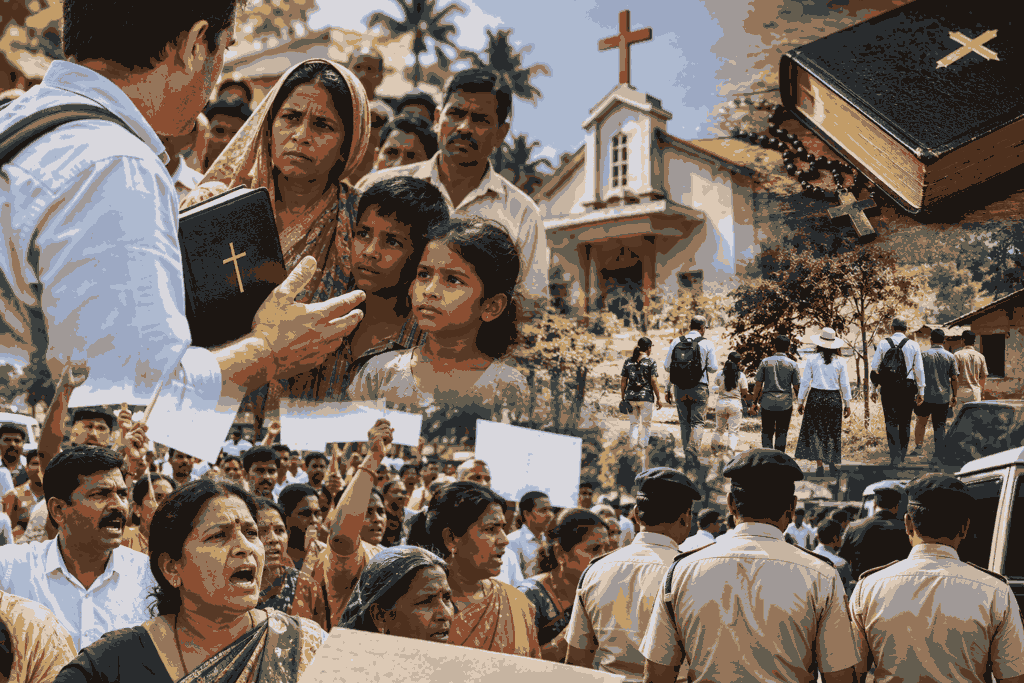
The Christian Conversion controversy in West Bengal has taken a sharper turn in recent weeks, with residents in several districts confronting individuals and organisations over alleged attempts to persuade economically vulnerable people and children to embrace Christianity. From North 24 Parganas to Bankura and Jalpaiguri, a series of local disputes has brought religious activities, missionary outreach and allegations of inducements under renewed public scrutiny.
One of the latest incidents was reported from Hingalganj in North 24 Parganas, where villagers questioned an Argentine national who had reportedly been staying in the area for several months. According to local allegations cited in reports, the foreign national had learned Bengali and established links with house churches in the region. Residents accused him of approaching local people with the intention of persuading them to convert. The allegations subsequently circulated widely on social media, prompting questions about the nature and purpose of his activities.
The controversy escalated when police reportedly questioned three people, including two foreign nationals, following information about an alleged religious gathering in Sandelerbil village panchayat. Local residents claimed that people from different countries had been visiting a particular house and alleged that tribal residents and people belonging to other faiths were being approached. Some villagers further alleged that economically weaker families were being offered money or other inducements. Police were examining the identities and activities of those involved, meaning the allegations remain subject to investigation.
The Christian Conversion debate gained another flashpoint in Hasnabad, where a free coaching centre for children became the focus of protests. Residents and members of the Hindu Jagran Manch alleged that, alongside tuition, children were being exposed to Christian religious material, including references to Jesus and the Bible. Protesters demanded that the activities be stopped, arguing that a centre presented as an educational facility should not simultaneously be used for religious instruction.
A person associated with the centre offered a different explanation, saying that its purpose was simply to provide free tuition to children. However, when questioned about the controversy, the individual indicated that religious activities would not continue if local residents objected. The dispute has consequently raised a broader question about the boundaries between charitable education and religious outreach, particularly when minors are involved.
The Christian Conversion controversy has also surfaced in Sonamukhi in Bankura district, where locals confronted organisers during what was described as a healing or prayer programme. According to reports and videos circulating online, protesters alleged that the gathering was being used to persuade Hindus and tribal residents to change their faith. They questioned organisers about religious books and material being distributed at the venue. The confrontation became heated as both sides argued over the nature of the programme and the purpose of the literature being used.
In Jalpaiguri, a separate confrontation in July further illustrated how emotionally charged such disputes have become. A Bengali woman confronted a Christian missionary during an argument over religion and questioned her about Sanatan Dharma. The incident, which was captured on video and circulated online, became another example of local tensions surrounding allegations of religious persuasion. While such confrontations can draw considerable public attention, they also underline the importance of authorities establishing facts through proper investigation rather than relying solely on viral claims.
The Christian Conversion issue has therefore moved beyond isolated incidents and become a subject of concern for sections of local communities. Residents who have protested in Hingalganj, Hasnabad and Sonamukhi say they are increasingly unwilling to ignore religious activities that they believe target vulnerable families, children or tribal communities. Their objections reflect a perception that charity, education and prayer programmes can sometimes become channels for religious outreach.
At the same time, the Christian Conversion allegations need to be distinguished from legitimate religious practice. India’s constitutional framework protects freedom of religion, including the right to profess and practise one’s faith, while allegations of coercion, fraud or inducement are matters that must be examined under applicable law. Simply conducting Christian religious activity does not by itself establish an illegal conversion, and accusations must be supported by evidence.
The Christian Conversion controversy is nevertheless significant because the recent incidents reveal growing friction at the grassroots level. In several locations, ordinary residents have moved from quietly observing religious activities to publicly demanding explanations from organisers and authorities. The protests suggest that questions surrounding missionary work, foreign visitors, charitable programmes and religious instruction are becoming increasingly sensitive in parts of West Bengal.
For the Christian Conversion debate to be resolved responsibly, law-enforcement agencies will have to separate genuine charitable or religious activity from any unlawful conduct. Investigations should establish whether money, material benefits, deception or coercion were actually used to influence individuals, while ensuring that legitimate religious freedoms are not unnecessarily curtailed.
The Christian Conversion row ultimately highlights a difficult balance between constitutional religious freedom and the state’s responsibility to prevent coercion or unlawful inducement. As tensions rise, the most credible response will be one based on evidence, transparent investigations and equal application of the law. For communities already divided by suspicion, establishing facts rather than allowing rumours to dictate events will be essential to preventing further confrontation.