
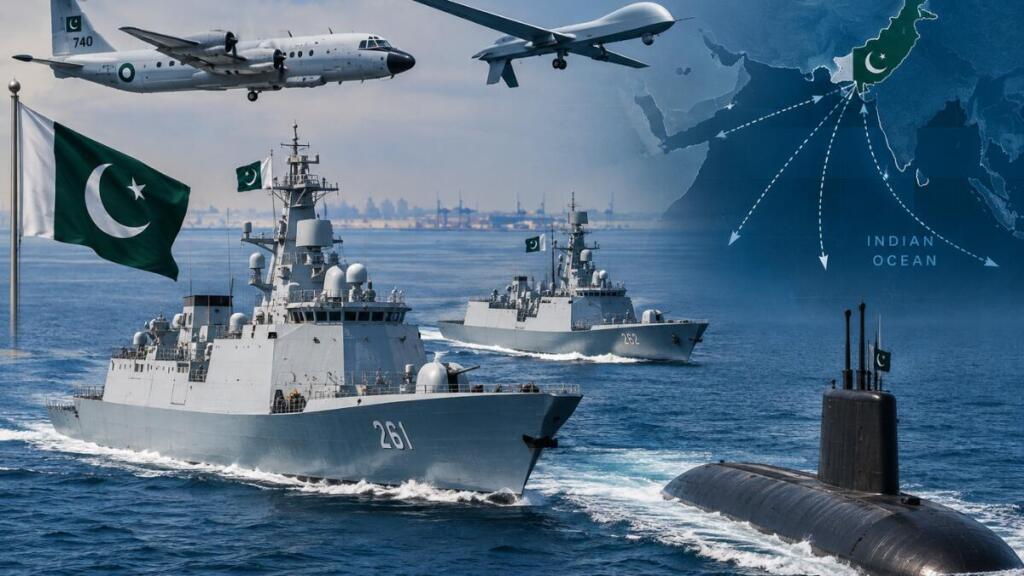
Pakistan’s navy has spent the past decade building a public image of a modernising, blue-water force capable of projecting influence well beyond its coastal waters. Yet a harder question sits beneath that narrative: does naval modernisation actually translate into better protection for Pakistani citizens at sea? The gap between the two suggests it often does not.
The modernisation itself is real. Pakistan has taken delivery of Chinese-built Type 054A/P frigates, added Hangor-class submarines to its underwater fleet through a co-production arrangement with China, and expanded its maritime surveillance capability with new patrol aircraft and unmanned systems. Naval planners speak openly of ambitions for greater regional influence, expeditionary reach and a larger footprint in the Indian Ocean, positioning the force as a rising component of Pakistan’s broader strategic posture.
This is the public narrative: a navy shedding its coastal-defence origins and stepping into blue-water relevance, backed by Chinese platforms and growing indigenous shipbuilding capacity at facilities such as Karachi Shipyard.
But naval power is ultimately judged by outcomes, not platforms. And on one recurring test — the safety of Pakistani seafarers caught in conflict zones or maritime crises abroad — the record raises uncomfortable questions. Pakistani nationals working as crew on merchant vessels have repeatedly found themselves stranded, detained or endangered in conflict-affected waters, from the Red Sea during the Houthi campaign against shipping to broader Gulf tensions, often with limited or delayed assistance from Pakistani authorities. Diaspora and labour organisations have periodically flagged the absence of a clear evacuation or protection mechanism for these citizens, despite the navy’s growing hardware inventory.
This is not necessarily a matter of capability. A frigate or submarine is not designed to extract stranded seafarers from a war zone, and blue-water platforms serve different strategic purposes than citizen-protection missions. But it does point to a question of priorities and institutional focus: if naval modernisation is justified partly on the grounds of protecting national maritime interests, that justification should logically extend to protecting the citizens who make their living on the sea, not only to prestige projects that enhance regional standing.
The contrast becomes sharper when set against other navies, including India’s, which have built out dedicated non-combatant evacuation and citizen-protection frameworks alongside their combat modernisation — treating the safety of nationals abroad as a maritime-security objective in its own right, not a secondary concern. Pakistan’s navy, by comparison, has invested heavily in submarines and frigates while its response mechanisms for seafarers in distress remain comparatively underdeveloped and reactive.
None of this is uncontested. Pakistani naval officials would likely argue that citizen protection is properly a Ministry of Foreign Affairs and diplomatic responsibility rather than a naval one, and that judging a navy’s modernisation purely by its performance on evacuation and welfare cases misreads what blue-water capability is actually for. Others might point out that every navy, including much larger and better-resourced ones, has struggled with the same problem of protecting nationals in fast-moving conflict zones, and that singling out Pakistan risks overstating a universal gap as a national failing. Both objections are worth weighing before drawing firm conclusions about where the credibility gap truly lies.