
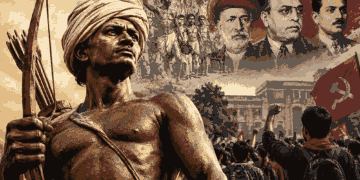




















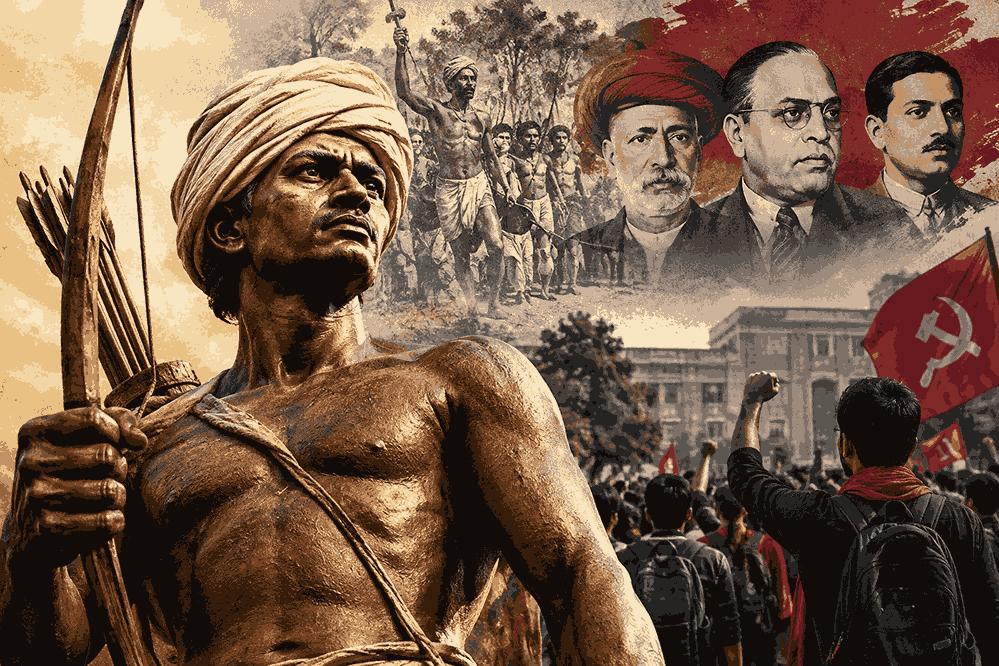
Birsa Munda, the tribal leader who led the late-19th-century Munda uprising against British rule and local exploitation, has become the subject of a fresh ideological debate after critical analysis examined claims that he should be presented as an opponent of Brahminism. The debate centers on how a historical figure associated with tribal resistance is interpreted by contemporary political and student movements.
Born in 1875 in the Chhotanagpur region, Birsa Munda emerged as a religious and political leader among the Mundas during a period of intense pressure on tribal land, customs and livelihoods. His movement, commonly known as the Ulgulan, challenged British authority as well as systems of land alienation and exploitation involving outsiders, landlords and other intermediaries. Historical accounts describe the struggle as having both political and religious dimensions.
The current controversy arises partly from the use of his name alongside those of Jyotirao Phule and B. R. Ambedkar in slogans and student politics. The OpIndia report points specifically to the slogan “Brahmanvaad ki chaati par, Birsa, Phule, Ambedkar,” arguing that contemporary groups have connected the three figures through a shared opposition to Brahminism. The interpretation is contested, however, because the social and historical contexts of the three leaders were markedly different.
At the Jawaharlal Nehru University, the name Birsa Munda has also appeared in the identity of student organisations. The Birsa Ambedkar Phule Students Association, or BAPSA, was formed in 2014 and has described itself as an organisation committed to opposing Brahmanism and capitalism while pursuing equality, liberty and fraternity. Contemporary reporting on JNU politics has documented how BAPSA represented an Ambedkarite alternative alongside Left and right-wing student organisations.
The question of his own religious journey adds another layer to the discussion. Articles do say that he spent part of his youth in a Christian missionary environment before breaking with Christianity and becoming a leader of a distinct religious movement among his followers. Other accounts similarly describe his opposition to missionary influence and British rule, while noting that his movement sought to reform aspects of Munda society. These details make it difficult to reduce his worldview to a single modern ideological category.
Land and political autonomy were central to the conflict that produced the rebellion. The Munda community had traditional systems of collective landholding, but nineteenth-century colonial policies and the growing presence of landlords, moneylenders and other outsiders weakened those arrangements. Historical summaries of the uprising describe the British administration, zamindars, missionaries and “dikus” as important parts of the environment against which the movement developed.
The religious dimension of the movement is equally significant. Accounts of his movement describe efforts to discourage practices he regarded as harmful, including excessive drinking and certain forms of superstition, while encouraging social discipline and a revival of tribal religious traditions. Some modern writers have also highlighted reported influences from Hindu traditions on his later spiritual outlook. These interpretations are not identical, and the available historical record is often read differently depending on the historian or source.
The British authorities eventually suppressed the uprising. After the movement escalated in 1899 and early 1900, he was captured and died in prison in June 1900, aged only 25. His short life nevertheless left a lasting imprint on the history of tribal resistance in eastern India. His legacy today extends beyond the original geography of the rebellion, with his name used in public commemorations, political speeches, educational institutions and social movements.
For many admirers, Birsa Munda remains primarily a symbol of resistance to colonial domination and the loss of tribal land and autonomy. For contemporary political groups, his name can carry additional meanings connected to caste, social justice and identity. That difference between historical context and modern political appropriation is at the heart of the current argument.
The debate over Birsa Munda therefore reflects a broader challenge in interpreting historical personalities: whether their lives should be understood through the circumstances in which they actually lived or through the political categories of the present. His documented opposition to British authority, missionary influence and systems that dispossessed tribal communities provides a concrete foundation for understanding his struggle. Beyond that, claims about his precise ideological identity require careful examination of contemporary records rather than assumptions drawn from modern slogans.