
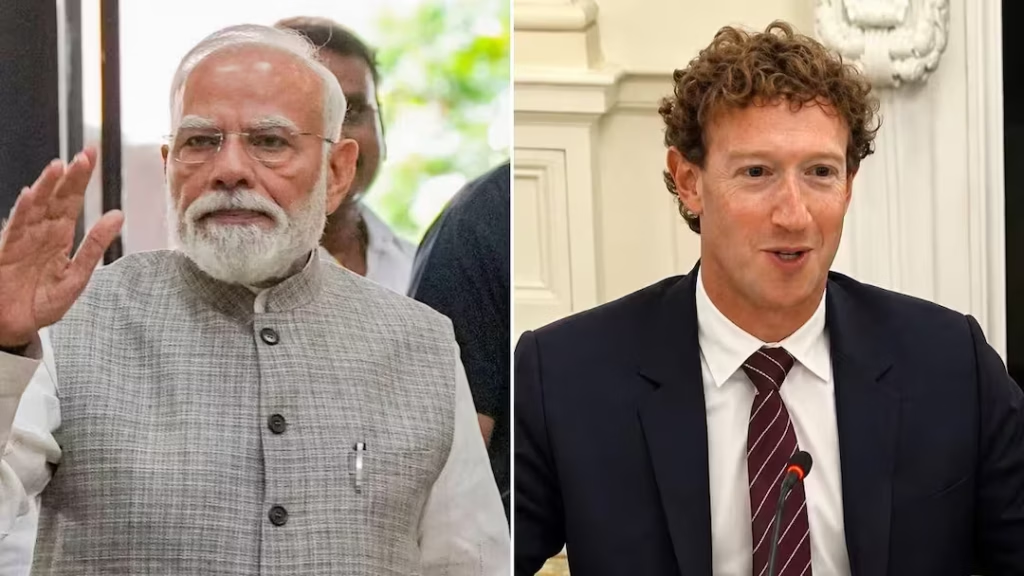
Meta chief executive Mark Zuckerberg has apologised to the Indian government over the temporary removal of a Facebook video posted by Prime Minister Narendra Modi, as well as lapses linked to child sexual abuse material (CSAM) and deepfake content on the company’s platforms, according to government sources. The apology follows a three-day ultimatum from a parliamentary panel that had threatened to strip Meta of the legal protection it relies on to operate in India.
What happened ?
The dispute began after Modi’s 23 July video, in which he addressed students on examination paper leaks, was taken off Facebook for five to six hours before being restored. Meta’s Chief Global Affairs Officer, Joel Kaplan, later told the government the takedown was “an error.”
The removal drew scrutiny from the Parliamentary Standing Committee on Communications and Information Technology, chaired by Bharatiya Janata Party MP Nishikant Dubey. Following a 3 August meeting attended by officials from the Ministry of Electronics and Information Technology (MeitY), the Ministry of Home Affairs, and platforms including Meta, Google, X, Snapchat and YouTube, the committee said the video’s removal amounted to Meta acting as a publisher rather than a neutral intermediary. Dubey said the committee had given Zuckerberg three days to issue a personal, unqualified apology, or it would consider recommending withdrawal of Meta’s safe harbour protection under Section 79 of the Information Technology Act.
The apology
Kaplan met MeitY Secretary S Krishnan and Union IT Minister Ashwini Vaishnaw in New Delhi on 5 August, a meeting that lasted around 45 minutes. Kaplan said he had personally apologised to the minister on Meta’s behalf. Government sources who were not named, however, said the apology was in fact conveyed by Zuckerberg himself.
Zuckerberg’s statement, according to government sources, addressed three areas: lapses in automated filtering that allowed illegal advertising content to surface on Instagram, including material linked to CSAM; the spread of unlabelled AI-generated imagery and deceptive financial scams; and, separately, operational errors of the kind that led to the Modi video’s removal. Meta’s representatives did not identify who inside the company was responsible for the takedown decision.
The regulatory stakes
At the centre of the dispute is Section 79 of the Information Technology Act, which shields intermediaries such as social media platforms from liability for content posted by users, provided they meet due-diligence obligations. The parliamentary committee’s letter to MeitY stated that this protection “may be withdrawn” and that action could be taken against Zuckerberg as a publisher if Meta failed to comply, according to a committee communication reviewed by TechTimes, which reported the deadline as expiring on 8 August.
Whether a parliamentary committee can withdraw safe harbour on its own is disputed. The Supreme Court’s 2015 ruling in Shreya Singhal v Union of India held that intermediaries lose safe harbour only through a court order or a formal notification under Section 69A — not through a parliamentary committee’s demand — and the ruling did not address algorithmic content curation, which had not become central to platforms’ operations at the time. Separately, the central government has told a Supreme Court-monitored committee it is examining a broader review of safe harbour protections and a possible legal provision making intermediaries liable to compensate victims of cyberfraud, in minutes dated 14 July and filed with the court on 3 August.
Opposition members of the parliamentary committee argued that decisions on content moderation should remain free of political influence; the committee separately raised concerns about Google’s intermediary status following cybercrime complaints from Hyderabad.
A pattern of apologies
This is not the first time Zuckerberg has apologised over the conduct of Meta’s platforms. In January 2024, he told families of victims of online exploitation at a US Senate Judiciary hearing that he was “sorry for everything you have all been through,” a hearing also attended by executives of Discord, Snap, X and TikTok, at which committee chair Dick Durbin criticised the platforms for failing to protect children.
In India specifically, Meta has apologised before: the company’s India public policy vice-president, Shivnath Thukral, apologised in 2024 after Zuckerberg suggested incumbent governments — including India’s — had lost elections that year due to their handling of the COVID-19 pandemic, calling the remark an “inadvertent error.”
What happens next
With the parliamentary committee’s deadline falling on 8 August, whether the apology satisfies the panel — and whether India moves to formally reassess Meta’s safe harbour status — remains unresolved. The broader question raised by lawmakers is whether algorithmic curation and content amplification by platforms should be treated as editorial activity akin to publishing, rather than passive hosting — a distinction with consequences for how governments hold platforms accountable for content that can shape political discourse and public safety, including around elections.