
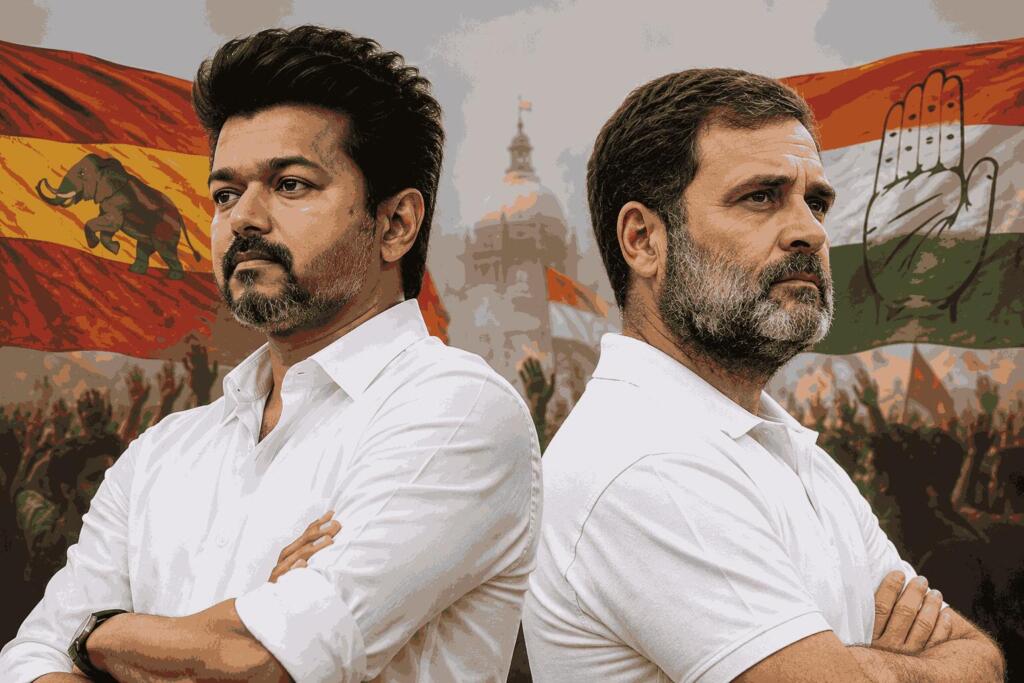
The TVK-Congress alliance in Tamil Nadu appears to be entering uncertain political territory, with senior leaders of Tamilaga Vettri Kazhagam reportedly making it clear that the party was not created to advance Rahul Gandhi’s bid for Prime Minister. Instead, the party is increasingly projecting its leader and Tamil Nadu Chief Minister C. Joseph Vijay as a potential national figure, raising questions about the future of the alliance ahead of the 2029 Lok Sabha election.
According to a report cited by The Commune from Junior Vikatan, a senior TVK minister has argued that the party has its own political programme and ambitions. The minister reportedly pointed to the example of the 1996 Lok Sabha election, when Janata Dal emerged with only 46 seats but coalition arithmetic eventually helped H.D. Deve Gowda become Prime Minister. The argument is that a similar political realignment could potentially occur after the 2029 election.
The minister reportedly suggested that if Vijay’s party were to secure around 100 Lok Sabha seats, the actor-turned-politician could emerge as a contender for the country’s top constitutional executive office. Such an assertion represents a significant departure from the conventional understanding of the alliance with Congress, which continues to regard Rahul Gandhi as its principal national leader and potential prime ministerial candidate.
The TVK leadership’s reported position has therefore created an uncomfortable situation for Congress. The two parties are currently political allies in Tamil Nadu, but their long-term ambitions may not necessarily converge. Congress wants to strengthen Rahul Gandhi’s national position, while Vijay’s political organisation appears to be considering how his enormous popularity in Tamil Nadu can be converted into a broader electoral presence.
The tension has already spilled into public statements. Tamil Nadu Congress Committee president Manickam Tagore reportedly criticised sections of Vijay’s party, accusing its leaders of behaving more like a fan club than a political organisation. He also pointed out that Congress had been among the early political formations to support Vijay’s emergence as Chief Minister. The remarks underline the growing sensitivity within Congress over the direction being taken by its ally.
The TVK has reportedly begun considering a strategy that extends beyond Tamil Nadu. According to the report, party leaders are examining Lok Sabha constituencies in different parts of India and exploring ways of establishing Vijay as a recognisable national political personality. There has even been speculation about changing the party’s name to “Desiya Vetri Kazhagam”, following the example of the Bharat Rashtra Samithi, which changed its identity before seeking a larger national role.
Several senior leaders have also reportedly joined the “Vijay for Prime Minister” campaign. Statements attributed to ministers and senior figures have portrayed Vijay as capable of eventually leading the country. What might once have appeared to be enthusiastic praise from individual supporters is consequently taking the shape of a more coordinated political narrative.
The TVK is also reportedly investing heavily in social-media promotion aimed at audiences outside Tamil Nadu. Junior Vikatan cited political observers who claimed that influencers from states including Uttar Pradesh, Bihar, Haryana, Maharashtra, Madhya Pradesh and Jharkhand were being used to produce videos promoting Vijay. The reported expenditure is around ₹5 crore per month, although these financial claims have not been independently established in the available report.
For Congress, the emergence of such a strategy raises a fundamental question: is Vijay’s party preparing to remain a regional ally or eventually compete for political space across India? The TVK may still be a relatively young political force, but its leader’s celebrity status gives it an unusual starting point. The challenge will be transforming personal popularity into an organised electoral machine capable of winning seats beyond its home state.
The TVK dispute also highlights the unpredictable nature of coalition politics in Tamil Nadu. Regional parties have historically played decisive roles in national governments, particularly when no single party secures a parliamentary majority. Vijay’s supporters appear to believe that a strong parliamentary performance could give him bargaining power far beyond the number of seats his party actually wins.
Whether that ambition becomes politically realistic remains uncertain. Winning 100 Lok Sabha seats would require a dramatic expansion of the party’s organisational network and electoral appeal. For now, the more immediate issue is the relationship with Congress. If Vijay’s supporters continue openly discussing a future in which he, rather than Rahul Gandhi, becomes a prime ministerial contender, the alliance could face increasing friction.
The TVK has thus placed itself at an intriguing crossroads. It can remain focused on consolidating power in Tamil Nadu while supporting a wider opposition arrangement, or it can attempt the much more difficult journey from a state-based movement to a national political force. The 2029 election is still some distance away, but the ambitions being voiced today suggest that Vijay’s political project may be considerably larger than a conventional Tamil Nadu alliance.