
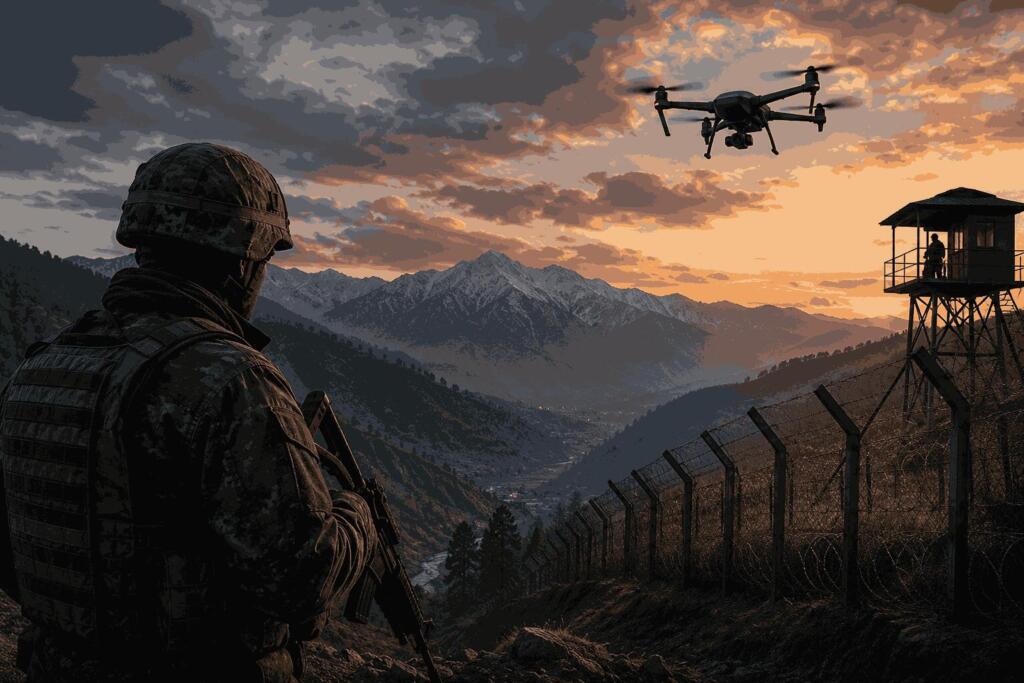
A Pakistani drone sighting over the Line of Control (LoC) in Jammu and Kashmir’s Poonch district has triggered a fresh security alert, with the Indian Army launching search operations and strengthening aerial surveillance across vulnerable border areas. The unmanned aerial vehicle was detected on Friday evening, August 28, around 8:05 pm, after which security forces moved swiftly to monitor the area and investigate whether the aerial activity was linked to any wider cross-border operation.
According to reports citing security officials, troops of the 22 Jammu and Kashmir Rifles detected the Pakistani drone over Behrooti village in the Mendhar sector of the Balakote area of Poonch. The location falls within the unit’s operational area, allowing troops to respond immediately. Counter-drone measures were activated after the sighting, prompting the aerial vehicle to retreat towards the Mangalnar-Dabrote axis near the LoC before moving back in the direction of Pakistan.
The latest incident has assumed significance because the Pakistani drone activity was not confined to a single location. Security forces have reportedly detected similar unmanned aerial vehicle movements in Rajouri, prompting additional search operations. The Army and paramilitary forces have subsequently expanded their vigilance across several districts, including Udhampur, Kathua and Rajouri. Surveillance from the air has also been intensified in forward areas adjoining the LoC.
The Pakistani drone sightings also form part of a pattern that security agencies have been monitoring for several months. Earlier this week, an unmanned aerial vehicle was reportedly spotted over forward villages in the Bobiyan area of Kathua’s Hiranagar sector. A similar sighting was reported in Rajouri’s Sunderbani sector last month, while an aerial vehicle had also been observed over forward posts in Poonch’s Balakote sector in June. The repeated incidents have increased concern over the possible use of unmanned platforms for surveillance or other cross-border activities.
The security response is being shaped by the fact that Pakistani drone networks have previously been associated with attempts to move weapons and narcotics across the border. Indian agencies have, in recent months, uncovered cases in which drones were allegedly used to deliver arms to handlers operating inside India. In June, authorities in Punjab reportedly intercepted a consignment containing 26 weapons in an alleged Pakistan-linked drone-based arms-drop case, while another investigation uncovered links extending overseas.
The threat has also been highlighted by earlier investigations into Pakistan-linked arms-smuggling networks. Delhi Police had previously busted a racket allegedly connected to Pakistan’s Inter-Services Intelligence, with drones reportedly used to move firearms and ammunition into India. Against that background, every Pakistani drone detected near the LoC is being treated with heightened caution, even when there is no immediate evidence that weapons or other material have been dropped. The emphasis remains on detection, tracking and verification rather than allowing an unidentified aerial platform to operate unchecked.
The latest Pakistani drone movements come amid wider scrutiny of military activity involving Pakistan. Reports have pointed to an increase in Turkish military transport flights into Pakistan during August, with aircraft reportedly landing at major Pakistani air bases. While the precise cargo carried by individual flights has not been established publicly, the reported increase has added another layer to regional security assessments. Any possible connection between these developments and recent drone sightings remains a matter for intelligence agencies to determine.
For residents of villages along the LoC, the renewed surveillance is a reminder of how quickly a seemingly distant military development can affect everyday life. Border communities have lived with the possibility of infiltration, shelling and cross-border activity for years, and the emergence of increasingly accessible drone technology has added another dimension to that security challenge. The Pakistani drone incident in Poonch therefore goes beyond a single aerial sighting: it underscores the continuing need for round-the-clock vigilance along India’s sensitive northern frontier.
For the Indian Army, the immediate priority is to ensure that hostile or suspicious aerial activity is detected before it can develop into a more serious threat. The activation of counter-drone systems following the latest sighting demonstrates the growing importance of layered surveillance and rapid response capabilities. As unmanned aircraft become more common in modern conflicts, the ability to identify, track and neutralise unauthorised platforms is becoming an increasingly important component of border security.
The latest developments also underline the changing nature of threats along the LoC. Traditional infiltration attempts are no longer the only concern; low-cost unmanned aircraft can potentially be used for reconnaissance, communications, logistics or weapons delivery. The Indian security establishment is consequently maintaining a broader surveillance posture across Jammu and Kashmir, with ground searches complementing aerial monitoring. For now, officials have not publicly established the precise purpose behind the latest drone movement, but the response makes clear that such activity will receive immediate and serious attention.