
















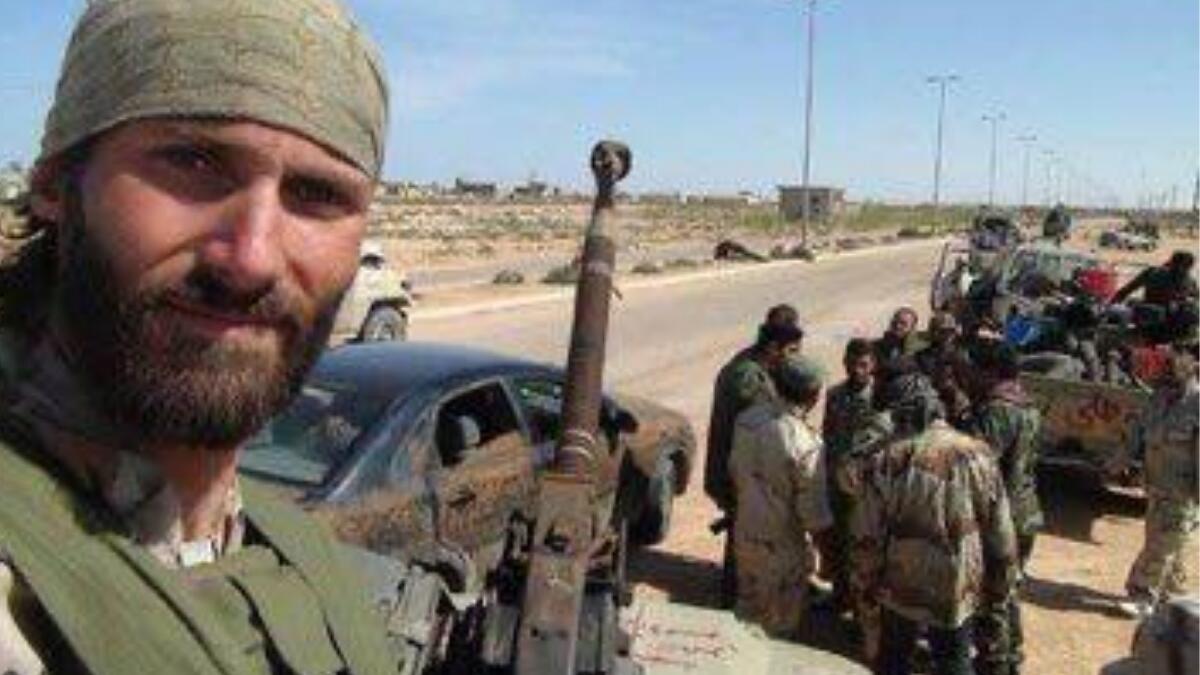
Strip away the humanitarian branding, and the case against Matthew VanDyke looks less like the story of a wrongly detained aid worker and more like the unraveling of a private military network that has spent over a decade inserting armed American-trained fighters into other countries’ wars.
VanDyke, 46, is in NIA custody in Tihar Jail on charges under the Unlawful Activities (Prevention) Act, India’s anti-terror law, after investigators say he and associates traveled through India’s northeast and illegally crossed into Myanmar to train ethnic armed groups. It is the latest — and most serious — legal exposure in a career built almost entirely around arming and training foreign combatants.
A pattern, not an accident
VanDyke’s résumé reads like a checklist of global conflict zones: Libya in 2011, where he took up arms with rebel forces after escaping loyalist captivity; Iraq and Syria, where his organization Sons of Liberty International (SOLI) trained Assyrian Christian militias; and, more recently, reported links to foreign-fighter networks supporting Ukraine. Each time, the pattern repeats — VanDyke arrives in a conflict zone, positions himself as a trainer or advisor, and leaves behind an armed force that didn’t exist before he showed up.
SOLI describes itself as the world’s first nonprofit private military contractor, run on donations rather than a government contract. Investigators and critics see something more familiar underneath the paperwork: an unlicensed, ideologically driven militia-trainer operating across borders with no state accountability, whose “nonprofit” status has functioned less as a constraint than as a shield. India’s NIA is now examining exactly that question — who funds SOLI, what its “training” actually produces on the ground, and whether VanDyke’s Myanmar trip was reconnaissance, recruitment, or both.
Compounding the picture, some Indian reporting has noted VanDyke’s history of failing a CIA polygraph years ago, and points to the consistency with which his deployments have tracked regions of active U.S. geopolitical interest — Libya during the anti-Gaddafi campaign, Iraq during the anti-ISIS fight, Myanmar’s borderlands amid growing great-power competition over Southeast Asia. VanDyke denies any intelligence ties, but the overlap has fueled speculation among Indian officials that his organization operates with more coordination — or cover — than its nonprofit status suggests.
The family’s version
VanDyke’s mother, Sharon, and SOLI have pushed back hard on this framing, calling his detention illegal and demanding urgent U.S. diplomatic intervention. In an August 30 statement, the organization said VanDyke has been denied adequate medical care for an injured leg and worsening eyesight, cut off from prescription medication, and largely isolated from family — his elderly mother has had only one brief call with him in months. His attorneys say a Delhi court denied requests in June for private hospital treatment and improved family contact, and that VanDyke has been on a liquids-only hunger strike since May in protest. U.S. Ambassador Gor reportedly raised the case with India’s Foreign Secretary and Secretary of State Rubio during a May visit to Delhi.
It’s worth noting VanDyke has not been convicted of any crime in this matter, and the “mercenary” characterization is one advanced by investigators and certain commentators rather than a settled legal finding — a distinction his family and lawyers say gets lost entirely in coverage that leads with his conflict-zone résumé instead of his current medical condition. His custody has been extended through September 8, and the NIA’s investigation, including a forensic review of his devices and finances, is still underway.