
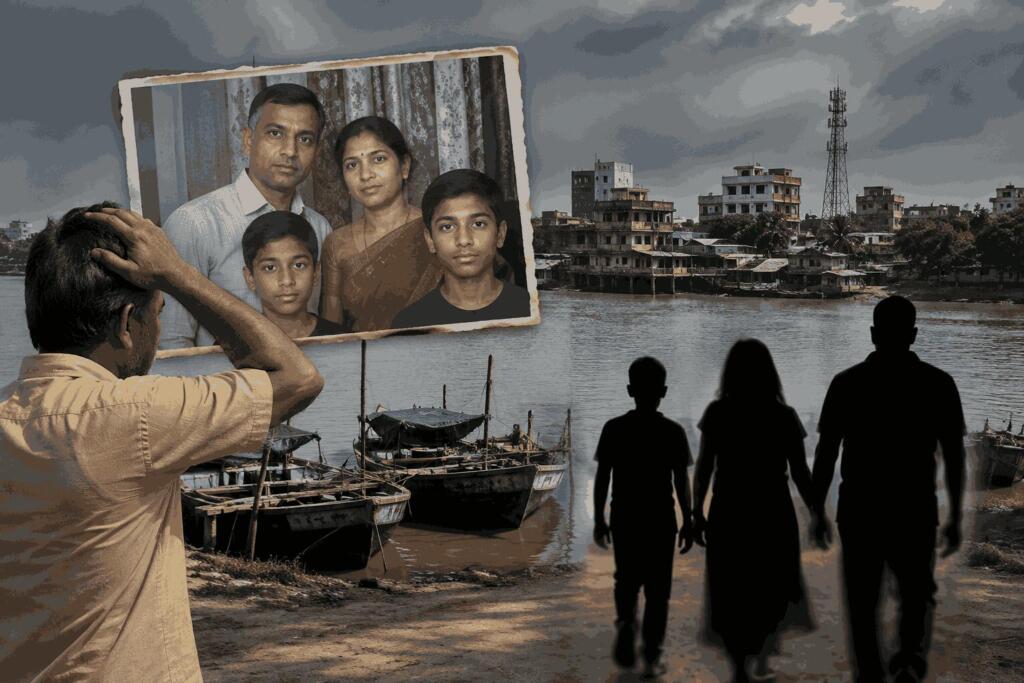
Concerns over Hindu persecution in Bangladesh have resurfaced after a Hindu businessman, his wife and their two sons reportedly disappeared from Chandpur, leaving relatives, customers and members of the local Hindu community searching for answers. Police have begun investigating the disappearance, but the circumstances remain unclear, with reports pointing both to financial difficulties and earlier threats faced by the businessman.
The missing businessman has been identified as Pintu Das, who operated SK Shilpalay at Madina Market in Chandpur city. His wife, Rimi Das, and their sons, Priyam Das and Rupam Das, are also missing. Priyam is reportedly a Class 10 student, while both boys are teenagers. Relatives said the family was no longer at their rented residence, triggering concern over their whereabouts.
The disappearance has attracted particular attention because Pintu was reportedly facing mounting financial pressure. His business involved lending money against pledged gold jewellery, and several customers are now worried about jewellery and money left with him. Local reports say he had borrowed from cooperative societies and other organisations and was struggling to meet his financial obligations. These details have complicated the search for a clear motive.
At the same time, allegations that Pintu had received threats before disappearing have added another troubling dimension to the case. A relative, Upoma Dey, who is associated with the district Hindu Buddhist Christian Students’ Unity Council, reportedly said the family had been under pressure and that Pintu had faced threats. However, police have yet to establish whether those threats were directly connected to the family’s disappearance.
The case has inevitably intensified discussions about Hindu persecution in Bangladesh, particularly because it comes against a wider backdrop of concern over the security of the country’s Hindu minority. Earlier incidents involving attacks on Hindu homes, businesses and religious institutions have contributed to anxiety within the community. Yet investigators must still determine whether the Chandpur disappearance was a criminal incident, a consequence of financial problems, a voluntary disappearance or something more sinister.
The financial aspect has already affected people beyond the missing family. Several customers reportedly pledged gold jewellery with Pintu in exchange for loans. One customer, Rasel Khan, said he had pledged 29.16 grams of gold and received 50,000 Bangladeshi taka. When he later returned with money to recover the jewellery, he was reportedly told to come back the following day. By then, Pintu and his family had disappeared. Other customers have also approached authorities over jewellery allegedly remaining with the businessman.
Questions surrounding Hindu persecution in Bangladesh have become particularly sensitive whenever cases involving members of the Hindu minority remain unresolved. Bangladesh’s Hindu population has repeatedly expressed concerns about security, property disputes, attacks and intimidation, while authorities have often attributed individual incidents to broader criminal, political or local disputes. That distinction makes a proper investigation essential in the Chandpur case rather than allowing speculation to substitute for evidence.
Another striking detail is the relatively recent history of Pintu’s business. Reports say he had shifted his establishment several times before opening SK Shilpalay at Madina Market approximately five or six months ago. His ancestral home is in Fatikchhari in Chattogram, while relatives are also said to live in Cumilla and Muradnagar. The family’s connections across different areas could provide investigators with important leads.
The disappearance has also revived concern about Hindu persecution in Bangladesh among community representatives who fear that vulnerable families may hesitate to report threats until circumstances become dangerous. For relatives, however, the immediate priority is much simpler: locating Pintu, Rimi and their two sons and determining whether they are safe.
Police at Chandpur Sadar Model Police Station have said that necessary steps are being taken to trace the missing family. Authorities will now have to examine the reported threats, Pintu’s financial dealings, outstanding debts, customer complaints and the family’s movements before they vanished.
The episode has once again placed Hindu persecution in Bangladesh in the spotlight, but the facts of this particular disappearance must ultimately be established through investigation. Until the family is found, every possibility remains open. The most urgent question is therefore not who is to blame, but where Pintu Das, his wife and their two sons are—and whether they are still safe.